
Benjamin Franklin
Quotes & Wisdom
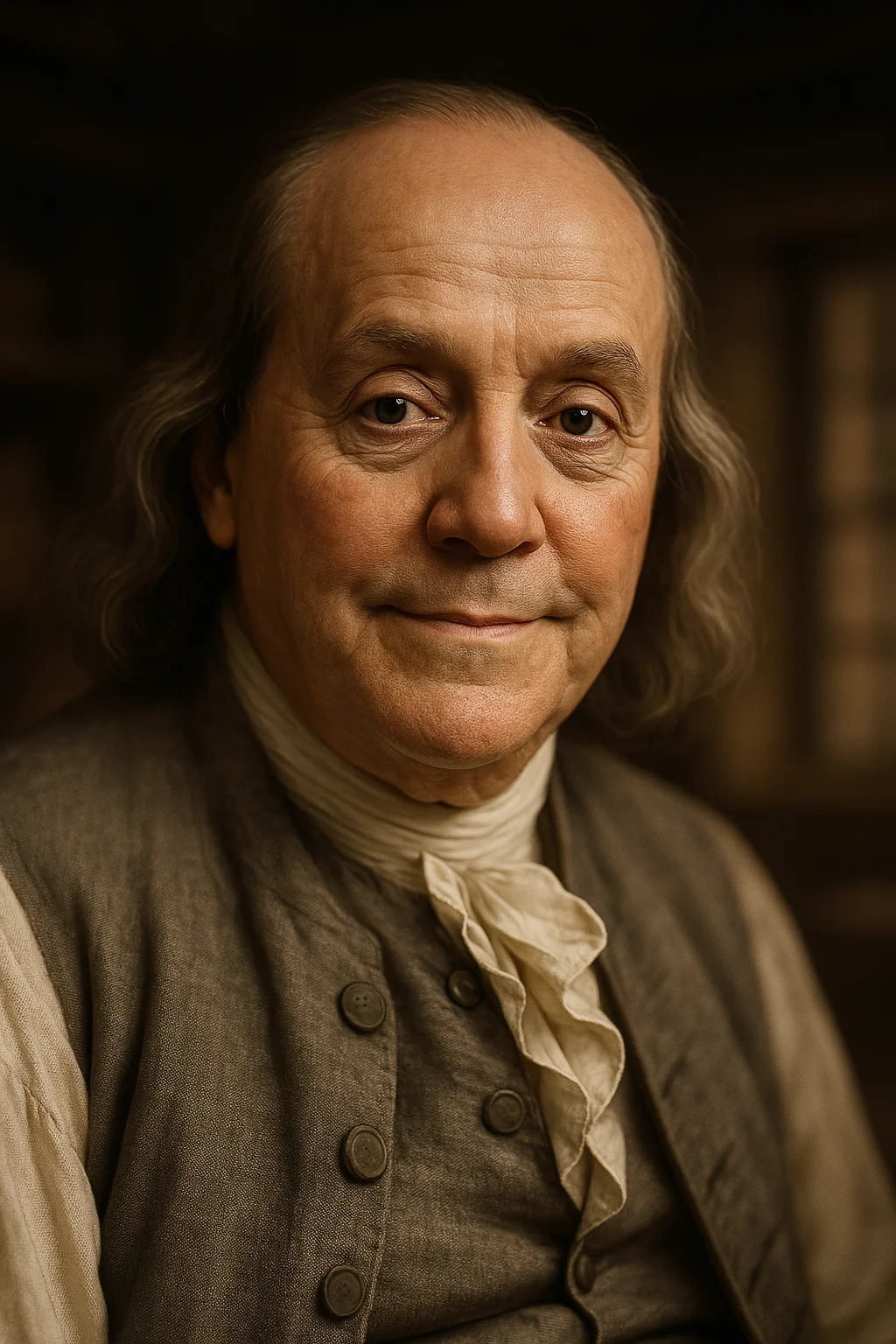
Benjamin Franklin embodies the self-made American before America itself existed. Rising from a Boston candle maker's son to become printer, scientist, inventor, diplomat, and Founding Father, he lived more lives than any single biography can contain. His kite experiment proved lightning was electrical; his wit and wisdom filled "Poor Richard's Almanack" for a quarter century; his diplomacy secured French support that made American independence possible. Franklin invented bifocals, the lightning rod, and the Franklin stove - and declined patents on all of them. His autobiography established the template for the American success story, while his later antislavery activism complicated the neat moral of his earlier self-help philosophy.
Context & Background
Benjamin Franklin was born on January 17, 1706, in Boston, Massachusetts, the fifteenth of seventeen children in a family of English Puritan immigrants. His father Josiah made soap and candles; the family lived respectably but without margin for extras. Young Benjamin's formal schooling ended at ten when he joined his father's trade.
Colonial Boston was a provincial town of some twelve thousand souls, perched at the edge of a vast, barely explored continent. Yet it was also a hub of printing, commerce, and religious ferment. The young Franklin absorbed its contradictions: Puritan moral seriousness alongside entrepreneurial hustle, deference to British authority alongside nascent colonial self-confidence.
At twelve, Franklin was apprenticed to his older brother James, who ran a printing shop. Here his real education began. He read voraciously, taught himself to write by imitating the Spectator essays, and discovered his gift for controversy when he secretly submitted satirical letters under the pseudonym "Silence Dogood." When James was jailed for offending authorities, Benjamin briefly ran the paper himself.
The Enlightenment was transforming European thought - reason over tradition, experiment over authority, progress over fatalism. Franklin absorbed these ideas through books and correspondence, becoming perhaps the first self-consciously modern American. He arrived in Philadelphia in 1723, a seventeen-year-old runaway with a loaf of bread under each arm, ready to reinvent himself.
Franklin's Philadelphia rise exemplifies the self-improvement ethic he would later preach. He worked as a printer, briefly traveled to London, returned to establish his own print shop, and by his mid-twenties was publishing the Pennsylvania Gazette. His marriage to Deborah Read in 1730 gave him a partner who managed household and shop while he pursued increasingly diverse interests.
"Poor Richard's Almanack," published from 1732 to 1758, made Franklin's name and fortune. These annual compilations of calendars, weather predictions, and homely wisdom reached nearly every colonial household. The proverbs Franklin crafted or collected - "Early to bed and early to rise," "A penny saved is a penny earned," "God helps those who help themselves" - shaped American common sense for generations.
Yet Franklin was no mere accumulator of wealth and maxims. He founded the Junto, a club for mutual improvement; the Library Company of Philadelphia; the American Philosophical Society; the Academy that became the University of Pennsylvania; and the first American fire company. These civic enterprises expressed his belief that private initiative could create public goods.
His "Autobiography," begun in 1771 but never finished, presented his life as a model of moral and material self-improvement. Its famous "thirteen virtues" - temperance, silence, order, resolution, frugality, industry, sincerity, justice, moderation, cleanliness, tranquility, chastity, humility - offered a program for self-perfection. That Franklin acknowledged his own frequent failures only enhanced the appeal.
Franklin's scientific work concentrated in the 1740s and 1750s, when electrical experiments were the rage of European salons. His famous kite experiment of 1752 - flying a kite in a thunderstorm to prove that lightning was electrical - was genuinely dangerous. Others attempting similar demonstrations died.
The experiment's real significance was theoretical. Franklin proposed that electricity was a single fluid, not two opposing forces as others believed. His terminology - positive and negative charges, battery, conductor - became standard. The lightning rod, his most practical invention, protected buildings from fire and seemed almost to give humanity power over the heavens themselves.
The Royal Society awarded him its Copley Medal; universities granted him honorary degrees. The provincial printer from Philadelphia became "Dr. Franklin," celebrated in European courts as proof that genius could emerge anywhere. His scientific reputation would later prove crucial to his diplomatic success - the French adored him as a philosopher who happened also to be American.
Yet Franklin was no systematic scientist. He made observations, proposed ingenious experiments, theorized boldly, then moved on to other interests. His scientific style was pragmatic: what works, what's useful, what can be demonstrated. The lightning rod saved lives; theoretical physics could wait.
Franklin spent most of the years from 1757 to 1775 in London as colonial agent, initially seeking compromise between Britain and the colonies. His famous examination before the House of Commons in 1766 helped repeal the Stamp Act. But the breach widened, and after being publicly humiliated over leaked letters, Franklin sailed home in 1775 radicalized.
He signed the Declaration of Independence at seventy - the oldest signatory by far - then immediately embarked for France on the most important mission of his life. American independence required French support: money, arms, ultimately military intervention. Franklin spent nine years in Paris securing it.
His success owed much to his celebrity. The French idolized him as a combination of Voltaire and Jean-Jacques Rousseau - philosophe and man of nature - come to life from the New World. He played the part brilliantly, wearing a fur cap that symbolized frontier simplicity, charming salons with his wit, and negotiating with unsentimental skill.
The 1778 alliance with France and the 1783 Treaty of Paris, which Franklin helped negotiate, rank among American diplomacy's greatest achievements. He returned home in 1785 to serve as president of Pennsylvania and attend the Constitutional Convention. His final public act was signing a petition to Congress for the abolition of slavery.
Franklin's private life complicates his public image. His common-law marriage to Deborah was stable but emotionally distant; she refused to join him in London, and they spent their last eighteen years corresponding rather than cohabiting. He fathered an illegitimate son, William, who remained loyal to Britain during the Revolution, rupturing their relationship permanently.
His French years included a passionate flirtation with Madame Brillon and a marriage proposal (probably playful) to Madame Helvetius. His "bagatelles" - whimsical essays on chess, drinking, and old age - reveal a sensibility quite different from Poor Richard's rectitude. The sage who counseled industry and frugality lived his last decades enjoying good wine, good conversation, and the company of admiring women.
Franklin's views on race evolved. Earlier writings expressed prejudices common to his era. But he came to oppose slavery vigorously, freed his own slaves, and became president of the Pennsylvania Abolition Society. His final public writing was a satirical essay mocking proslavery arguments by putting them in the mouth of an Algerian defending the enslavement of Christians.
He died on April 17, 1790, at eighty-four, attended by some twenty thousand mourners in Philadelphia - the largest gathering in American history to that point. His epitaph, which he had composed decades earlier, compared his body to "the cover of an old book, its contents torn out," awaiting a "new and more elegant edition, revised and corrected by the Author." Even in death, the printer's apprentice couldn't resist a literary metaphor.
Benjamin Franklin Quotes
They who can give up essential liberty to obtain a little temporary safety deserve neither liberty nor safety.
By failing to prepare, you are preparing to fail.
Being ignorant is not so much a shame, as being unwilling to learn.
If all printers were determined not to print anything till they were sure it would offend nobody, there would be very little printed.
Beware of little expenses; a small leak will sink a great ship.
We do not stop playing because we grow old, we grow old because we stop playing!
My refusing to eat flesh occasioned an inconveniency, and I was frequently chided for my singularity, but, with this lighter repast, I made the greater progress, for greater clearness of head and quicker comprehension. Flesh eating is unprovoked murder.
If we look back into history for the character of present sects in Christianity, we shall find few that have not in their turns been persecutors, and complainers of persecution. The primitive Christians thought persecution extremely wrong in the Pagans, but practised it on one another. The first Protestants of the Church of England, blamed persecution in the Roman church, but practised it against the Puritans: these found it wrong in the Bishops, but fell into the same practice themselves both here and in New England.
While we may not be able to control all that happens to us, we can control what happens inside us.
Were I a Roman Catholic, perhaps I should on this occasion vow to build a chapel to some saint, but as I am not, if I were to vow at all, it should be to build a light-house.
Work as if you were to live a thousand years, play as if you were to die tomorrow.
Those things that hurt, instruct.
A Brother may not be a Friend, but a Friend will always be a Brother.
Educate your children to self-control, to the habit of holding passion and prejudice and evil tendencies subject to an upright and reasoning will, and you have done much to abolish misery from their future and crimes from society.
If you fail to plan, you are planning to fail!
For the want of a nail the shoe was lost,
Trouble knocked at the door, but, hearing laughter, hurried away
I am for doing good to the poor, but...I think the best way of doing good to the poor, is not making them easy in poverty, but leading or driving them out of it. I observed...that the more public provisions were made for the poor, the less they provided for themselves, and of course became poorer. And, on the contrary, the less was done for them, the more they did for themselves, and became richer.
The best thing to give to your enemy is forgiveness; to an opponent, tolerance; to a friend, your heart; to your child, a good example; to a father, deference; to your mother, conduct that will make her proud of you; to yourself, respect; to all others, charity.
Either write something worth reading or do something worth writing.
Three may keep a secret, if two of them are dead.
Tell me and I forget, teach me and I may remember, involve me and I learn.
He that can have patience can have what he will.
In wine there is wisdom, in beer there is Freedom, in water there is bacteria.
Never ruin an apology with an excuse.
We are all born ignorant, but one must work hard to remain stupid.
Justice will not be served until those who are unaffected are as outraged as those who are.
I didn't fail the test, I just found 100 ways to do it wrong.
Those who would give up essential liberty to purchase a little temporary safety, deserve neither liberty nor safety.
Beer is proof that God loves us and wants us to be happy.
How many observe Christ's birthday! How few, His precepts!
An investment in knowledge always pays the best interest.
Well done is better than well said.
Hide not your talents, they for use were made,
It is the first responsibility of every citizen to question authority.
Instead of cursing the darkness, light a candle.
The Constitution only guarantees the American people the right to pursue happiness. You have to catch it yourself.
Be at war with your vices, at peace with your neighbors, and let every new year find you a better man.
Keep your eyes wide open before marriage, half shut afterwards.
Who is wise? He that learns from everyone. Who is powerful? He that governs his passions. Who is rich? He that is content. Who is that? Nobody.
In the Affairs of this World Men are saved, not by Faith,
Be civil to all; sociable to many; familiar with few; friend to one; enemy to none.
If a man could have half of his wishes, he would double his troubles.
Speak ill of no man, but speak all the good you know of everybody.
Never leave till tomorrow that which you can do today.
Most people die at 25 and aren’t buried until they’re 75.
I agree to this Constitution with all its faults, if they are such: because I think a General Government necessary for us, and there is no
The way to see by faith is to shut the eye of reason.
Don't put off until tomorrow what you can do today.
Security without liberty is called prison.
A house is not a home unless it contains food and fire for the mind as well as the body.
When the well is dry, we know the worth of water.
Contentment makes poor men rich,
All mankind is divided into three classes: those that are immovable, those that are movable, and those that move.
The only thing that is more expensive than education is ignorance.
It takes many good deeds to build a good reputation, and only one bad one to lose it.
Dost thou love life? Then do not squander time, for that's the stuff life is made of.
Early to bed and early to rise makes a man healthy, wealthy, and wise.
Never confuse Motion with Action.
He that is good for making excuses is seldom good for anything else.
Whatever is begun in anger, ends in shame.
Do not anticipate trouble, or worry about what may never happen.
Whoever would overthrow the liberty of a nation must begin by subduing the freeness of speech.
Be slow in choosing a friend, slower in changing.
An ounce of prevention is worth a pound of cure.
We must all hang together, or assuredly we shall all hang separately.
When you are finished changing, you're finished.
To find out a girl's faults, praise her to her girlfriends.
In all your Amours you should prefer old Women to young ones. You call this a Paradox, and demand my Reasons. They are these:
When you're testing to see how deep water is, never use two feet.
...but in this world nothing can be said to be certain, except death and taxes.
Life biggest tragedy is that we get old too soon and wise too late
A slip of the foot you may soon recover, but a slip of the tongue you may never get over.
If you would not be forgotten, as soon as you are dead and rotten, either write things worth reading, or do things worth writing.
Happiness depends more on the inward disposition of mind than on outward circumstances.
To be humble to superiors is a duty, to equals courtesy, to inferiors nobleness.
Eat to live, don't live to eat.
Remember not only to say the right thing in the right place, but far more difficult still, to leave unsaid the wrong thing at the tempting moment.
Tis a great confidence in a friend to tell him your faults; greater to tell him his.
The person who deserves most pity is a lonesome one on a rainy day who doesn't know how to read.
Love your Enemies, for they tell you your Faults.
The heart of a fool is in his mouth, but the mouth of a wise man is in his heart.
There was never a bad peace or a good war.
A Penny Saved is a Penny Earned
“The U.S. Constitution doesn't guarantee happiness, only the pursuit of it. Your have to catch up with it yourself.”
“You will find the key to success under the alarm clock.”
“That bodies should be lent us, while they can afford us pleasure, assist us in acquiring knowledge, or doing good to our fellow creatures, is a kind and benevolent act of God - when they become unfit for these purposes and afford us pain instead of pleasure-instead of an aid, become an encumbrance and answer none of the intentions for which they were given, it is equally kind and benevolent that a way is provided by which we may get rid of them. Death is that way.”
“You may delay, but time will not.”
“If Jack's in love, he's no judge of Jill's beauty.”
“Many people die at twenty five and aren't buried until they are seventy five.”
“Who is rich? He that rejoices in his portion”
“Fear not death for the sooner we die, the longer we shall be immortal.”
“Lost Time is never found again.”
“The way to wealth is as plain as the way to market. It depends chiefly on two words, industry and frugality: that is, waste neither time nor money, but make the best use of both. Without industry and frugality nothing will do, and with them everything.”