
Friedrich Nietzsche
Quotes & Wisdom
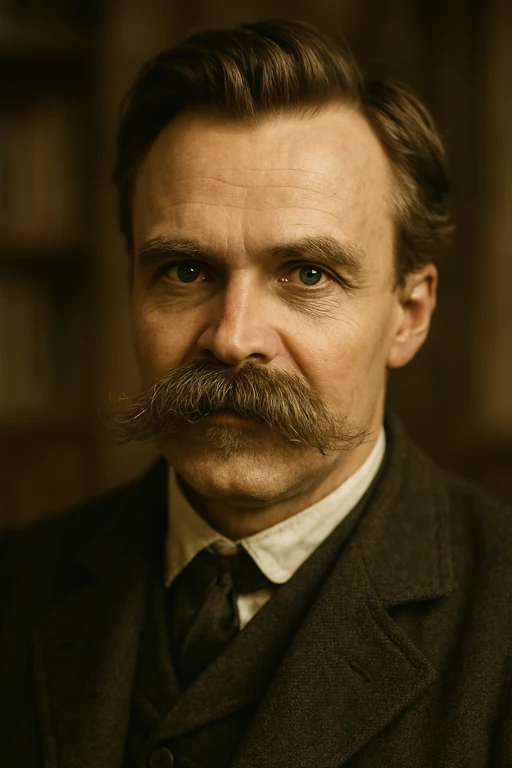
Friedrich Nietzsche: Revolutionary Philosopher and Cultural Critic
Friedrich Nietzsche (1844-1900) stands as one of the most influential and controversial philosophers of the modern era. His radical questioning of traditional values, penetrating psychological insights, and unique literary style transformed Western philosophy and cultural criticism. As a German philosopher, cultural critic, and philologist, Nietzsche challenged the foundations of Christianity, traditional morality, and conventional philosophical ideas about truth. His concepts of the "will to power," "eternal recurrence," and the "Übermensch" continue to resonate in contemporary discussions of human potential, cultural values, and individual authenticity. Despite his complex legacy and frequent misinterpretation, Nietzsche's influence extends far beyond philosophy into literature, psychology, and political thought.
Context & Background
The nineteenth century witnessed unprecedented social, political, and intellectual upheaval that profoundly shaped Nietzsche's thinking. The industrial revolution was transforming European society, while Darwin's theory of evolution challenged religious worldviews. Germany had recently unified under Bismarck's leadership, fostering a new sense of national identity and cultural confidence. The rise of historical criticism, particularly in Biblical scholarship, coincided with growing secularization among European intellectuals.
Nietzsche's personal world was equally tumultuous. Born into a Lutheran pastoral family, he lost his father at a young age, an event that deeply influenced his perspective on faith and authority. His academic career at the University of Basel made him the youngest professor of classical philology at age 24, but chronic health issues forced his early retirement. This period saw the rise of pessimistic philosophy, exemplified by Arthur Schopenhauer, whose work significantly influenced young Nietzsche.
The Franco-Prussian War, in which Nietzsche briefly served as a medical orderly, exposed him to human suffering on an unprecedented scale. Meanwhile, the growing influence of science and rationalism, coupled with increasing urbanization and industrialization, created a sense of cultural crisis that Nietzsche diagnosed as "European nihilism."
Nietzsche's development as a philosopher marked a dramatic departure from traditional academic philosophy. His early work in classical philology provided him with deep insights into ancient Greek culture, which he saw as a healthier alternative to modern Christian civilization. The influence of Wagner's music and personality initially shaped his cultural criticism, though he later broke dramatically with the composer.
His unique writing style evolved from conventional academic prose to increasingly experimental forms, including aphorisms, philosophical poetry, and symbolic narratives. This stylistic evolution reflected his conviction that traditional philosophical writing could not adequately express the radical nature of his ideas. His relationship with Lou Salomé and Paul Rée during this period sparked some of his most psychologically penetrating insights into human motivation and morality.
Nietzsche's philosophical contributions fundamentally challenged Western thought's basic assumptions. His critique of traditional morality as "slave morality" introduced a radical historical perspective into ethical thinking. The concept of "perspectivism" – the idea that there are no absolute truths, only interpretations from different perspectives – anticipated many developments in twentieth-century philosophy.
His psychological insights into human motivation, particularly regarding unconscious drives and the role of power in human relationships, influenced the development of psychoanalysis and modern psychology. His analysis of how values are created and maintained through historical processes introduced a new dimension to philosophical and cultural criticism.
Beyond his philosophical work, Nietzsche was an accomplished pianist and composer, writing several musical pieces throughout his life. His daily routine was highly regimented due to his health issues, including strict dietary habits and long walks regardless of weather conditions. He was known for his impeccable politeness and gentle demeanor, contrasting sharply with the explosive nature of his writings.
His relationship with his sister Elisabeth proved tragically consequential, as she later manipulated his works to align with nationalist and antisemitic ideas he had explicitly opposed. Few know that Nietzsche was stateless for the last decade of his life, having renounced his Prussian citizenship. His personal library, which survived to modern times, reveals an extensive collection of scientific works, showing his deep engagement with contemporary scientific developments.
His final decade of insanity, spent under the care of his mother and sister, remains a subject of medical speculation, with modern diagnoses ranging from syphilis to CADASIL syndrome. During his lucid years, he was known for carrying expensive Swiss chocolate with him to help cope with his frequent migraines.
Friedrich Nietzsche Quotes
Only great pain, the long, slow pain that takes its time... compels us to descend to our ultimate depths... I doubt that such pain makes us "better"; but I know it makes us more profound... In the end, lest what is most important remain unsaid: from such abysses, from such severe sickness, one returns newborn, having shed one's skin... with merrier senses, with a second dangerous innocence in joy, more childlike and yet a hundred times subtler than one has ever been before.
What destroys a man more quickly than to work, think and feel without inner necessity, without any deep personal desire, without pleasure - as a mere automaton of duty?
Physiologists should think before putting down the instinct of self-preservation as the cardinal instinct of an organic being. A living thing seeks above all to discharge its strength--life itself is will to power; self-preservation is only one of the indirect and most frequent results.
Whoever fights monsters should see to it that in the process he does not become a monster. And if you gaze long enough into an abyss, the abyss will gaze back into you.
Giving style to one’s character - a great and rare art! It is exercised by those who see all the strengths and weaknesses of their own natures and then comprehend them in an artistic plan until everything appears as art and reason and even weakness delights the eye.
To recognize untruth as a condition of life--that certainly means resisting accustomed value feelings in a dangerous way; and a philosophy that risks this would by that token alone place itself beyond good and evil.
And do you know what the world is to me? Shall I show it to you in my mirror? This world: a monster of energy, without beginning, without end; a firm, iron magnitude of force that does not grow bigger or smaller, that does not expend itself but only transforms itself; as a whole, of unalterable size, a household without expenses or losses, but likewise without increase or income; enclosed by nothingness as by a boundary; not something blurry or wasted, not something endlessly extended, but set in a definite space as a definite force, and not a space that might be empty here or there, but rather as force throughout, as a play of forces and waves of forces, at the same time one and many, increasing here and at the same time decreasing there; a sea of forces flowing and rushing together, eternally changing, eternally flooding back, with tremendous years of recurrence, with an ebb and a flood of its forms; out of the simplest forms striving toward the most complex, out of the stillest, most rigid, coldest forms striving toward the hottest, most turbulent, most self-contradictory, and then again returning home to the simple out of this abundance, out of the play of contradictions back to the joy of concord, still affirming itself in this uniformity of its courses and its years, blessing itself as that which must return eternally, as a becoming that knows no satiety, no disgust, no weariness: this, my Dionysian world of the eternally self- creating, the eternally self-destroying, this mystery world of the twofold voluptuous delight, my beyond good and evil, without goal, unless the joy of the circle is itself a goal; without will, unless a ring feels good will toward itself— do you want a name for this world? A solution for all of its riddles? A light for you, too, you best-concealed, strongest, most intrepid, most midnightly men?— This world is the will to power—and nothing besides! And you yourselves are also this will to power—and nothing besides!
To learn to see- to accustom the eye to calmness, to patience, and to allow things to come up to it; to defer judgment, and to acquire the habit of approaching and grasping an individual case from all sides. This is the first preparatory schooling of intellectuality. One must not respond immediately to a stimulus; one must acquire a command of the obstructing and isolating instincts.
For believe me! — the secret for harvesting from existence the greatest fruitfulness and the greatest enjoyment is: to live dangerously! Build your cities on the slopes of Vesuvius! Send your ships into uncharted seas! Live at war with your peers and yourselves! Be robbers and conquerors as long as you cannot be rulers and possessors, you seekers of knowledge! Soon the age will be past when you could be content to live hidden in forests like shy deer! At long last the search for knowledge will reach out for its due: — it will want to rule and possess, and you with it!
You know these things as thoughts, but your thoughts are not your experiences, they are an echo and after-effect of your experiences: as when your room trembles when a carriage goes past. I however am sitting in the carriage, and often I am the carriage itself.
I am too inquisitive, too skeptical, too arrogant, to let myself be satisfied with an obvious and crass solution of things. God is such an obvious and crass solution; a solution which is a sheer indelicacy to us thinkers - at bottom He is really nothing but a coarse commandment against us: ye shall not think!
In the end things must be as they are and have always been--the great things remain for the great, the abysses for the profound, the delicacies and thrills for the refined, and, to sum up shortly, everything rare for the rare.
But it is the same with man as with the tree. The more he seeks to rise into the height and light, the more vigorously do his roots struggle earthword, downword, into the dark, the deep - into evil.
The true man wants two things: danger and play. For that reason he wants woman, as the most dangerous plaything.
We have art in order not to die of the truth.
To those human beings who are of any concern to me I wish suffering, desolation, sickness, ill-treatment, indignities—I wish that they should not remain unfamiliar with profound self-contempt, the torture of self-mistrust, the wretchedness of the vanquished: I have no pity for them, because I wish them the only thing that can prove today whether one is worth anything or not—that one endures.
The worst readers are those who behave like plundering troops: they take away a few things they can use, dirty and confound the remainder, and revile the whole.
At bottom every man knows well enough that he is a unique being, only once on this earth; and by no extraordinary chance will such a marvelously picturesque piece of diversity in unity as he is, ever be put together a second time.
My dear friend, what is this our life? A boat that swims in the sea, and all one knows for certain about it is that one day it will capsize. Here we are, two good old boats that have been faithful neighbors, and above all your hand has done its best to keep me from "capsizing"! Let us then continue our voyage—each for the other's sake, for a long time yet, a long time! We should miss each other so much! Tolerably calm seas and good winds and above all sun—what I wish for myself, I wish for you, too, and am sorry that my gratitude can find expression only in such a wish and has no influence at all on wind or weather!
I want to learn more and more to see as beautiful what is necessary in things; then I shall be one of those who make things beautiful. Amor fati: let that be my love henceforth! I do not want to wage war against what is ugly. I do not want to accuse; I do not even want to accuse those who accuse. Looking away shall be my only negation. And all in all and on the whole: some day I wish to be only a Yes-sayer.
I know my fate. One day my name will be associated with the memory of something tremendous — a crisis without equal on earth, the most profound collision of conscience, a decision that was conjured up against everything that had been believed, demanded, hallowed so far. I am no man, I am dynamite.
But the worst enemy you can meet will always be yourself; you lie in wait for yourself in caverns and forests. Lonely one, you are going the way to yourself! And your way goes past yourself, and past your seven devils! You will be a heretic to yourself and witch and soothsayer and fool and doubter and unholy one and villain. You must be ready to burn yourself in your own flame: how could you become new, if you had not first become ashes?
The most spiritual men, as the strongest, find their happiness where others would find their destruction: in the labyrinth, in hardness against themselves and others, in experiments. Their joy is self-conquest: asceticism becomes in them nature, need, and instinct. Difficult tasks are a privilege to them; to play with burdens that crush others, a recreation. Knowledge–a form of asceticism. They are the most venerable kind of man: that does not preclude their being the most cheerful and the kindliest.
Meaning and morality of One's life come from within oneself. Healthy, strong individuals seek self expansion by experimenting and by living dangerously. Life consists of an infinite number of possibilities and the healthy person explores as many of them as posible. Religions that teach pity, self-contempt, humility, self-restraint and guilt are incorrect. The good life is ever changing, challenging, devoid of regret, intense, creative and risky.
He who has attained the freedom of reason to any extent cannot, for a long time, regard himself otherwise than as a wanderer on the face of the earth - and not even as a traveler towards a final goal, for there is no such thing. But he certainly wants to observe and keep his eyes open to whatever actually happens in the world; therefore he cannot attach his heart too firmly to anything individual; he must have in himself something wandering that takes pleasure in change and transitoriness.
The slow arrow of beauty. The most noble kind of beauty is that which does not carry us away suddenly, whose attacks are not violent or intoxicating (this kind easily awakens disgust), but rather the kind of beauty which infiltrates slowly, which we carry along with us almost unnoticed, and meet up with again in dreams; finally, after it has for a long time lain modestly in our heart, it takes complete possession of us, filling our eyes with tears, our hearts with longing. What do we long for when we see beauty? To be beautiful. We think much happiness must be connected with it. But that is an error.
The overman...Who has organized the chaos of his passions, given style to his character, and become creative. Aware of life's terrors, he affirms life without resentment.
What then is truth? A movable host of metaphors, metonymies, and anthropomorphisms: in short, a sum of human relations which have been poetically and rhetorically intensified, transferred, and embellished, and which, after long usage, seem to a people to be fixed, canonical, and binding. Truths are illusions which we have forgotten are illusions — they are metaphors that have become worn out and have been drained of sensuous force.
What if a demon were to creep after you one night, in your loneliest loneliness, and say, 'This life which you live must be lived by you once again and innumerable times more; and every pain and joy and thought and sigh must come again to you, all in the same sequence. The eternal hourglass will again and again be turned and you with it, dust of the dust!' Would you throw yourself down and gnash your teeth and curse that demon? Or would you answer, 'Never have I heard anything more divine'?
There is a false saying: How can someone who can’t save himself save others? Supposing I have the key to your chains, why should your lock and my lock be the same?
Was that life? Well then, once more!
I love him who seeks to create over and beyond himself and thus perishes.
You say 'I' and you are proud of this word. But greater than this- although you will not believe in it - is your body and its great intelligence, which does not say 'I' but performs 'I'.
It is not when truth is dirty, but when it is shallow, that the lover of knowledge is reluctant to step into its waters.
And so, onwards... along a path of wisdom, with a hearty tread, a hearty confidence.. however you may be, be your own source of experience. Throw off your discontent about your nature. Forgive yourself your own self. You have it in your power to merge everything you have lived through- false starts, errors, delusions, passions, your loves and your hopes- into your goal, with nothing left over.
Plato was a bore.
Those who know that they are profound strive for clarity. Those who would like to seem profound to the crowd strive for obscurity. For the crowd believes that if it cannot see to the bottom of something it must be profound. It is so timid and dislikes going into the water.
Marriage as a long conversation. - When marrying you should ask yourself this question: do you believe you are going to enjoy talking with this woman into your old age? Everything else in a marriage is transitory, but most of the time that you're together will be devoted to conversation.
Every true faith is infallible. It performs what the believing person hopes to find in it. But it does not offer the least support for the establishing of an objective truth. Here the ways of men divide. If you want to achieve peace of mind and happiness, have faith. If you want to be a disciple of truth, then search.
My formula for greatness in a human being is amor fati: that one wants nothing to be different, not forward, not backward, not in all eternity. Not merely bear what is necessary, still less conceal it—all idealism is mendaciousness in the face of what is necessary—but love it
Dancing in all its forms cannot be excluded from the curriculum of all noble education; dancing with the feet, with ideas, with words, and, need I add that one must also be able to dance with the pen?
It is a self-deception of philosophers and moralists to imagine that they escape decadence by opposing it. That is beyond their will; and, however little they acknowledge it, one later discovers that they were among the most powerful promoters of decadence.
Man is something that shall be overcome. Man is a rope, tied between beast and overman — a rope over an abyss. What is great in man is that he is a bridge and not an end.
There is a point in the history of society when it becomes so pathologically soft and tender that among other things it sides even with those who harm it, criminals, and does this quite seriously and honestly. Punishing somehow seems unfair to it, and it is certain that imagining "punishment" and "being supposed to punish" hurts it, arouses fear in it. "Is it not enough to render him undangerous? Why still punish?
Of all evil I deem you capable: Therefore I want good from you. Verily, I have often laughed at the weaklings who thought themselves good because they had no claws.
One must learn to love.— This is what happens to us in music: first one has to learn to hear a figure and melody at all, to detect and distinguish it, to isolate it and delimit it as a separate life; then it requires some exertion and good will to tolerate it in spite of its strangeness, to be patient with its appearance and expression, and kindhearted about its oddity:—finally there comes a moment when we are used to it, when we wait for it, when we sense that we should miss it if it were missing: and now it continues to compel and enchant us relentlessly until we have become its humble and enraptured lovers who desire nothing better from the world than it and only it.— But that is what happens to us not only in music: that is how we have learned to love all things that we now love. In the end we are always rewarded for our good will, our patience, fairmindedness, and gentleness with what is strange; gradually, it sheds its veil and turns out to be a new and indescribable beauty:—that is its thanks for our hospitality. Even those who love themselves will have learned it in this way: for there is no other way. Love, too, has to be learned.
There are no eternal facts, as there are no absolute truths.
It is the business of the very few to be independent; it is a privilege of the strong. And whoever attempts it, even with the best right, but without being OBLIGED to do so, proves that he is probably not only strong, but also daring beyond measure. He enters into a labyrinth, he multiplies a thousandfold the dangers which life in itself already brings with it; not the least of which is that no one can see how and where he loses his way, becomes isolated, and is torn piecemeal by some minotaur of conscience. Supposing such a one comes to grief, it is so far from the comprehension of men that they neither feel it, nor sympathize with it. And he cannot any longer go back! He cannot even go back again to the sympathy of men!
The heaviest burden: What, if some day or night, a demon were to steal after you into your loneliest loneliness and say to you: ‘This life, as you now live it and have lived it, you will have to live once more and innumerable times more; and there will be nothing new in it, but every pain and every joy and every thought and sigh… must return to you—all in the same succession and sequence—even this spider and this moonlight between the trees and even this moment and I myself. The eternal hourglass of existence is turned over again and again—and you with it, speck of dust!’ Would you not throw yourself down and gnash your teeth and curse the demon who spoke thus? Or have you once experienced a tremendous moment when you would have answered him: ‘You are a god, and never have I heard anything more divine!’ If this thought were to gain possession of you, it would change you as you are, or perhaps crush you. The question in each and every thing, do you want this once more and innumerable times more? would lie upon your actions as the greatest weight. Or how well disposed would you have to become to yourself and to life to crave nothing more fervently than this ultimate eternal confirmation and seal?
The earth has a skin and that skin has diseases; one of its diseases is called man.
One must shed the bad taste of wanting to agree with many. "Good" is no longer good when one's neighbor mouths it. And how should there be a "common good"! The term contradicts itself: whatever can be common always has little value. In the end it must be as it is and always has been: great things remain for the great, abysses for the profound, nuances and shudders for the refined, and, in brief, all that is rare for the rare.
To predict the behavior of ordinary people in advance, you only have to assume that they will always try to escape a disagreeable situation with the smallest possible expenditure of intelligence.
Without forgetting it is quite impossible to live at all.
My solitude doesn’t depend on the presence or absence of people; on the contrary, I hate who steals my solitude without, in exchange, offering me true company.
Beware that, when fighting monsters, you yourself do not become a monster... for when you gaze long into the abyss. The abyss gazes also into you.
All things are subject to interpretation. Whichever interpretation prevails at a given time is a function of power and not truth.
I change too quickly: my today refutes my yesterday. When I ascend I often jump over steps, and no step forgives me that.
The Christian resolution to find the world ugly and bad has made the world ugly and bad.
The life of the enemy . Whoever lives for the sake of combating an enemy has an interest in the enemy's staying alive.
There is an old illusion. It is called good and evil.
It is nobler to declare oneself wrong than to insist on being right --especially when one is right.
It is impossible to suffer without making someone pay for it; every complaint already contains revenge.
If a man has character, he has also his typical experience, which always recurs.
He who obeys, does not listen to himself!
A politician divides mankind into two classes: tools and enemies.
Objection, evasion, joyous distrust, and love of irony are signs of health; everything absolute belongs to pathology.
Of all that is written I love only what a man has written in his own blood.
Everyone who has ever built anywhere a new heaven first found the power thereto in his own hell.
The real man wants two different things: danger and play. Therefore he wants woman, as the most dangerous plaything.
Truths are illlusions which we have forgotten are illusions.
Most people are far too much occupied with themselves to be malicious.
Blessed are the forgetful; for they get over their stupidities, too.
I am not upset that you lied to me, I am upset that from now on I cannot believe you.
Many are stubborn in pursuit of the path they have chosen. Few in pursuit of the goal.
The desire to annoy no one, to harm no one, can equally well be the sign of a just as of an anxious disposition.
You say, it's dark. And in truth, I did place a cloud before your sun. But do you not see how the edges of the cloud are already glowing and turning light.
Knowledge kills action; action requires the veils of illusion.
The vanity of others runs counter to our taste only when it runs counter to our vanity.
We do not place especial value on the possession of a virtue until we notice its total absence in our opponent.
There will always be rocks in the road ahead of us. They will be stumbling blocks or stepping stones; it all depends on how you use them.
If we train our conscience, it kisses us while it hurts
There is no such thing as moral phenomena, but only a moral interpretation of phenomena
The world is beautiful, but has a disease called man.
I have learned to walk: since then I have run. I have learned to fly: since then I do not have to be pushed in order to move.
He who fights too long against dragons becomes a dragon himself; and if you gaze too long into the abyss, the abyss will gaze into you.
A joke is an epigram on the death of a feeling.
the voice of beauty speaks softly; it creeps only into the most fully awakened souls
Distrust all in whom the impulse to punish is powerful.
One must give value to their existence by behaving as if ones very existence were a work of art.
If you know the why, you can live any how.
It is my ambition to say in ten sentences what others say in a whole book.
True, we love life, not because we are used to living, but because we are used to loving. There is always some madness in love, but there is also always some reason in madness.
Whenever I climb I am followed by a dog called 'Ego'.
I assess the power of a will by how much resistance, pain, torture it endures and knows how to turn to its advantage
Remorse.-- Never yield to remorse, but at once tell yourself: remorse would simply mean adding to the first act of stupidity a second.
Convictions are more dangerous foes of truth than lies.
For art to exist, for any sort of aesthetic activity or perception to exist, a certain physiological precondition is indispensable: intoxication.
Love is a state in which a man sees things most decidedly as they are not.
There is an innocence in admiration: it occurs in one who has not yet realized that they might one day be admired.
Nothing on earth consumes a man more quickly than the passion of resentment.