
George Orwell
Quotes & Wisdom
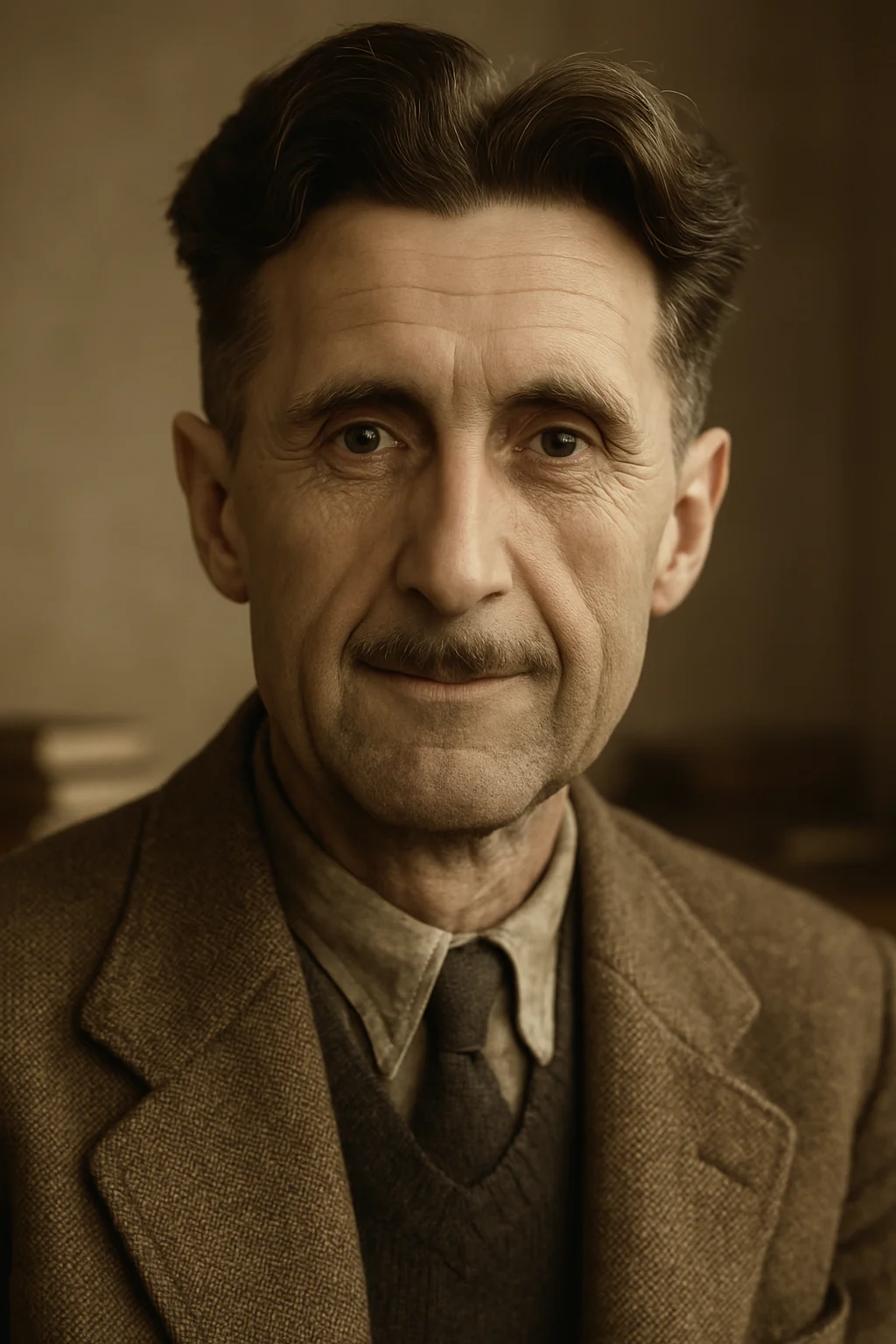
George Orwell - the pen name of Eric Arthur Blair - became the twentieth century's most urgent voice against tyranny in all its forms. From colonial Burma to the trenches of Spain to the bombed streets of wartime London, he witnessed enough human cruelty to fuel a lifetime of angry, lucid prose. His final novels, "Animal Farm" and "Nineteen Eighty-Four," gave the English language new words for political oppression: Big Brother, thoughtcrime, doublethink. Yet Orwell was no mere dystopian prophet. His essays set the standard for clear, honest writing about politics, poverty, and everyday life. His insistence that political language be plain and truthful remains revolutionary in an age of spin.
Context & Background
Eric Arthur Blair was born on June 25, 1903, in Motihari, Bengal, during the twilight of the British Empire his family served. His father was a minor colonial official in the Indian Civil Service; his mother brought him back to England at age one, and he rarely saw his father again until childhood's end. This pattern of displacement - never quite belonging to any class or country - would define his life.
The England to which young Eric returned was rigidly hierarchical, and the Blairs occupied an awkward position: "lower-upper-middle class," as Orwell would later describe it. Respectable enough for scholarships to St. Cyprian's preparatory school and then Eton, but too poor for the easy confidence of true aristocracy. His 1947 essay "Such, Such Were the Joys" recalls the misery of school with scarifying honesty - the snobbery, the beatings, the systematic humiliation of boys without money.
The interwar years that shaped Orwell's maturity were haunted by the carnage of the First World War and shadowed by rising totalitarianism. Fascism in Italy, Nazism in Germany, Stalinism in Russia - the political experiments of the 1930s would all horrify him in their different ways. The global depression radicalized millions; Orwell moved leftward too, though his socialism remained stubbornly English and libertarian, suspicious of doctrine and bureaucracy alike.
Rather than proceed to Oxford or Cambridge after Eton, Orwell joined the Imperial Police in Burma - a choice that still puzzles biographers. For five years he enforced colonial rule, growing to hate imperialism while complicit in its machinery. His first novel, "Burmese Days," and essays like "A Hanging" and "Shooting an Elephant" record this moral education through vivid, guilt-soaked prose.
Returning to Europe in 1927, Orwell embarked on deliberate self-impoverishment. He lived as a tramp in London, washed dishes in Paris, picked hops in Kent - experiences that became "Down and Out in Paris and London" (1933). This wasn't poverty tourism but penance, an attempt to understand and share the lives of those his class had always ignored.
"The Road to Wigan Pier" (1937) extended this mission to the industrial north, documenting coal miners' lives with devastating clarity. Yet characteristically, Orwell also attacked the middle-class socialists who claimed to champion workers while knowing nothing of their lives. His honesty made him enemies across the political spectrum.
The Spanish Civil War transformed Orwell from socialist sympathizer to committed anti-fascist, then nearly killed him for it. He arrived in Barcelona in December 1936, saw workers' militias running the city, and felt he had glimpsed genuine revolution. He joined the POUM militia - Marxist but anti-Stalinist - and fought on the Aragon front.
Then the Communists, backed by Soviet arms, turned on their revolutionary allies. The POUM was suppressed, its members arrested or shot. Orwell fled Spain with a bullet wound in his throat and a visceral understanding of how totalitarian movements operate: not just through terror but through lies, the rewriting of history, the insistence that what you saw with your own eyes never happened.
"Homage to Catalonia" (1938) records this education with characteristic clarity. His later works grew from Spanish soil: the recognition that the left could be as capable of tyranny as the right, that propaganda's power to reshape reality was the century's most dangerous force.
Orwell spent World War II in London, working for the BBC and writing the "As I Please" columns that refined his style to crystalline directness. "Animal Farm" - the fable of a revolution betrayed by pigs who become indistinguishable from the farmers they replaced - appeared in 1945 and made him famous.
"Nineteen Eighty-Four" followed in 1949, written as tuberculosis consumed his body. The novel's totalitarian future - perpetual war, constant surveillance, the systematic destruction of truth and memory - drew on his Spanish experience, his BBC observations, and his horror at where modern states seemed heading. The telescreen, the Ministry of Truth, Room 101 - his inventions entered the language because they named fears people already felt but couldn't articulate.
Orwell died on January 21, 1950, at forty-six, leaving behind a body of work that grows more relevant with each passing year. His warnings about political language, about the corruption of truth, about technology's potential for control - all feel more urgent than when he wrote them.
Orwell's commitment to plain living bordered on asceticism. He preferred roll-your-own cigarettes, strong tea, and simple food. His homes were famously shabby; his personal appearance famously neglected. Friends recalled a tall, gaunt figure with a thin mustache and a persistent cough that foreshadowed his early death.
Yet he was no grim ideologue. He loved fishing, gardening, and English cooking. His essays on topics like "A Nice Cup of Tea," "In Defence of English Cooking," and "Some Thoughts on the Common Toad" reveal genuine pleasure in ordinary things. He believed socialism should mean more of life's pleasures for everyone, not their puritanical suppression.
His pen name itself tells a story. "George" was the most common English Christian name; "Orwell" was a river he loved in Suffolk. Together they announced his self-reinvention as a quintessentially English writer, leaving behind the imperial associations of Eric Blair.
He married twice - first to Eileen O'Shaughnessy, who died during surgery in 1945, then to Sonia Brownell just months before his own death. He adopted a son, Richard, whom friends raised after his death. Throughout his short life, his personal relationships remained somewhat enigmatic, overshadowed by his consuming dedication to writing and political engagement.
Orwell's grave in a quiet Oxfordshire churchyard bears the simple inscription "Here lies Eric Arthur Blair." Even in death, he kept the two names separate - the private man and the public writer, the imperial servant's son and the prophet who tried to wake the world.
George Orwell Quotes
If you want to keep a secret, you must also hide it from yourself.
We shall meet in the place where there is no darkness.
Until they become conscious they will never rebel, and until after they have rebelled they cannot become conscious.
Freedom is the freedom to say that two plus two make four. If that is granted, all else follows.
The great enemy of clear language is insincerity. When there is a gap between one’s real and one’s declared aims, one turns as it were instinctively to long words and exhausted idioms, like a cuttlefish spurting out ink.
He gazed up at the enormous face. Forty years it had taken him to learn what kind of smile was hidden beneath the dark moustache. O cruel, needless misunderstanding! O stubborn, self-willed exile from the loving breast! Two gin-scented tears trickled down the sides of his nose. But it was all right, everything was all right, the struggle was finished. He had won the victory over himself. He loved Big Brother.
If you set yourself to it, you can live the same life, rich or poor. You can keep on with your books and your ideas. You just got to say to yourself, "I'm a free man in here" - he tapped his forehead - "and you're all right.
The stars are a free show; it don’t cost anything to use your eyes
Only old Benjamin professed to remember every detail of his long life and to know that things never had been, nor ever could be much better or much worse--hunger, hardship, and disappointment being, so he said, the unalterable law of life.
Your worst enemy, he reflected, was your own nervous system. At any moment the tension inside you was liable to translate itself into some visible symptom.
Winston Smith: Does Big Brother exist?
There are some ideas so absurd that only an intellectual could believe them.
In the end the Party would announce that two and two made five, and you would have to believe it. It was inevitable that they should make that claim sooner or later: the logic of their position demanded it. Not merely the validity of experience, but the very existence of external reality, was tacitly denied by their philosophy. The heresy of heresies was common sense. And what was terrifying was not that they would kill you for thinking otherwise, but that they might be right. For, after all, how do we know that two and two make four? Or that the force of gravity works? Or that the past is unchangeable? If both the past and the external world exist only in the mind, and if the mind itself is controllable—what then?
If there is hope, it lies in the proles.
Perhaps a lunatic was simply a minority of one. At one time it had been a sign of madness to believe that the Earth goes round the Sun; today, to believe the past is inalterable. He might be alone in holding that belief, and if alone, then a lunatic. But the thought of being a lunatic did not greatly trouble him; the horror was that he might also be wrong.
If people cannot write well, they cannot think well, and if they cannot think well, others will do their thinking for them.
In philosophy, or religion, or ethics, or politics, two and two might make five, but when one was designing a gun or an aeroplane they had to make four.
Don’t you see that the whole aim of Newspeak is to narrow the range of thought? In the end we shall make thoughtcrime literally impossible, because there will be no words in which to express it.
To write or even speak English is not a science but an art. There are no reliable words. Whoever writes English is involved in a struggle that never lets up even for a sentence. He is struggling against vagueness, against obscurity, against the lure of the decorative adjective, against the encroachment of Latin and Greek, and, above all, against the worn-out phrases and dead metaphors with which the language is cluttered up.
they had come to a time when no one dared speak his mind, when fierce, growling dogs roamed everywhere, and when you had to watch your comrades torn to pieces after confessing to shocking crimes.
You must try harder. It is not easy to become sane.
The Ministry of Peace concerns itself with war, the Ministry of Truth with lies, the Ministry of Love with torture and the Ministry of Plenty with starvation. These contradictions are not accidental, nor do they result from from ordinary hypocrisy: they are deliberate exercises in doublethink
During times of universal deceit, telling the truth becomes a revolutionary act.
It is a feeling of relief, almost of pleasure, at knowing yourself at last genuinely down and out. You have talked so often of going to the dogs — and well, here are the dogs, and you have reached them, and you can stand it. It takes off a lot of anxiety.
It had become usual to give Napoleon the Credit for every Successful achievement and every stroke of good fortune. You would often hear one hen remark to another, Under the guidance of our leader, Comrade Napoleon, I have laid five eggs in six days or two cows, enjoying a drink at the pool, would exclaim,
But you could not have pure love or pure lust nowadays. No emotion was pure, because everything was mixed up with fear and hatred. Their embrace had been a battle, the climax a victory. It was a blow struck against the Party. It was a political act.
The mistake you make, don't you see,is in thinking one can live in a corrupt society without being corrupt oneself. After all, what do you achieve by refusing to make money? You're trying to behave as though one could stand right outside our economic system. But one can't. One's got to change the system, or one changes nothing. One can't put things right in a hole-and-corner way, if you take my meaning.
Pacifism is objectively pro-fascist. This is elementary common sense. If you hamper the war effort of one side, you automatically help out that of the other. Nor is there any real way of remaining outside such a war as the present one. In practice, 'he that is not with me is against me'.
The consequences of every act are included in the act itself.
It was curious to think that the sky was the same for everybody, in Eurasia or Eastasia as well as here. And the people under the sky were also very much the same--everywhere, all over the world, hundreds or thousands of millions of people just like this, people ignorant of one another's existence, held apart by walls of hatred and lies, and yet almost exactly the same--people who had never learned to think but were storing up in their hearts and bellies and muscles the power that would one day overturn the world.
The essential act of war is destruction, not necessarily of human lives, but of the products of human labour. War is a way of shattering to pieces, or pouring into the stratosphere, or sinking in the depths of the sea, materials which might otherwise be used to make the masses too comfortable, and hence, in the long run, too intelligent.
Twelve voices were shouting in anger, and they were all alike. No question, now, what had happened to the faces of the pigs. The creatures outside looked from pig to man, and from man to pig, and from pig to man again; but already it was impossible to say which was which.
It is curious how people take it for granted that they have a right to preach at you and pray over you as soon as your income falls below a certain level.
And if all others accepted the lie which the Party imposed—if all records told the same tale—then the lie passed into history and became truth. 'Who controls the past' ran the Party slogan, 'controls the future: who controls the present controls the past.
It struck him that in moments of crisis one is never fighting against an external enemy, but always against one’s own body... On the battlefield, in the torture chamber, on a sinking ship, the issues that you are fighting for are always forgotten, because the body swells up until it fills the universe, and even when you are not paralysed by fright or screaming with pain, life is a moment-to-moment struggle against hunger or cold or sleeplessness, against a sour stomach or an aching tooth.
But it was alright, everything was alright, the struggle was finished. He had won the victory over himself. He loved Big Brother.
There will be no curiosity, no enjoyment of the process of life. All competing pleasures will be destroyed. But always— do not forget this, Winston— always there will be the intoxication of power, constantly increasing and constantly growing subtler. Always, at every moment, there will be the thrill of victory, the sensation of trampling on an enemy who is helpless.
The smell of her hair, the taste of her mouth, the feeling of her skin seemed to have got inside him, or into the air all round him. She had become a physical necessity.
Freedom is the right to tell people what they do not want to hear.
Nothing was your own except the few cubic centimetres inside your skull.
A scrupulous writer, in every sentence that he writes, will ask himself at least four questions, thus: 1. What am I trying to say? 2. What words will express it? 3. What image or idiom will make it clearer? 4. Is this image fresh enough to have an effect?
This work was strictly voluntary, but any animal who absented himself from it would have his rations reduced by half.
No one believes more firmly than Comrade Napoleon that all animals are equal. He would be only too happy to let you make your decisions for yourselves. But sometimes you might make the wrong decisions, comrades, and then where should we be?
Who controls the past controls the future. Who controls the present controls the past.
All animals are equal, but some animals are more equal than others.
War is peace.
The best books... are those that tell you what you know already.
Every generation imagines itself to be more intelligent than the one that went before it, and wiser than the one that comes after it.
The creatures outside looked from pig to man, and from man to pig, and from pig to man again; but already it was impossible to say which was which.
The most effective way to destroy people is to deny and obliterate their own understanding of their history.
But if thought corrupts language, language can also corrupt thought.
If you want a picture of the future, imagine a boot stamping on a human face—for ever.
It was a bright cold day in April, and the clocks were striking thirteen.
If liberty means anything at all, it means the right to tell people what they do not want to hear.
Political language is designed to make lies sound truthful and murder respectable, and to give an appearance of solidity to pure wind.
Now I will tell you the answer to my question. It is this. The Party seeks power entirely for its own sake. We are not interested in the good of others; we are interested solely in power, pure power. What pure power means you will understand presently. We are different from the oligarchies of the past in that we know what we are doing. All the others, even those who resembled ourselves, were cowards and hypocrites. The German Nazis and the Russian Communists came very close to us in their methods, but they never had the courage to recognize their own motives. They pretended, perhaps they even believed, that they had seized power unwillingly and for a limited time, and that just around the corner there lay a paradise where human beings would be free and equal. We are not like that. We know that no one ever seizes power with the intention of relinquishing it. Power is not a means; it is an end. One does not establish a dictatorship in order to safeguard a revolution; one makes the revolution in order to establish the dictatorship. The object of persecution is persecution. The object of torture is torture. The object of power is power. Now you begin to understand me.
If you loved someone, you loved him, and when you had nothing else to give, you still gave him love.
In the face of pain there are no heroes.
Perhaps a lunatic was simply a minority of one.
Reality exists in the human mind, and nowhere else.
It's a beautiful thing, the destruction of words.
Man is the only real enemy we have. Remove Man from the scene, and the root cause of hunger and overwork is abolished forever.
I hate purity, I hate goodness! I don't want virtue to exist anywhere. I want everyone to be corrupt to the bones.
In general, the greater the understanding, the greater the delusion; the more intelligent, the less sane.
Those who control the present, control the past and those who control the past control the future.
Four legs good, two legs better! All Animals Are Equal. But Some Animals Are More Equal Than Others.
His answer to every problem, every setback was I will work harder! —which he had adopted as his personal motto.
Comrades!' he cried. 'You do not imagine, I hope, that we pigs are doing this in a spirit of selfishness and privilege? Many of us actually dislike milk and apples. I dislike them myself. Our sole object in taking these things is to preserve our health. Milk and apples (this has been proved by Science, comrades) contain substances absolutely necessary to the well-being of a pig. We pigs are brainworkers. The whole management and organisation of this farm depend on us. Day and night we are watching over your welfare. It is for your sake that we drink the milk and eat those apples.
Sometimes they threaten you with something - something you can't stand up to, can't even think about. And then you say, "Don't do it to me, do it to somebody else, do it to So-and-so." And perhaps you might pretend, afterwards, that it was only a trick and that you just said it to make them stop and didn't mean it. But that isn't true. At the time when it happens you do mean it. You think there's no other way of saving yourself, and you're quite ready to save yourself that way. You WANT it to happen to the other person. You don't give a damn what they suffer. All you care is yourself.
Under the spreading chestnut tree I sold you and you sold me:
Let's face it: our lives are miserable, laborious, and short.
The Party told you to reject the evidence of your eyes and ears. It was their final, most essential command.
It was possible, no doubt, to imagine a society in which wealth, in the sense of personal possessions and luxuries, should be evenly distributed, while power remained in the hands of a small privileged caste. But in practice such a society could not long remain stable. For if leisure and security were enjoyed by all alike, the great mass of human beings who are normally stupefied by poverty would become literate and would learn to think for themselves; and when once they had done this, they would sooner or later realise that the privileged minority had no function, and they would sweep it away. In the long run, a hierarchical society was only possible on a basis of poverty and ignorance.
So long as I remain alive and well I shall continue to feel strongly about prose style, to love the surface of the earth, and to take a pleasure in solid objects and scraps of useless information.
Beasts of England, beasts of Ireland,
You will be hollow. We shall squeeze you empty, and then we shall fill you with ourselves.
The Revolution will be complete when the language is perfect.
The past was alterable. The past never had been altered. Oceania was at war with Eastasia. Oceania had always been at war with Eastasia.
Power is not a means; it is an end.
All writers are vain, selfish, and lazy, and at the very bottom of their motives there lies a mystery. Writing a book is a horrible, exhausting struggle, like a long bout of some painful illness. One would never undertake such a thing if one were not driven on by some demon whom one can neither resist nor understand. For all one knows that demon is simply the same instinct that makes a baby squall for attention. And yet it is also true that one can write nothing readable unless one constantly struggles to efface one's own personality. Good prose is like a windowpane.
The real division is not between conservatives and revolutionaries but between authoritarians and libertarians.
He wears a mask, and his face grows to fit it.
At 50, everyone has the face he deserves.
It was not by making yourself heard but by staying sane that you carried on the human heritage.
He felt as though he were wandering in the forests of the sea bottom, lost in a monstrous world where he himself was the monster. He was alone. The past was dead, the future was unimaginable
That rifle on the wall of the labourer's cottage or working class flat is the symbol of democracy. It is our job to see that it stays there.
they say that time heals all things,
But the thought of being a lunatic did not greatly trouble him; the horror was that he might also be wrong.
If you kept the small rules, you could break the big ones.
What can you do, thought Winston, against the lunatic who is more intelligent than yourself, who gives your arguments a fair hearing and then simply persists in his lunacy?
So long as they (the Proles) continued to work and breed, their other activities were without importance. Left to themselves, like cattle turned loose upon the plains of Argentina, they had reverted to a style of life that appeared to be natural to them, a sort of ancestral pattern...Heavy physical work, the care of home and children, petty quarrels with neighbors, films, football, beer and above all, gambling filled up the horizon of their minds. To keep them in control was not difficult.
The greatest enemy of clear language is insincerity.
Fear of the mob is a superstitious fear. It is based on the idea that there is some mysterious, fundamental difference between rich and poor, as though they were two different races, like Negroes and white men. But in reality there is no such difference. The mass of the rich and the poor are differentiated by their incomes and nothing else, and the average millionaire is only the average dishwasher dressed in a new suit. Change places, and handy dandy, which is the justice, which is the thief? Everyone who has mixed on equal terms with the poor knows this quite well. But the trouble is that intelligent, cultivated people, the very people who might be expected to have liberal opinions, never do mix with the poor. For what do the majority of educated people know about poverty?
He would say that God had given him a tail to keep the flies off, but that he would sooner have had no tail and no flies.
He was conscious of nothing except the blankness of the page in front of him, the itching of the skin above his ankle, the blaring of the music, and a slight booziness caused by the gin.
Can you not understand that liberty is worth more than just ribbons?
Man is the only creature that consumes without producing
If both the past and the external world exist only in the mind, and if the mind itself is controllable - what then?
If there really is such a thing as turning in one's grave, Shakespeare must get a lot of exercise.
We are all capable of believing things which we know to be untrue, and then, when we are finally proved wrong, impudently twisting the facts so as to show that we were right.