
Henry Ford
Quotes & Wisdom
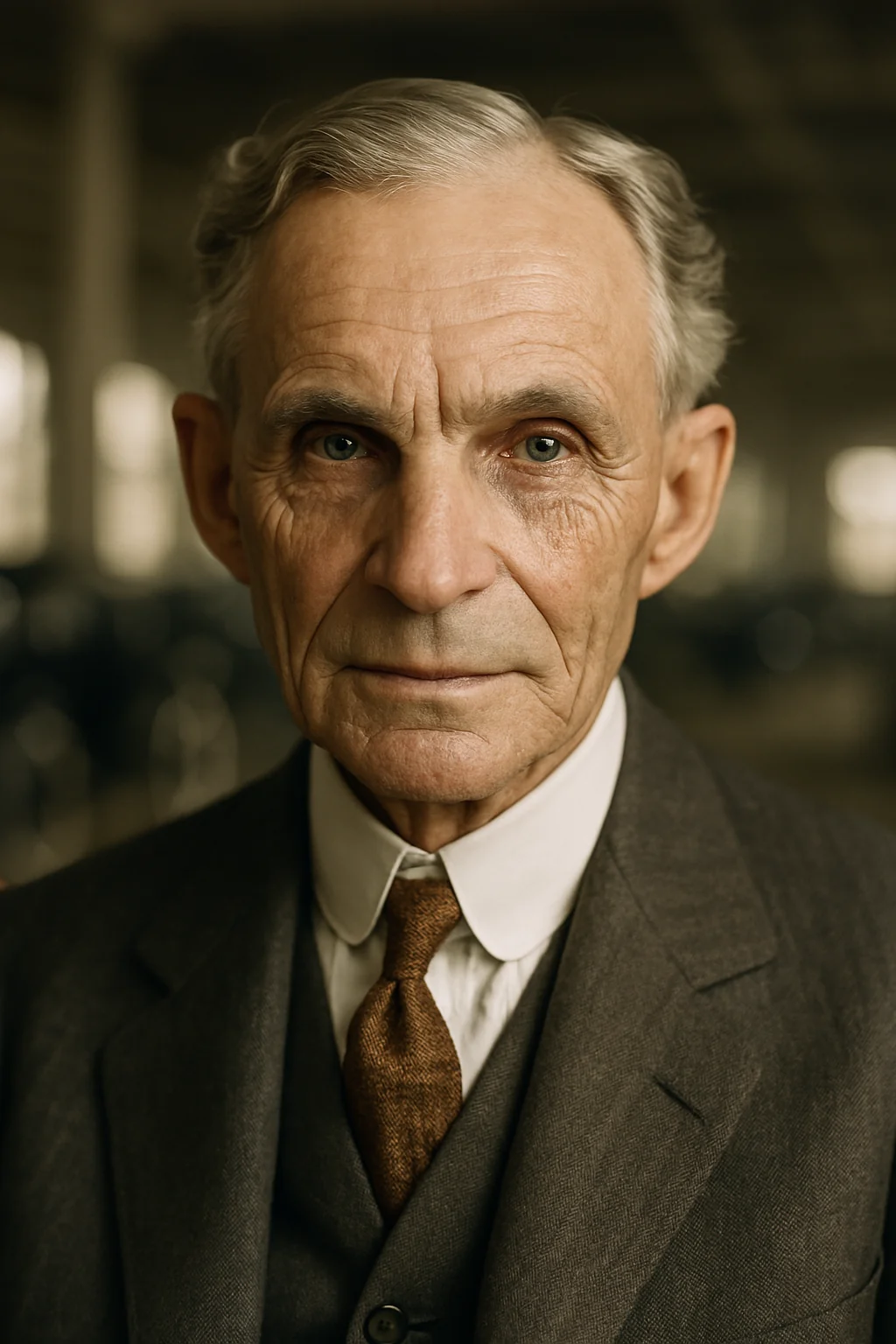
Henry Ford transformed the automobile from rich man's toy to everyman's necessity, and in doing so remade modern life. His assembly line techniques didn't just make cars affordable - they created mass production itself, the manufacturing system that defined the twentieth century. The five-dollar workday made his employees consumers of the products they built, demonstrating that high wages could drive economic growth. Yet Ford's legacy is deeply shadowed: his virulent antisemitism, his opposition to labor unions, and his authoritarian management complicate any simple celebration of his achievements. He embodied both industrial America's creative power and its ugliest prejudices.
Context & Background
Henry Ford was born on July 30, 1863, on a farm in Dearborn, Michigan, the eldest surviving son of Irish immigrant parents. Rural Michigan in the post-Civil War era was a world of small farms, village workshops, and self-reliance - values Ford would celebrate even as his factories made that world obsolete.
He showed mechanical aptitude early, repairing watches for neighbors, and felt no vocation for farming. In 1879, he walked to Detroit to apprentice as a machinist, beginning a career in the machine shops and engine rooms of industrial America. He worked for Westinghouse on steam engines, experimented with gasoline engines, and in 1896 completed his first automobile - the Quadricycle, built in a shed behind his home.
The automobile industry at the turn of the century was a chaos of competing technologies and entrepreneurs. Electric cars, steam cars, and gasoline cars all had advocates; dozens of manufacturers rose and fell. Ford founded and failed at two automobile companies before establishing Ford Motor Company in 1903 with backing from investors who would later regret the terms they'd accepted.
The early Ford cars sold well to wealthy buyers, but Ford's vision was different: he wanted to build a car that ordinary people could afford. "I will build a motor car for the great multitude," he declared. The Model T, introduced in 1908, would make that vision reality.
The Model T was simple, durable, and repairable by any competent farmer with basic tools - essential qualities when paved roads and repair shops barely existed. Ford stripped away options (famously declaring customers could have any color "so long as it is black") to minimize complexity and cost.
More revolutionary was how Ford built it. The moving assembly line, introduced at Highland Park in 1913, broke manufacturing into simple, repetitive tasks. Instead of skilled craftsmen building entire vehicles, each worker performed one operation as the car moved past. Production time for a single chassis dropped from over twelve hours to ninety-three minutes.
The assembly line was not Ford's invention - meat packers had used similar techniques - but he applied it with unprecedented thoroughness. His engineers studied every motion, eliminated wasted effort, and achieved efficiencies that seemed miraculous. By 1914, Ford was producing more cars than all other manufacturers combined.
The five-dollar day, announced in January 1914, shocked the business world. Ford more than doubled wages while reducing hours, claiming he wanted workers who could buy the products they made. The actual motivations were mixed: turnover on the dehumanizing assembly line was astronomical, and Ford needed to keep workers. But the effect was transformative - workers lined up for jobs, and other industries gradually followed Ford's wage example.
Ford's genius coexisted with vicious prejudice. In 1920, his newspaper The Dearborn Independent began publishing "The International Jew," a series of antisemitic articles that blamed Jewish conspiracies for everything from jazz music to Bolshevism. These articles, collected into pamphlets, spread worldwide and influenced Nazi ideology - Adolf Hitler kept Ford's portrait in his office and cited him in "Mein Kampf."
Ford eventually apologized under legal pressure in 1927, claiming he hadn't known what his paper was publishing - a claim no one believed. His antisemitism was sincere, rooted in rural Protestant traditions that associated Jews with urban finance and cultural decay. He never fully recanted, and the damage done by his propaganda outlived him.
His treatment of workers revealed similar contradictions. The five-dollar day came with strings: Ford's "Sociological Department" investigated workers' home lives, demanding sobriety, cleanliness, and Americanization from immigrants. Union organizing was met with violence; Ford's Service Department employed thugs who beat union activists. The 1937 "Battle of the Overpass," in which Ford security men attacked UAW organizers, became infamous.
His company's resistance to unionization continued until 1941, when Ford finally capitulated after a strike, becoming the last major automaker to accept the UAW. His wife Clara reportedly threatened to leave him if he didn't settle - the one person whose influence he couldn't resist.
As Ford aged, his backward-looking tendencies strengthened. He built Greenfield Village and the Henry Ford Museum to preserve artifacts of the pre-industrial America his factories had destroyed. He championed square dancing, old-time music, and McGuffey Readers. The man who had revolutionized manufacturing romanticized the crafts his assembly line had made obsolete.
His management style, always autocratic, became erratic. He drove away talented executives, refused to modernize the Model T until competitors had passed him, and allowed his son Edsel's ideas to be sabotaged by Harry Bennett, the security chief who became a malevolent power behind the throne. Edsel's death in 1943, probably hastened by stress, left Ford devastated.
He suffered strokes that impaired his judgment further. Control passed to his grandson Henry Ford II in 1945, who immediately fired Bennett and began rebuilding the company. The founder died on April 7, 1947, during a power failure that left his Dearborn estate lit only by candles - an oddly appropriate end for a man who had done so much to electrify America.
Ford's personal habits were eccentric. He believed in reincarnation, diet fads, and folk wisdom. He thought soybeans could solve most problems and had his engineers develop soybean-based plastics. He didn't drink or smoke and expected employees to follow suit.
His friendship with Thomas Edison was genuine and long-lasting - Ford had worked for Edison as a young engineer, and Edison's encouragement had helped launch his automotive career. The two camped together with Harvey Firestone and others on well-publicized "Vagabond" trips that combined genuine camaraderie with savvy public relations.
His pacifism, sincere if naive, led him to sponsor a "Peace Ship" in 1915, attempting to end World War I through civilian mediation. The expedition was a fiasco, mocked by the press, but it reflected his genuine belief that war was organized waste. The same man who published antisemitic propaganda believed he was working for world peace.
Ford's impact extends beyond automobiles. He pioneered vertical integration, controlling everything from iron mines to rubber plantations. His wage innovations helped create the American middle class. His efficiency obsessions influenced everything from fast food (the McDonald brothers explicitly modeled their system on Ford's) to hospital design. Modern life is lived in systems that Henry Ford helped invent - which makes his hatreds and blind spots all the more troubling.
Henry Ford Quotes
It is well enough that people of the nation do not understand our banking and monetary system, for if they did, I believe there would be a revolution before tomorrow morning.
If you always do what you’ve always done, you’ll always get what you’ve always got.
Nothing is particularly hard if you divide it into small jobs
You say I started out with practically nothing, but that isn't correct. We all start with all there is, it's how we use it that makes things possible.
When Henry Ford decided to produce his famous V-8 motor, he chose to build an engine with the entire eight cylinders cast in one block, and instructed his engineers to produce a design for the engine. The design was placed on paper, but the engineers agreed, to a man, that it was simply impossible to cast an eight-cylinder engine-block in one piece.
There is no man living who isn't capable of doing more than he thinks he can do.
If there is any one secret of success, it lies in the ability to get the other person's point of view and see things from that person's angle as well as from your own.
If money is your hope for independence, you will never have it. The only real security that a man can have in this world is a reserve of knowledge, experience and ability.
Whether you think you can, or you think you can't--you're right.
Anyone who stops learning is old, whether at twenty or eighty. Anyone who keeps learning stays young.
Failure is only the opportunity more intelligently to begin again.
You can't build a reputation on what you are going to do.
If I had asked people what they wanted, they would have said faster horses.
My best friend is the one who brings out the best in me.
Don't find fault, find a remedy; anybody can complain
The only real mistake is the one from which we learn nothing.
Obstacles are those frightful things you see when you take your eyes off your goals.
When everything seem to be going against you, remember that the airplane takes off against the wind, not with it ....
Thinking is the hardest work there is, which is probably the reason so few engage in it.
Any customer can have a car painted any colour that he wants so long as it is black.
Quality means doing it right when no one is looking.
Chop your own wood and it will warm you twice
One of the greatest discoveries a person makes, one of their great surprises, is to find they can do what they were afraid they couldn't do.
Most people spend more time and energy going around problems than in trying to solve them.
Any man who thinks he can be happy and prosperous by letting the government
You can't learn in school what the world is going to do next year.
“Vision without execution is just hallucination.”
“To do more for the world than the world does for you - that is success.”
“The whole secret of a successful life is to find out what is one's destiny to do, and then do it.”