
Leonardo da Vinci
Quotes & Wisdom
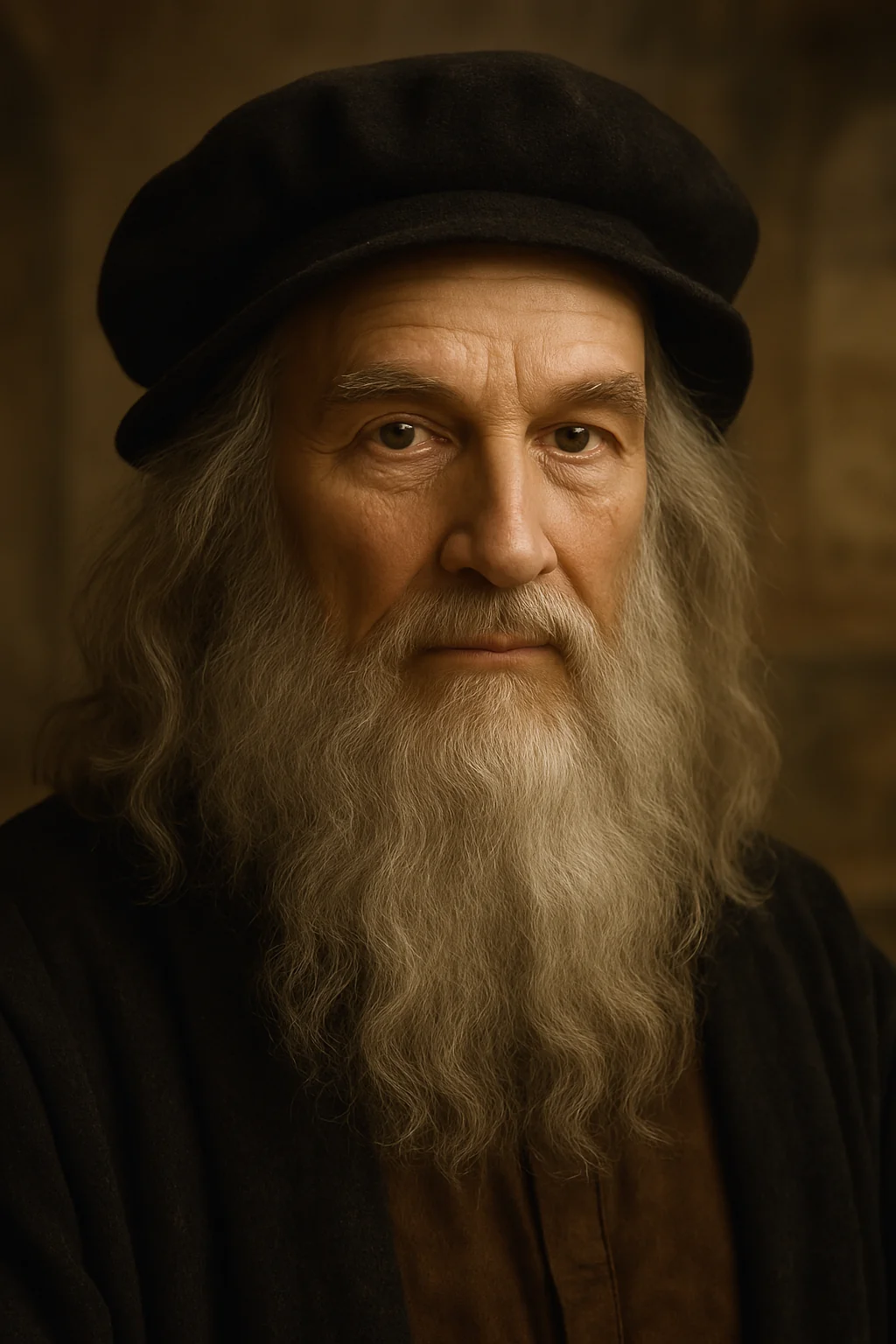
Leonardo da Vinci stands as the supreme example of the Renaissance ideal - the universal genius whose curiosity recognized no boundaries between art and science, observation and imagination. His paintings, though few in number, include the most famous works in Western art: the Mona Lisa's enigmatic smile, the Last Supper's dramatic composition. Yet painting was almost incidental to a mind that designed flying machines, anatomized human bodies, theorized about geology and optics, and filled thousands of pages with mirror-written notes that scientists still study. Leonardo represents not merely talent but a way of seeing - the conviction that everything connects to everything else, and that true understanding requires drawing what you observe.
Context & Background
Leonardo was born on April 15, 1452, in the Tuscan town of Vinci, the illegitimate son of a notary named Piero and a peasant woman named Caterina. This accident of birth freed him from expectations. He could not follow his father into the notarial profession; instead, his obvious talents led to apprenticeship with the Florentine painter and sculptor Andrea del Verrocchio.
Renaissance Florence was experiencing an extraordinary flowering of artistic and intellectual achievement. The Medici family patronized artists and scholars; Brunelleschi's dome had just crowned the cathedral; humanist scholars were recovering ancient texts. Competition among workshops drove innovation. In Verrocchio's bottega, Leonardo learned painting, sculpture, metalwork, and engineering - the diverse skills that Renaissance masters were expected to command.
Yet Florence's world of patronage, guild restrictions, and endless commissions eventually felt constraining. In 1482, Leonardo moved to Milan, seeking the court of Ludovico Sforza. His letter of application emphasized military engineering - designing bridges, weapons, and fortifications - with painting mentioned almost as an afterthought. Milan offered larger scope for his ambitions and a patron willing to fund grand projects.
The Italy of Leonardo's maturity was a patchwork of competing states - Florence, Milan, Venice, Rome, Naples - constantly at war, constantly intriguing. Artists moved between courts as circumstances changed. Leonardo would serve the Sforza, the Borgia, the French king, and finally the pope, never finding the stable support his most ambitious projects required.
Leonardo left fewer than twenty authenticated paintings, many unfinished, yet they transformed European art. The sfumato technique - soft, smoky transitions between colors - created effects of depth and atmosphere that had never been seen. The mysterious smile of the Mona Lisa, the psychological drama of the Last Supper, the dynamic compositions of his battle scenes - all demonstrated what painting could achieve.
For Leonardo, painting was not decoration but philosophy. "Painting is a science," he insisted, requiring knowledge of anatomy, optics, botany, geology, and mathematics. The painter must understand how light falls, how muscles move, how emotions register on faces. Only through such understanding could art achieve truth.
His obsessive perfectionism and restless curiosity meant that many projects remained unfinished. The Battle of Anghiari, commissioned for Florence's council hall, was abandoned; the great equestrian statue for Milan, il cavallo, never cast. Yet even his incomplete works and preparatory drawings reveal a mind working out problems that no one else had posed.
The notebooks record his visual investigations: studies of water flowing, birds flying, babies in the womb, old men's wrinkles. Drawing was thinking made visible. Where others saw finished appearances, Leonardo saw processes, mechanisms, forces at work.
Leonardo's notebooks contain designs for machines that seem prophetic: flying machines, tanks, diving equipment, self-propelled vehicles. These have made him a symbol of visionary genius, the man who anticipated the future.
The reality is more complex and more interesting. Leonardo was an engineer of his time, solving practical problems for his patrons: designing canals, fortifications, theatrical machinery. His military designs, however fantastical they appear, responded to real military needs. His flying machines built on contemporary experiments with human flight.
What distinguished Leonardo was the systematic way he approached problems. He studied birds' flight not to imitate them directly but to understand the principles of lift and air resistance. He designed by drawing - working out mechanisms on paper, visualizing how parts would move. This engineering method itself was innovative.
Many designs could not have worked. His ornithopters, powered by human muscle alone, could never generate sufficient lift. His tank would have been impractically heavy. But the impulse behind them - to understand nature's principles well enough to extend human capabilities - was genuinely scientific.
Leonardo conducted some of the most thorough anatomical investigations before the modern era, dissecting at least thirty human corpses and countless animals. His drawings of the heart, the skeleton, the muscles, and the fetus in the womb combine scientific accuracy with artistic beauty.
He understood the heart as a pump before Harvey's discovery of circulation. He grasped the mechanical principles of joints and muscles. His studies of the eye and optics contributed to understanding vision. Had he published, anatomy might have advanced by decades.
But Leonardo did not publish. His notebooks remained private, dispersed after his death, many lost, others not fully studied until the twentieth century. The mirror writing that fills them - perhaps a natural habit of a left-hander, perhaps deliberate concealment - ensured that his discoveries remained personal explorations rather than shared knowledge.
This failure to systematize and communicate represents Leonardo's greatest limitation. The scientist who sees further than others contributes fully only when he enables others to see too. Leonardo's insights, however brilliant, remained locked in his notebooks while the Scientific Revolution awaited other founders.
Leonardo cut a striking figure: tall, beautiful in his youth, dressed elegantly, keeping a workshop full of apprentices, animals, and curiosities. He was vegetarian - unusual for his time - and reportedly bought caged birds only to release them. His homosexuality, suggested by a 1476 accusation of sodomy (charges dropped), remains biographically uncertain but accepted by most scholars.
He was notoriously slow, maddening patrons with endless delays. The prior of Santa Maria delle Grazie complained to the duke that Leonardo would stare at the Last Supper for hours without painting. Leonardo replied that the greatest geniuses sometimes accomplish most when they work least - when they are mentally searching for the perfect solution.
His rivalry with Michelangelo was legendary. Twenty-three years younger, Michelangelo represented a newer, more emotionally intense style. The two apparently loathed each other. When both were commissioned to paint battle scenes for Florence's council hall, neither finished - perhaps competition paralyzed both.
Leonardo spent his final years in France, invited by Francis I, who gave him the manor house of Clos Luce near Amboise. He died there on May 2, 1519, supposedly in the king's arms - a scene that probably never happened but perfectly captures the Renaissance ideal of the artist honored by royalty. His remains were scattered during the French Revolution, a final dispersal fitting for a mind that could never be contained.
Leonardo da Vinci Quotes
As a well spent day brings happy sleep, so life well used brings happy death.
I love those who can smile in trouble, who can gather strength from distress, and grow brave by reflection. 'Tis the business of little minds to shrink, but they whose heart is firm, and whose conscience approves their conduct, will pursue their principles unto death
There are three classes of people: those who see. Those who see when they are shown. Those who do not see.
As you cannot do what you want,
One has no right to love or hate anything if one has not acquired a thorough knowledge of its nature. Great love springs from great knowledge of the beloved object, and if you know it but little you will be able to love it only a little or not at all.
You will never have a greater or lesser dominion than that over yourself...the height of a man's success is gauged by his self-mastery; the depth of his failure by his self-abandonment. ...And this law is the expression of eternal justice. He who cannot establish dominion over himself will have no dominion over others.
Why does the eye see more clearly when asleep than the imagination when awake?
life without love, is no life at all
I have offended God and mankind because my work didn't reach the quality it should have.
God sells us all things at the price of labor.
Patience serves as a protection against wrongs as clothes do against cold. For if you put on more clothes as the cold increases, it will have no power to hurt you. So in like manner you must grow in patience when you meet with great wrongs, and they will then be powerless to vex your mind.
My body will not be a tomb for other creatures.
He who does not oppose evil......commands it to be done.
Once you have tasted flight, you will forever walk the earth with your eyes turned skyward, for there you have been, and there you will always long to return.
Nothing strengthens authority so much as silence.
The painter has the Universe in his mind and hands.
I love those who can smile in trouble...
The noblest pleasure is the joy of understanding.
Nothing can be loved or hated unless it is first understood.
The smallest feline is a masterpiece.
Art is never finished, only abandoned.
Learning never exhausts the mind.
The knowledge of all things is possible
The greatest deception men suffer is from their own opinions.
I have been impressed with the urgency of doing. Knowing is not enough; we must apply. Being willing is not enough; we must do.
It is easier to resist at the beginning than at the end.
The deeper the feeling, the greater the pain
The function of muscle is to pull and not to push, except in the case of the genitals and the tongue.
I thought I was learning to live; I was only learning to die.
Art is the queen of all sciences communicating knowledge to all the generations of the world.
In rivers, the water that you touch is the last of what has passed and the first of that which comes; so with present time.
He who wishes to be rich within a day, will be hanged within a year.
To develop a complete mind: Study the science of art; Study the art of science. Learn how to see. Realize that everything connects to everything else.
The time will come when men such as I will look upon the murder of animals as they now look on the murder of men.
The artist sees what others only catch a glimpse of.
Realize that everything connects to everything else.
Make your work to be in keeping with your purpose
Time stays long enough for those who use it.
Intellectual passion drives out sensuality.
Where the spirit does not work with the hand, there is no art.
All our knowledge has its origin in our perceptions
Water is the driving force in nature.
One can have no smaller or greater mastery than mastery of oneself.
I have from an early age abjured the use of meat, and the time will come when men such as I will look upon the murder of animals as they now look upon the murder of men.
If you are alone you belong entirely to yourself. If you are accompanied by even one companion you belong only half to yourself or even less in proportion to the thoughtlessness of his conduct and if you have more than one companion you will fall more deeply into the same plight.
Principles for the Development of a Complete Mind: Study the science of art. Study the art of science. Develop your senses- especially learn how to see. Realize that everything connects to everything else.
Every now and then go away, have a little relaxation, for when you come back to your work your judgment will be surer. Go some distance away because then the work appears smaller and more of it can be taken in at a glance and a lack of harmony and proportion is more readily seen.
An average human looks without seeing, listens without hearing, touches without feeling, eats without tasting, moves without physical awareness, inhales without awareness of odour or fragrance, and talks without thinking.
A painter should begin every canvas with a wash of black, because all things in nature are dark except where exposed by the light.
Learn how to see. Realize that everything connects to everything else.
Simplicity is the ultimate sophistication.
Learning is the only thing the mind never exhausts, never fears, and never regrets.
A poet knows he has achieved perfection not when there is nothing left to add, but when there is nothing left to take away.
I awoke only to find that the rest of the world was still asleep.
once you have tasted the taste of sky, you will forever look up
Blinding ignorance does mislead us. O! Wretched mortals, open your eyes!
He who thinks little errs much…
He who possesses most must be most afraid of loss.
He who loves practice without theory is like the sailor who boards ship without a rudder and compass and never knows where he may cast.
“It had long since come to my attention that people of accomplishment rarely sat back and let things happen to them. They went out and happened to things.”
“Although nature commences with reason and ends in experience it is necessary for us to do the opposite, that is to commence with experience and from this to proceed to investigate the reason.”
“All sciences are vain and full of errors that are not born of Experience, the mother of all Knowledge.”
“Painting is poetry that is seen rather than felt, and poetry is painting that is felt rather than seen.”
“Truth at last cannot be hidden. Dissimulation is of no avail. Dissimulation is to no purpose before so great a judge. Falsehood puts on a mask. Nothing is hidden under the sun.”
“Our life is made by the death of others.”
“Obstacles cannot crush me. Every obstacle yields to stern resolve. He who is fixed to a star does not change his mind.”
“Der Augenblick ist zeitlos.”