
Mother Teresa
Quotes & Wisdom
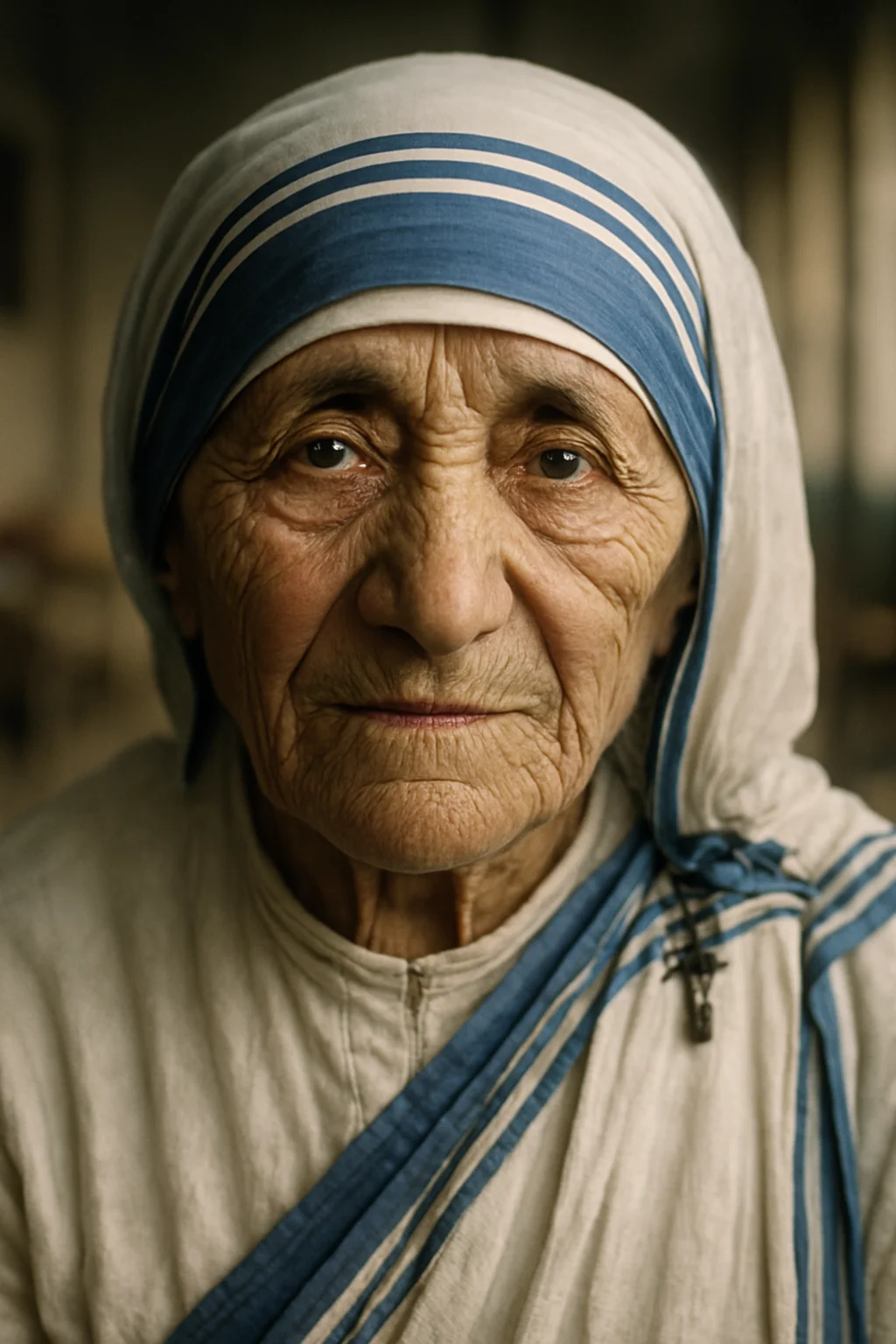
Mother Teresa became the twentieth century's most recognizable symbol of selfless service, the diminutive nun in the blue-bordered sari who lifted the dying from Calcutta's gutters. For nearly five decades, she built an organization serving the poorest of the poor across six continents, winning the Nobel Peace Prize and becoming, for many, a living saint. Yet her posthumously revealed letters exposed decades of spiritual darkness - a profound sense of God's absence that makes her public faith all the more remarkable. Whether viewed as saint, symbol, or complex human being, she embodied a challenge: that love expressed in small acts for particular people can transform the world.
Context & Background
Anjeze Gonxhe Bojaxhiu was born on August 26, 1910, in Skopje, then part of the Ottoman Empire, to an Albanian Catholic family. Her father Nikola was a successful merchant involved in Albanian nationalist politics; his sudden death when Anjeze was eight left the family struggling. Her mother Drana, deeply devout, raised her children on stories of saints and missions.
The Catholic Church of early twentieth-century Europe offered women one path to education, travel, and meaningful work outside marriage: religious life. At eighteen, Anjeze joined the Sisters of Loreto, an Irish missionary order, taking the name Teresa after Therese of Lisieux, the French saint who believed small acts of love mattered as much as grand gestures.
She was sent to India, arriving in 1929 in a Calcutta still under British rule. For nearly twenty years, she taught geography at St. Mary's High School, becoming principal and taking final vows. The comfortable convent school served middle-class Bengali girls while famine, disease, and desperate poverty surged outside its walls - a contradiction that would eventually become unbearable.
On September 10, 1946 - the "Day of Inspiration" - she experienced what she described as a call within a call: to leave the convent and serve Christ among the poorest of the poor, to live with them, to be one of them. After two years seeking permission from Church authorities, she stepped through the convent gates into Calcutta's slums wearing a cheap sari with a blue border - the dress of poor Bengali women that would become her worldwide symbol.
Teresa began alone, with five rupees and no organizational support, teaching slum children and begging for food. Her former students began joining her. In 1950, the Vatican approved the Missionaries of Charity as a new religious congregation dedicated to caring for "the hungry, the naked, the homeless, the crippled, the blind, the lepers, all those people who feel unwanted, unloved, uncared for throughout society."
The first Kalighat Home for the Dying opened in 1952, in a building adjacent to a Hindu temple. Here the destitute could die with dignity - cleaned, fed, comforted - rather than on the streets. Critics have since questioned whether the homes provided adequate medical care; defenders argue that Teresa's goal was never to cure but to ensure that no one died unloved.
The congregation grew rapidly: new houses across India, then internationally. By the 1990s, the Missionaries of Charity operated over 600 missions in 123 countries - hospitals, hospices, orphanages, schools. Mother Teresa herself traveled constantly, opening houses, visiting the sick, meeting world leaders. The small Albanian nun became a global figure, recognizable everywhere.
Her message was deceptively simple: love begins at home, expressed in small acts. "If you can't feed a hundred people, then just feed one." "Not all of us can do great things. But we can do small things with great love." These sayings became refrigerator-magnet wisdom, but she meant them literally - and lived them out through daily contact with dying bodies, leprous limbs, abandoned children.
Mother Teresa received the Nobel Peace Prize in 1979, the first humanitarian rather than political figure so honored. Her acceptance speech denounced abortion as "the greatest destroyer of peace today" - a characteristic mixing of compassion for the poor with conservative Catholic positions that frustrated admirers who wanted a more purely progressive saint.
Criticism intensified over the years. Christopher Hitchens' "The Missionary Position" (1995) accused her of glorifying suffering rather than alleviating it, of providing substandard medical care while directing donations to expanding her order, of befriending dictators and accepting money from fraudsters. The medical criticism particularly stung: visitors to her facilities reported inadequate pain management, reused needles, insufficient treatment.
Defenders responded that she never claimed to run hospitals; her mission was presence, dignity, love for those society had discarded. The money went to opening more houses, not to upgrading existing ones to first-world standards. Her friendships with the powerful - including Charles Keating and the Duvaliers of Haiti - reflected her focus on souls rather than politics and her willingness to accept donations without inquiry.
The debate about her legacy continues. Was she a saint who did immeasurable good through presence and love? Or a symbol whose reputation obscured questionable practices? Perhaps both can be true - human beings are not simple, and institutions serving the desperate inevitably face impossible tradeoffs.
After her death in 1997, her private letters were published, revealing decades of spiritual darkness that shocked many admirers. "Where is my faith?" she wrote. "Even deep down... there is nothing but emptiness and darkness... If there be God - please forgive me." For nearly fifty years, she experienced no sense of God's presence, only silence.
For some, these revelations undermined her sanctity - how could a saint doubt so profoundly? For others, they deepened it. The Christian mystical tradition recognizes "dark nights of the soul" as stages on the spiritual journey. Teresa's persistence in faith and service despite feeling nothing, her continued prayer to a seemingly absent God, represented heroic virtue rather than its absence.
Her canonization as Saint Teresa of Calcutta in 2016 recognized precisely this persistence. The Church declared that miracles occurred through her intercession; more fundamentally, it honored a life of radical service maintained through personal desolation. Her darkness became not scandal but teaching - that faith is faithfulness, not feeling.
Teresa was barely five feet tall, increasingly bent in her later years, with a face that seemed made of Calcutta's dust and sun. Her hands were rough from washing the dying; her manner was often brusque, businesslike. She had no time for sentiment when there was work to do.
Her politics were consistently pro-life in the broadest Catholic sense: opposing abortion and contraception, but also capital punishment, economic exploitation, and the arms race. She spoke against divorce at Princess Diana's wedding; she accepted the Congressional Gold Medal while condemning American foreign policy. Neither left nor right could fully claim her.
She maintained the daily schedule of a religious sister throughout her global celebrity: early morning Mass, hours of prayer, manual labor alongside her sisters. Fame was a tool for her work, not a pleasure. She refused biography, redirecting attention to Christ and the poor.
Her death on September 5, 1997, came just days after Princess Diana's, somewhat overshadowed by the younger celebrity's tragic end. The contrast captured something about modern fame and modern sanctity - the beautiful princess mourned with global hysteria, the tiny nun buried with dignified grief. Both had touched lepers; only one had spent a lifetime with them.
Mother Teresa Quotes
I must be willing to give whatever it takes to do good to others. This requires that I be willing to give until it hurts. Otherwise, there is no true love in me, and I bring injustice, not peace, to those around me.
We need to find God, and he cannot be found in noise and restlessness. God is the friend of silence. See how nature - trees, flowers, grass- grows in silence; see the stars, the moon and the sun, how they move in silence... We need silence to be able to touch souls.
Never be so busy as not to think of others.
Profound joy of the heart is like a magnet that indicates the path of life.
We must know that we have been created for greater things, not just to be a number in the world, not just to go for diplomas and degrees, this work and that work. We have been created in order to love and to be loved.
Let us not be satisfied with just giving money. Money is not enough, money can be got, but they need your hearts to love them. So, spread your love everywhere you go.
Spread love everywhere you go: first of all in your own home. Give love to your children, to your wife or husband, to a next door neighbor . . . Let no one ever come to you without leaving better and happier. Be the living expression of God's kindness; kindness in your face, kindness in your eyes, kindness in your smile, kindness in your warm greeting.
If a mother can kill her own child - what is left for me to kill you and you to kill me - there is nothing between.
I was once asked why I don't participate in anti-war demonstrations. I said that I will never do that, but as soon as you have a pro-peace rally, I'll be there.
A sacrifice to be real must cost, must hurt, and must empty ourselves. Give yourself fully to God. He will use you to accomplish great things on the condition that you believe much more in his love than in your weakness.
Be faithful in small things because it is in them that your strength lies.
Love to be real, it must cost—it must hurt—it must empty us of self.
Being unwanted, unloved, uncared for, forgotten by everybody, I think that is a much greater hunger, a much greater poverty than the person who has nothing to eat.
I feel the greatest destroyer of peace today is 'Abortion', because it is a war against the child... A direct killing of the innocent child, 'Murder' by the mother herself... And if we can accept that a mother can kill even her own child, how can we tell other people not to kill one another? How do we persuade a woman not to have an abortion? As always, we must persuade her with love... And we remind ourselves that love means to be willing to give until it hurts...
In the silence of the heart God speaks. If you face God in prayer and silence, God will speak to you. Then you will know that you are nothing. It is only when you realize your nothingness, your emptiness, that God can fill you with Himself. Souls of prayer are souls of great silence.
Spread the love of God through your life but only use words when necessary.
Pain and suffering have come into your life, but remember pain, sorrow, suffering are but the kiss of Jesus - a sign that you have come so close to Him that He can kiss you.
God made the world for the delight of human beings-- if we could see His goodness everywhere, His concern for us, His awareness of our needs: the phone call we've waited for, the ride we are offered, the letter in the mail, just the little things He does for us throughout the day. As we remember and notice His love for us, we just begin to fall in love with Him because He is so busy with us -- you just can't resist Him. I believe there's no such thing as luck in life, it's God's love, it's His.
Hungry for love, He looks at you. Thirsty for kindness, He begs of you. Naked for loyalty, He hopes in you. Homeless for shelter in your heart, He asks of you. Will you be that one to Him?
It is easy to love the people far away. It is not always easy to love those close to us. It is easier to give a cup of rice to relieve hunger than to relieve the loneliness and pain of someone unloved in our own home. Bring love into your home for this is where our love for each other must start.
In the West we have a tendency to be profit-oriented, where everything is measured according to the results and we get caught up in being more and more active to generate results. In the East -- especially in India -- I find that people are more content to just be, to just sit around under a banyan tree for half a day chatting to each other. We Westerners would probably call that wasting time. But there is value to it. Being with someone, listening wihtout a clock and without anticipation of results, teaches us about love. The success of love is in the loving -- it is not in the result of loving.
If you judge people, you have no time to love them.
Not all of us can do great things. But we can do small things with great love.
Yesterday is gone. Tomorrow has not yet come. We have only today. Let us begin.
Kind words can be short and easy to speak, but their echoes are truly endless.
The most terrible poverty is loneliness, and the feeling of being unloved.
It's not how much we give but how much love we put into giving.
I alone cannot change the world, but I can cast a stone across the waters to create many ripples.
At the end of life we will not be judged by how many diplomas we have received, how much money we have made, how many great things we have done.
God doesn't require us to succeed, he only requires that you try.
The hunger for love is much more difficult to remove than the hunger for bread.
Never travel faster than your guardian angel can fly.
Live simply so others may simply live.
We know only too well that what we are doing is nothing more than a drop in the ocean. But if the drop were not there, the ocean would be missing something.
I can do things you cannot, you can do things I cannot; together we can do great things.
It is a poverty to decide that a child must die so that you may live as you wish.
The way you help heal the world is you start with your own family.
Intense love does not measure it just gives.
Love is a fruit in season at all times and within reach of every hand.
There are many people who can do big things, but there are very few people who will do the small things.
A joyful heart is the normal result of a heart burning with love. She gives most who gives with joy.
Jesus said love one another. He didn't say love the whole world.
Loneliness and the feeling of being unwanted is the most terrible poverty.
Go out into the world today and love the people you meet. Let your presence light new light in the hearts of people.
Words which do not give the light of Christ increase the darkness.
If I look at the mass I will never act.
We do not need guns and bombs to bring peace, we need love and compassion.
When you have nothing left but God,you have more than enough to start over again.
I prefer you to make mistakes in kindness than work miracles in unkindness.
Some people come in our life as blessings. Some come in your life as lessons.
I think it is very good when people suffer. To me that is like the kiss of Jesus.
A life not lived for others is not a life.
I would rather make mistakes in kindness and compassion than work miracles in unkindness and hardness.
Let us make one point, that we meet each other with a smile, when it is difficult to smile. Smile at each other, make time for each other in your family.
Never worry about numbers. Help one person at a time and always start with the person nearest you.
May God break my heart so completely that the whole world falls in.
The person who gives with a smile is the best giver because God loves a cheerful giver.
Give, but give until it hurts.
Without patience, we will learn less in life. We will see less. We will feel less. We will hear less. Ironically, rush and more usually mean less.
When you don't have anything, then you have everything.
Prayer in action is love, love in action is service.
How can there be too many children? That is like saying there are too many flowers.
I do not pray for success, I ask for faithfulness.
Love begins by taking care of the closest ones - the ones at home.
Life is a game, play it.
Each one of them is Jesus in disguise.
Peace begins with a smile..
Do not think that love in order to be genuine has to be extraordinary. What we need is to love without getting tired. Be faithful in small things because it is in them that your strength lies.
What can you do to promote world peace? Go home and love your family.
These are the few ways we can practice humility:
The Simple Path
Prayer is not asking. Prayer is putting oneself in the hands of God, at His disposition, and listening to His voice in the depth of our hearts.
If you are humble nothing will touch you, neither praise nor disgrace, because you know what you are.
Do not wait for leaders; do it alone, person to person.
It is a kingly act to assist the fallen.
“Let us always meet each other with smile, for the smile is the beginning of love.”
“The greatest disease in the West today is not TB or leprosy; it is being unwanted, unloved, and uncared for. We can cure physical diseases with medicine, but the only cure for loneliness, despair, and hopelessness is love. There are many in the world who are dying for a piece of bread but there are many more dying for a little love. The poverty in the West is a different kind of poverty -- it is not only a poverty of loneliness but also of spirituality. There's a hunger for love, as there is a hunger for God.”
“If we have no peace, it is because we have forgotten that we belong to each other.”
“Be happy in the moment, that's enough. Each moment is all we need, not more.”
“I'm a little pencil in the hand of a writing God, who is sending a love letter to the world.”
“Prayer is the mortar that holds our house together.”
“At the heart of silence is prayer. At the heart of prayer is faith. At the heart of faith is life. At the heart of life is service.”
“In the final analysis it is between you and God, it was never between you and them anyway.”
“Love is not patronizing and charity isn't about pity, it is about love. Charity and love are the same -- with charity you give love, so don't just give money but reach out your hand instead.”
“I have found the paradox that if I love until it hurts, then there is no hurt, but only more love.”
“I used to pray that God would feed the hungry, or do this or that, but now I pray that he will guide me to do whatever I'm supposed to do, what I can do. I used to pray for answers, but now I'm praying for strength. I used to believe that prayer changes things, but now I know that prayer changes us and we change things.”
“Let no one ever come to you without leaving better and happier. Be the living expression of God's kindness: kindness in your face, kindness in your eyes, kindness in your smile.”
“Work without love is slavery.”
“I am not sure exactly what heaven will be like, but I know that when we die and it comes time for God to judge us, he will not ask, 'How many good things have you done in your life?' rather he will ask, 'How much love did you put into what you did?”