
Nelson Mandela
Quotes & Wisdom
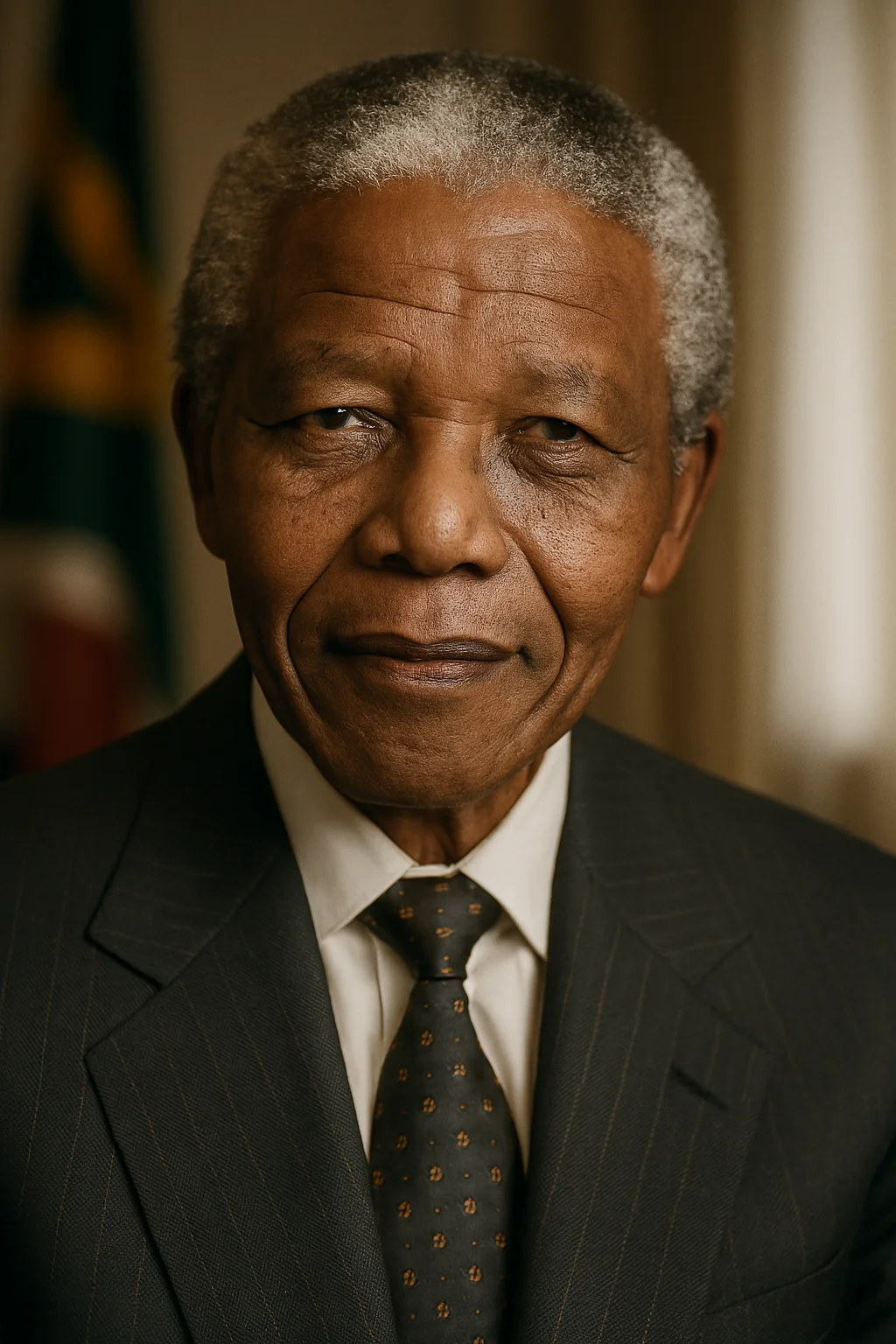
Nelson Mandela became the twentieth century's most powerful symbol of reconciliation, transforming himself from imprisoned revolutionary to beloved statesman who chose forgiveness over vengeance. For twenty-seven years, South Africa's apartheid regime held him on Robben Island and in other prisons, hoping to break his spirit; instead, confinement refined it. Upon his release in 1990, he negotiated the peaceful end of white minority rule, became South Africa's first Black president, and established the Truth and Reconciliation Commission that offered the world a new model for healing divided societies. His life demonstrated that moral authority, earned through suffering and sustained through principle, can overcome seemingly insurmountable injustice.
Context & Background
Rolihlahla Mandela was born on July 18, 1918, in the village of Mvezo in South Africa's Eastern Cape, to a chief of the Thembu people. A teacher later gave him the English name Nelson. His father died when he was nine; the acting paramount chief of the Thembu took him in and raised him for leadership.
South Africa in Mandela's youth was already a society structured by racial hierarchy. The 1913 Land Act had restricted Black ownership to a small fraction of the country. Pass laws controlled movement. But the full apparatus of apartheid - the Afrikaans word means "apartness" - came only in 1948, when the National Party won power and began systematically legislating racial separation into every aspect of life.
Mandela studied law at the University of Fort Hare and later in Johannesburg, one of very few Black South Africans with professional training. He joined the African National Congress in 1944, helping found its Youth League and pushing the organization toward more militant action. The Defiance Campaign of 1952, civil disobedience against unjust laws, brought him to national prominence and government attention.
The 1960 Sharpeville massacre, in which police killed sixty-nine peaceful protesters, convinced Mandela that nonviolent resistance alone could not defeat apartheid. He co-founded Umkhonto we Sizwe ("Spear of the Nation"), the ANC's armed wing, and traveled abroad to receive military training and support. Captured in 1962, he was sentenced to five years for leaving the country illegally and inciting strikes.
The Rivonia Trial of 1963-64 charged Mandela and other ANC leaders with sabotage and conspiracy to overthrow the government - charges that carried the death penalty. Mandela's statement from the dock, lasting over four hours, became one of history's great speeches of defiance: "I have cherished the ideal of a democratic and free society in which all persons live together in harmony... It is an ideal for which I am prepared to die."
He received life imprisonment rather than death, beginning twenty-seven years behind bars. Most were spent on Robben Island, in a cell seven feet square, breaking rocks in the quarry, permitted one visitor and one letter every six months. The regime hoped imprisonment would render him forgotten and irrelevant.
Instead, Mandela became the world's most famous political prisoner. International campaigns demanded his release; his image appeared on posters and album covers; "Free Mandela" became a global rallying cry. Within prison, he studied Afrikaans, earned a law degree by correspondence, and began the long process of understanding his enemies well enough to negotiate with them.
The transformation was internal as well as strategic. Mandela entered prison angry, committed to armed struggle, certain of his righteousness. He emerged with a capacity for empathy that extended even to his jailers. He famously invited his former prosecutor to his inauguration and befriended his Robben Island guards. This was not weakness but strength - the recognition that lasting peace required transcending victimhood.
President F.W. de Klerk, recognizing apartheid's unsustainability, unbanned the ANC and released Mandela on February 11, 1990. The world watched as he walked through the prison gates, fist raised, after more than ten thousand days of captivity.
What followed was perhaps history's most successful negotiated revolution. Mandela and de Klerk, who shared the 1993 Nobel Peace Prize, steered South Africa away from the civil war that many predicted. The Convention for a Democratic South Africa hammered out a new constitution. The 1994 elections - the first in which all South Africans could vote - produced lines stretching for miles, people waiting hours to exercise a right they had never possessed.
Mandela won overwhelmingly and became president at seventy-five. His inauguration in Pretoria, attended by dignitaries from around the world, marked apartheid's definitive end. His government faced enormous challenges: a divided society, entrenched inequality, expectations that no administration could fully meet.
The Truth and Reconciliation Commission, chaired by Archbishop Desmond Tutu, offered amnesty to those who fully confessed their crimes under apartheid. Critics argued this let perpetrators escape justice; defenders countered that it enabled a fragile democracy to survive. Mandela's approach rejected both Nuremberg-style trials and collective amnesia, seeking instead a third way through acknowledgment and conditional forgiveness.
Mandela served only one term as president, stepping down in 1999 when he might easily have remained. This voluntary relinquishment of power set an example rare in African politics and demonstrated his commitment to democratic norms over personal rule.
His final years were devoted to philanthropy and advocacy - AIDS awareness (he had lost a son to the disease), children's welfare, conflict resolution. He mediated disputes, lent his moral authority to causes, and became universally addressed as "Madiba," his clan name, a term of affection and respect.
His death on December 5, 2013, brought tributes from every corner of the world. Presidents and ordinary people alike mourned a figure who had become something more than politician - a symbol of what humanity might achieve through suffering transformed into service.
Mandela's autobiography, "Long Walk to Freedom" (1994), was largely written in secret on Robben Island, the manuscript buried in the prison garden when authorities grew suspicious. It ranks among the great prison memoirs, alongside those of Jawaharlal Nehru and Antonio Gramsci.
His personal life was marked by sacrifice and sadness. His first marriage to Evelyn Mase ended in divorce; his second, to Winnie Madikizela, produced two daughters and sustained him through imprisonment but collapsed amid her radicalization and scandals. His third marriage, to Graca Machel (widow of Mozambique's president), brought late-life happiness.
He possessed genuine charisma - tall, dignified, with a smile that could light up stadiums and a courtliness that charmed even opponents. He memorized names, remembered personal details, made each person feel significant. These were not merely political skills but expressions of a philosophy that saw every individual as worthy of respect.
His faults were real: he could be autocratic within the ANC, his economic policies disappointed many, and his reconciliation focus sometimes seemed to excuse too much. But his achievement remains: he took a country poised for bloodbath and steered it toward a democracy that, however imperfect, continues to function. In an age of cynicism about political leadership, his example suggests what becomes possible when principle and pragmatism align.
Nelson Mandela Quotes
Courage is not the absence of fear — it s inspiring others to move beyond it.
You will achieve more in this world through acts of mercy than you will through acts of retribution.
One cannot be prepared for something while secretly believing it will not happen.
We know too well that our freedom is incomplete without the freedom of the Palestinians.
Nothing is black or white.
Freedom is indivisible; the chains on any one of my people were the chains on all of them, the chains on all of my people were the chains on me.
There can be no keener revelation of a society's soul than the way in which it treats its children.
It is not where you start but how high you aim that matters for success.
Know your enemy — and learn about his favorite sport.
Your playing small does not serve the world. Who are you not to be great?
I AM THE MASTER OF MY FATE AND THE CAPTAIN OF MY DESTINY.
It is what we make out of what we have, not what we are given, that separates one person from another.
We must use time creatively, and forever realize that the time is always ripe to do right.
“Live life as though nobody is watching, and express yourself as though everyone is listening.”
“I am not an optimist, but a great believer of hope.”