
Ralph Waldo Emerson
Quotes & Wisdom
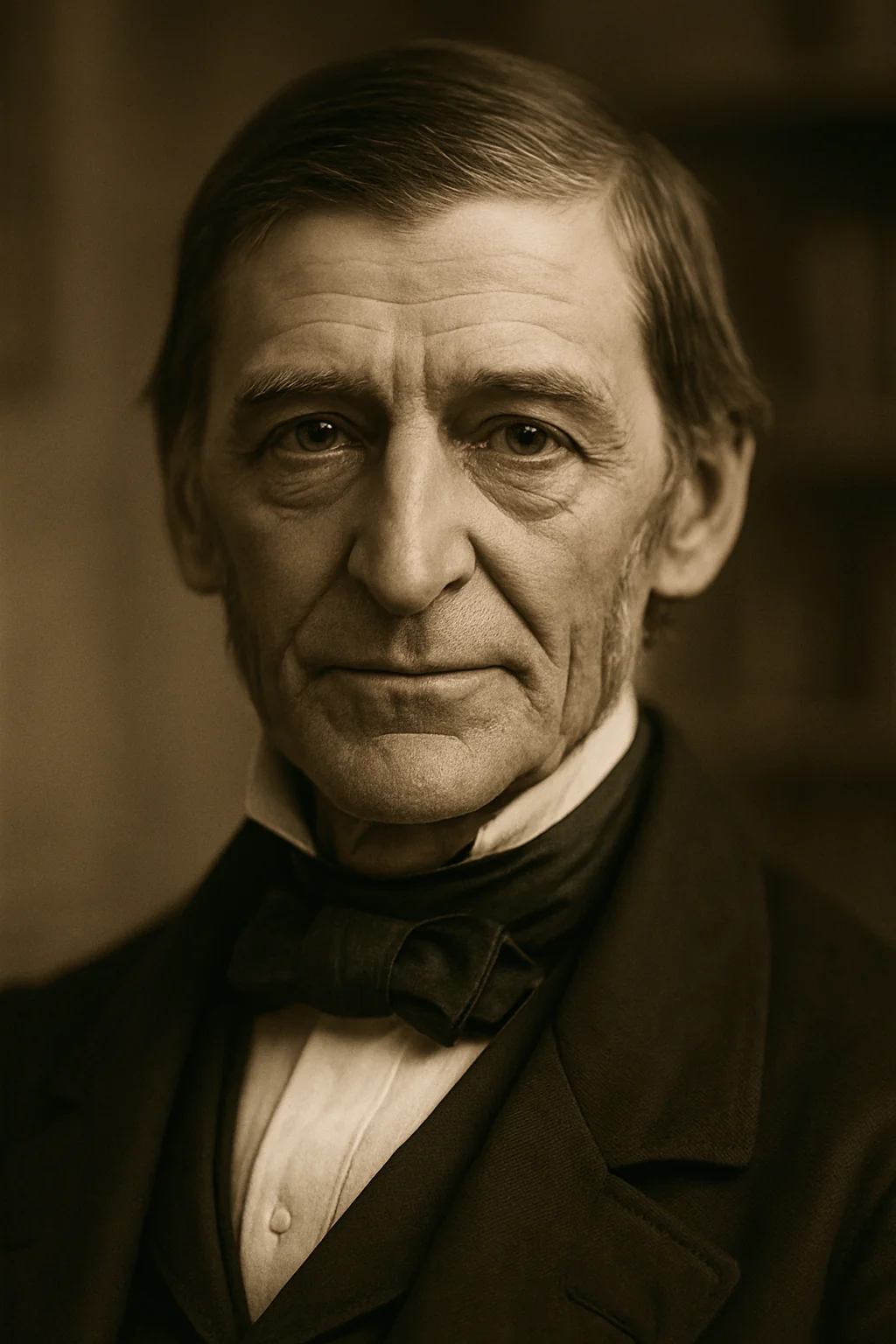
Ralph Waldo Emerson ignited a revolution in American thought by insisting that wisdom lived not in inherited doctrines but in each individual soul. The Sage of Concord, as he became known, transformed a small Massachusetts town into the intellectual capital of antebellum America, gathering around him a circle that would reshape philosophy, literature, and social reform. His essays on self-reliance, nature, and the oversoul articulated a distinctly American spirituality - democratic, optimistic, and radically individualist. Though his transcendentalism could veer toward abstraction, Emerson's best passages still strike readers with the force of personal revelation. His call to trust one's own genius continues to inspire anyone who has ever felt constrained by conformity.
Context & Background
Ralph Waldo Emerson was born on May 25, 1803, in Boston, Massachusetts, into a long line of New England ministers. His father, a Unitarian pastor, died when Ralph was eight, leaving the family in genteel poverty. His formidable aunt Mary Moody Emerson stepped in as intellectual mentor, instilling in young Waldo (as he preferred to be called) a fierce independence of mind that would define his life.
Early nineteenth-century New England was undergoing profound transformation. The stern Calvinism of the Puritans had softened into Unitarianism, which emphasized reason and human goodness over predestination and depravity. Yet even this liberalized Christianity began to feel insufficient to young seekers hungering for direct spiritual experience rather than secondhand faith.
The intellectual currents of Romanticism were filtering across the Atlantic - Samuel Taylor Coleridge, Thomas Carlyle, and German idealist philosophers challenging Enlightenment rationalism with emphasis on intuition, nature, and the individual imagination. Meanwhile, Jacksonian democracy was democratizing American politics, and reform movements were stirring against slavery, for women's rights, and toward utopian experiments. Emerson would synthesize these currents into something new.
After Harvard and a brief, troubled career as a Unitarian minister - he resigned over his refusal to administer communion - Emerson embarked on a European tour that changed everything. He met Carlyle, Coleridge, and William Wordsworth, finding kindred spirits who confirmed his intuitions about the primacy of individual insight over institutional authority.
Emerson's 1836 essay "Nature" announced Transcendentalism's arrival with a famous image: standing in the woods, he becomes "a transparent eye-ball; I am nothing; I see all; the currents of the Universal Being circulate through me." This mystical experience of unity with nature became the foundation of his philosophy.
For Emerson, nature was not merely scenery but a living symbol of spiritual truths. Every natural fact corresponded to a moral truth. The world existed as a vast poem to be read by those with eyes to see. This wasn't pantheism exactly - Emerson retained a sense of divinity transcending nature - but it democratized spiritual access. Anyone walking in woods could encounter the divine directly, without priests or scripture.
This nature mysticism had practical consequences. If divinity pervaded the natural world and every human soul, then inherited institutions - churches, governments, social conventions - had no authority beyond what individuals chose to grant them. The implications were radical.
"Self-Reliance" (1841) remains Emerson's most influential and most misunderstood essay. Its famous injunctions - "Trust thyself," "Whoso would be a man must be a nonconformist," "A foolish consistency is the hobgoblin of little minds" - have been quoted by everyone from civil rights leaders to Silicon Valley entrepreneurs.
Yet Emerson's self-reliance was not mere individualism. The self he urged readers to trust was not the petty ego but the deeper soul connected to the universal oversoul. Self-reliance meant fidelity to one's authentic perceptions against the pressure of tradition, custom, and majority opinion. It meant intellectual and spiritual independence, not selfishness.
The essay attacks conformity with prophetic fury. Emerson despised the way people suppressed their genuine insights to fit in, the way they quoted texts rather than thinking for themselves, the way they valued consistency over growth. His call to live from the inside out rather than outside in still challenges readers who recognize themselves in his critique.
Critics have noted that Emerson's optimism about human nature and individual insight could ignore the ways people deceive themselves, the value of tradition, and the need for community. Herman Melville and Nathaniel Hawthorne, his darker contemporaries, would explore what Emerson's sunny philosophy overlooked.
Emerson's Concord home became a pilgrimage site for seekers and a launching pad for American literary culture. Henry David Thoreau was his most devoted disciple, building a cabin on Emerson's land at Walden Pond to conduct his famous experiment in simple living. Margaret Fuller edited The Dial, the Transcendentalist journal, from Emerson's parlor. Bronson Alcott, Theodore Parker, and other reformers gathered regularly.
This circle pushed Emerson toward engagement with the great moral issue of his time: slavery. Initially hesitant to join the abolitionists - he distrusted their methods and worried about mob passion - the Fugitive Slave Act of 1850 radicalized him. He denounced the law requiring Northern complicity in returning escaped slaves, supported John Brown after Harpers Ferry, and celebrated the Emancipation Proclamation.
Emerson's lyceum lectures carried his ideas across America. He traveled constantly, speaking to audiences from Maine to California, becoming perhaps America's first public intellectual. His oracular style - dense with imagery, proceeding by intuitive leaps rather than logical argument - frustrated some listeners but electrified others.
Emerson's personal losses shaped his philosophy as much as his ideas did. His first wife Ellen died of tuberculosis after barely two years of marriage; he visited her grave obsessively and reportedly opened her coffin to look upon her remains a year later. His beloved son Waldo died at age five in 1842, shattering Emerson's optimism and forcing his philosophy to grapple with tragedy.
His memory began failing in his sixties, and his final years were marked by what was probably dementia. At Henry Wadsworth Longfellow's funeral, he reportedly remarked that the deceased was "a sweet, beautiful soul, but I have entirely forgotten his name." The sage who had celebrated the power of individual consciousness faced its dissolution with characteristic dignity.
Emerson's journal, kept for over fifty years, reveals a more self-doubting figure than the confident essayist. He worried about his coldness, his inability to form deep attachments, his remoteness even from his children. The transparent eyeball could see the universe but struggled with intimate connection.
He was buried in Sleepy Hollow Cemetery in Concord, near Thoreau, Hawthorne, and the Alcotts - the circle that had transformed American literature gathered together in death. His epitaph, fittingly, quotes his own work: "The passive Master lent his hand / To the vast soul that o'er him planned." Even his tombstone embodied his teaching that individual minds channel universal truths.
Ralph Waldo Emerson Quotes
“Emerson's own best insight into fame is in his essay on Character. "The most dismaying aspect of fame from the point of view of its possessor is not just that fame is generally disproportionate to actual achievement, but that the fame that we first assume to be a reward for work well done becomes instead an impossible promise of about future work. Fame casts an anticipatory chill over current efforts because it awakens expectations that can never fully be met".”
Every spirit builds itself a house; and beyond its house, a world; and beyond its world a heaven. Know then, that the world exists for you: build, therefore, your own world.
Is it so bad, then, to be misunderstood? Pythagoras was misunderstood, and Socrates, and Jesus, and Luther, and Copernicus, and Galileo, and Newton, and every pure and wise spirit that ever took flesh. To be great is to be misunderstood.
It is easy in the world to live after the world's opinion; it is easy in solitude to live after our own; but the great man is he who in the midst of the crowd keeps with perfect sweetness the independence of solitude.
Whatever you do, you need courage. Whatever course you decide upon, there is always someone to tell you that you are wrong. There are always difficulties arising that tempt you to believe your critics are right. To map out a course of action and follow it to an end requires some of the same courage that a soldier needs. Peace has its victories, but it takes brave men and women to win them.
Cultivate the habit of being grateful for every good thing that comes to you, and to give thanks continuously. And because all things have contributed to your advancement, you should include all things in your gratitude.
Scatter joy!
Do not be too timid and squeamish about your actions. All life is an experiment. The more experiments you make the better. What if they are a little coarse and you may get your coat soiled or torn? What if you do fail, and get fairly rolled in the dirt once or twice? Up again, you shall never be so afraid of a tumble.
Life is a train of moods like a string of beads; and as we pass through them they prove to be many colored lenses, which paint the world their own hue, and each shows us only what lies in its own focus.
Man is timid and apologetic; he is no longer upright; he dares not say "I think," "I am," but quotes some saint or sage. He is ashamed before the blade of grass or the blowing rose. These roses under my window make no reference to former roses or to better ones; they are for what they are; they exist with God to-day. There is no time to them. There is simply the rose; it is perfect in every moment of its existence. Before a leaf-bud has burst, its whole life acts; in the full-blown flower there is no more; in the leafless root there is no less. Its nature is satisfied, and it satisfies nature, in all moments alike. But man postpones or remembers; he does not live in the present, but with reverted eye laments the past, or, heedless of the riches that surround him, stands on tiptoe to foresee the future. He cannot be happy and strong until he too lives with nature in the present, above time.
To go into solitude, a man needs to retire as much from his chamber as from society. I am not solitary whilst I read and write, though nobody is with me. But if a man would be alone, let him look at the stars.
To believe your own thought, to believe that what is true for you in your private heart, is true for all men,—that is genius. Speak your latent conviction, and it shall be the universal sense; for the inmost in due time becomes the outmost,—and our first thought is rendered back to us by the trumpets of the Last Judgment.
A man should learn to detect and watch that gleam of light which flashes across his mind from within, more than the lustre of the firmament of bards and sages. Yet he dismisses without notice his thought, because it is his. In every work of genius we recognize our own rejected thoughts: they come back to us with a certain alienated majesty.
The lover of nature is he whose inward and outward senses are still truly adjusted to each other; who has retained the spirit of infancy even into the era of manhood. His intercourse with heaven and earth, becomes part of his daily food. In the presence of nature, a wild delight runs through the man, in spite of real sorrows...
There is a time in every man's education when he arrives at the conviction that envy is ignorance; that imitation is suicide; that he must take himself for better for worse as his portion; that though the wide universe is full of good, no kernel of nourishing corn can come to him but through his toil bestowed on that plot of ground which is given to him to till. The power which resides in him is new in nature, and none but he knows what that is which he can do, nor does he know until he has tried. Not for nothing one face, one character, one fact makes much impression on him, and another none. This sculpture in the memory is not without preéstablishcd harmony. The eye was placed where one ray should fall, that it might testify of that particular ray. We but half express ourselves, and are ashamed of that divine idea which each of us represents. It may be safely trusted as proportionate and of good issues, so it be faithfully imparted, but God will not have his work made manifest by cowards. A man is relieved and gay when he has put his heart into his work and done his best; but what he has said or done otherwise shall give hint no peace. It is a deliverance which does not deliver. In the attempt his genius deserts him; no muse befriends; no invention, no hope.
Traveling is a fool's paradise. Our first journeys discover to us the indifference of places. At home I dream that at Naples, at Rome, I can be intoxicated with beauty, and lose my sadness. I pack my trunk, embrace my friends, embark on the sea, and at last wake up in Naples, and there beside me is the stern fact, the sad self, unrelenting, identical, that I fled from. I seek the Vatican, and the palaces. I affect to be intoxicated with sights and suggestions, but I am not intoxicated. My giant goes with me wherever I go.
I pack my trunk, embrace my friends, embark on the sea and at last wake up in Naples, and there beside me is the stern fact, the sad self, unrelenting, identical, that I fled from.
Whatever course you decide upon there is always someone to tell you that you are wrong. There are always difficulties arising which tempt you to believe that your critics are right. To map out a course of action and follow it to an end requires....courage.
Be yourself; no base imitator of another, but your best self. There is something which you can do better than another. Listen to the inward voice and bravely obey that. Do the things at which you are great, not what you were never made for.
Riding a horse is not a gentle hobby, to be picked up and laid down like a game of solitaire. It is a grand passion. It seizes a person whole and once it has done so, he/she will have to accept that his life will be radically changed.
We are students of words: we are shut up in schools, and colleges, and recitation -rooms, for ten or fifteen years, and come out at last with a bag of wind, a memory of words, and do not know a thing.
Insist on yourself; never imitate. Your own gift you can present every moment with the cumulative force of a whole life's cultivation; but of the adopted talent of another you have only an extemporaneous half possession. That which each can do best, none but his Maker can teach him.
My life is not an apology, but a life. It is for itself and not for a spectacle. I much prefer that it should be of a lower strain, so it be genuine and equal, than that it should be glittering and unsteady.
In the highest civilization, the book is still the highest delight. He who has once known its satisfactions is provided with a resource against calamity.
Even in the mud and scum of things, something always, always sings.
When you were born you were crying and everyone else was smiling. Live your life so at the end, your're the one who is smiling and everyone else is crying.
Beauty without expression is boring.
Friendship, like the immortality of the soul, is too good to be believed. When friendships are real, they are not glass threads or frost work but the solidest things we know.
Whoso would be a man must be a nonconformist.
I am the lover of uncontained and immortal beauty. In the wilderness, I find something more dear and connate than in streets or villages. In the tranquil landscape, and especially in the distant line of the horizon, man beholds somewhat as beautiful as his own nature.
Enthusiasm is one of the most powerful engines of success. When you do a thing, do it with all your might. Put your whole soul into it. Stamp it with your own personality. Be active, be energetic, be enthusiastic and faithful, and you will accomplish your object. Nothing great was ever achieved without enthusiasm.
Be not the slave of your own past - plunge into the sublime seas, dive deep, and swim far, so you shall come back with new self-respect, with new power, and with an advanced experience that shall explain and overlook the old.
Don't be too timid and squeamish about your actions. All life is an experiment. The more experiments you make the better.
Our chief want is someone who will inspire us to be what we know we could be.
Let me never fall into the vulgar mistake of dreaming that I am persecuted whenever I am contradicted.
A friend is a person with whom I may be sincere. Before him I may think aloud. I am arrived at last in the presence of a man so real and equal, that I may drop even those undermost garments of dissimulation, courtesy, and second thought, which men never put off, and may deal with him with the simplicity and wholeness with which one chemical atom meets another.
A foolish consistency is the hobgoblin of little minds, adored by little statesmen and philosophers and divines. With consistency a great soul has simply nothing to do. He may as well concern himself with his shadow on the wall. Speak what you think now in hard words, and to-morrow speak what to-morrow thinks in hard words again, though it contradict every thing you said to-day. — 'Ah, so you shall be sure to be misunderstood.' — Is it so bad, then, to be misunderstood? Pythagoras was misunderstood, and Socrates, and Jesus, and Luther, and Copernicus, and Galileo, and Newton, and every pure and wise spirit that ever took flesh. To be great is to be misunderstood.
Guard well your spare moments. They are like uncut diamonds. Discard them and their value will never be known. Improve them and they will become the brightest gems in a useful life.
Every artist was first an amateur.
If the stars should appear one night in a thousand years, how would men believe and adore; and preserve for many generations the remembrance of the city of God which had been shown! But every night come out these envoys of beauty, and light the universe with their admonishing smile.
Most of the shadows of this life are caused by standing in one's own sunshine.
This is my wish for you: Comfort on difficult days, smiles when sadness intrudes, rainbows to follow the clouds, laughter to kiss your lips, sunsets to warm your heart, hugs when spirits sag, beauty for your eyes to see, friendships to brighten your being, faith so that you can believe, confidence for when you doubt, courage to know yourself, patience to accept the truth, Love to complete your life.
Few people know how to take a walk. The qualifications are endurance, plain clothes, old shoes, an eye for nature, good humor, vast curiosity, good speech, good silence and nothing too much.
The ornament of a house is the friends who frequent it.
Nature and Books belong to the eyes that see them.
Dream delivers us to dream, and there is no end to illusion. Life is like a train of moods like a string of beads, and, as we pass through them, they prove to be many-colored lenses which paint the world their own hue. . . .
Finish each day and be done with it. You have done what you could. Some blunders and absurdities no doubt crept in; forget them as soon as you can. Tomorrow is a new day. You shall begin it serenely and with too high a spirit to be encumbered with your old nonsense.
The purpose of life is not to be happy. It is to be useful, to be honorable, to be compassionate, to have it make some difference that you have lived and lived well.
The glory of friendship is not the outstretched hand, not the kindly smile, nor the joy of companionship; it is the spiritual inspiration that comes to one when you discover that someone else believes in you and is willing to trust you with a friendship.
Write it on your heart
Common sense is genius dressed in its working clothes.
Always do what you are afraid to do.
I cannot remember the books I've read any more than the meals I have eaten; even so, they have made me.
Live in the sunshine, swim the sea, drink the wild air.
What you do speaks so loudly that I cannot hear what you say.
When it is dark enough, you can see the stars.
Make your own Bible. Select and collect all the words and sentences that in all your readings have been to you like the blast of a trumpet.
All I have seen teaches me to trust the Creator for all I have not seen.
The earth laughs in flowers.
It is not the length of life, but the depth.
The only person you are destined to become is the person you decide to be.
Dare to live the life you have dreamed for yourself. Go forward and make your dreams come true.
Write it on your heart that every day is the best day in the year.
Once you make a decision, the universe conspires to make it happen.
Without ambition one starts nothing. Without work one finishes nothing. The prize will not be sent to you. You have to win it.
Life is a journey, not a destination.
If we encounter a man of rare intellect, we should ask him what books he reads.
Make the most of yourself....for that is all there is of you.
Nothing great was ever achieved without enthusiasm.
The end of the human race will be that it will eventually die of civilization.
Your actions speak so loudly, I can not hear what you are saying.
Life consists of what man is thinking about all day.
It is a happy talent to know how to play.
I dream of a better tomorrow, where chickens can cross the road and not be questioned about their motives.
Its the not the Destination, It's the journey.
Colleges hate geniuses, just as convents hate saints.
People destined to meet will do so, apparently by chance, at precisely the right moment.
If I have lost confidence in myself, I have the universe against me.
The First wealth is health.
The world belongs to the energetic.
Character is higher than intellect. A great soul will be strong to live as well as think.
Tis the good reader that makes the good book.
The religion of one age is the literary entertainment of the next.
What can we see, read, acquire, but ourselves. Take the book, my friend, and read your eyes out, you will never find there what I find.
Don't waste yourself in rejection, nor bark against the bad, but chant the beauty of the good.
We boil at different degrees.
One of the illusions of life is that the present hour is not the critical, decisive hour. Write it on your hear that every day is the best day of the year.
Every man is a divinity in disguise, a god playing the fool.
We acquire the strength we have overcome.
God will not have his work made manifest by cowards
Speak what you think today in hard words and tomorrow speak what tomorrow thinks in hard words again, though it contradict every thing you said today.
Treat a man as he is, and he will remain as he is. Treat a man as he could be, and he will become what he should be.
In every work of genius we recognize our own rejected thoughts; they come back to us with a certain alienated majesty.
There is one other reason for dressing well, namely that dogs respect it, and will not attack you in good clothes.
A child is a curly, dimpled lunatic.
The best lightning rod for your protection is your own spine.
the great man is he who in the midst of the crowd keeps with perfect sweetness the independence of solitude.
Every wall is a door.
If the stars should appear but one night every thousand years how man would marvel and adore.
I awoke this morning with devout thanksgiving for my friends, the old and the new.