
Steve Jobs
Quotes & Wisdom
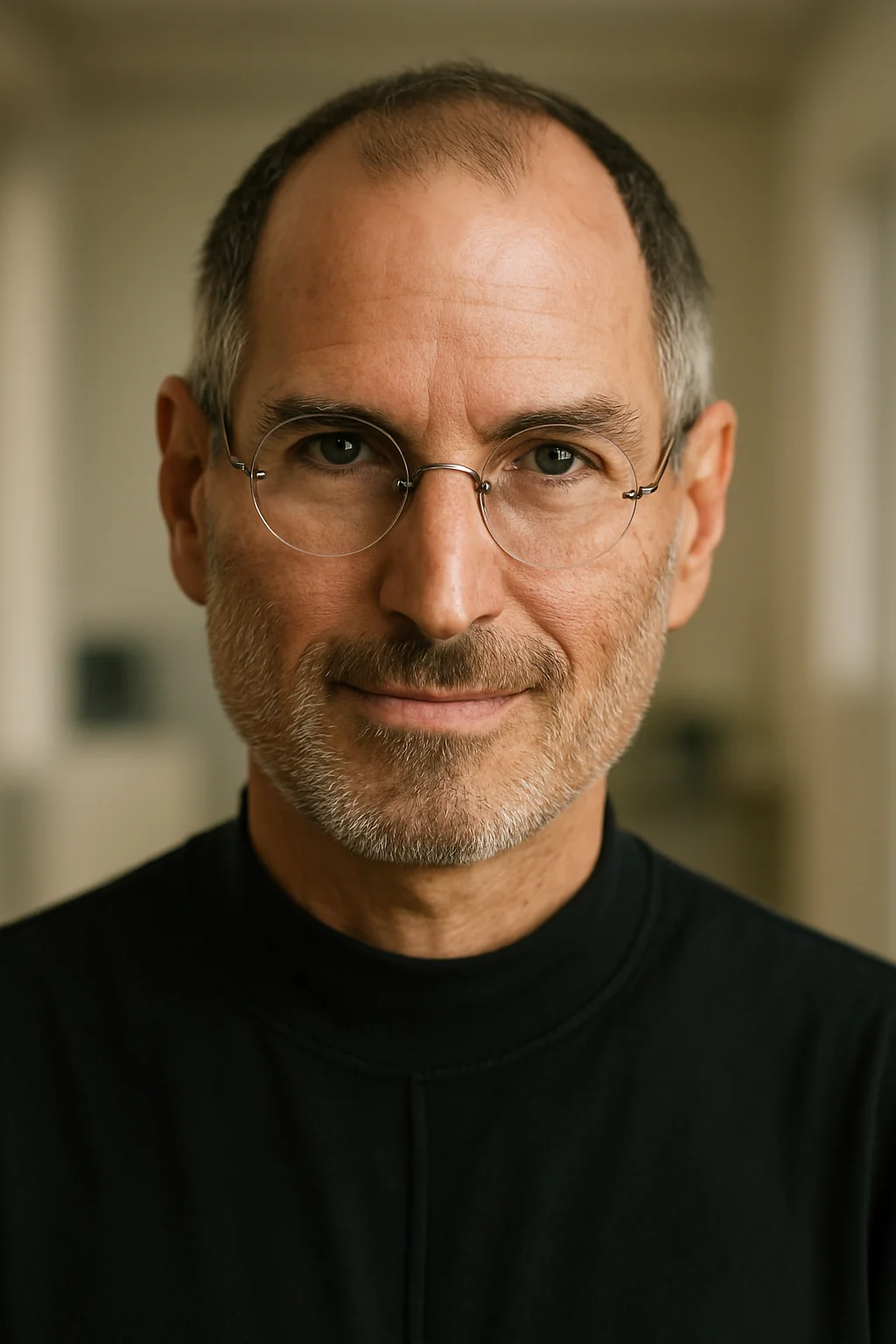
Steve Jobs remade the technology industry by insisting that computers could be beautiful, that design mattered as much as engineering, and that products should be so intuitive that manuals became unnecessary. The Apple co-founder who was fired from his own company returned to save it, launching the iMac, iPod, iPhone, and iPad - devices that transformed not just their categories but entire industries. His demanding perfectionism alienated colleagues and his reality distortion field could twist facts into whatever shape served his vision. Yet that same intensity produced objects that millions of people love with an attachment usually reserved for art. Jobs proved that technology could have a soul - even if the soul came with a difficult personality.
Context & Background
Steven Paul Jobs was born on February 24, 1955, in San Francisco, to an unmarried graduate student who gave him up for adoption. Paul and Clara Jobs, a working-class couple in Mountain View, raised him with the promise to send him to college - a promise they kept despite modest means. The biological father Jobs later met by accident was a Syrian immigrant; the sense of abandonment shaped him profoundly.
Silicon Valley in Jobs's youth was transforming from orchards to electronics. Hewlett-Packard, Fairchild Semiconductor, and Intel were inventing the components of the digital age nearby. The counterculture was equally present - psychedelics, Eastern mysticism, the Whole Earth Catalog's DIY ethos. Jobs absorbed both influences: engineering precision and hippie idealism, computing and consciousness expansion.
He attended Reed College briefly, dropped out, and audited classes (including calligraphy, which he credited for the Mac's beautiful typography). He worked at Atari, traveled to India seeking enlightenment, experimented with LSD, and in 1976 co-founded Apple Computer with Steve Wozniak in his parents' garage.
Wozniak was the engineering genius; Jobs was the visionary who understood what personal computers could mean. The Apple II became one of the first successful mass-market personal computers. Apple went public in 1980, making Jobs a multimillionaire at twenty-five. The Macintosh, launched in 1984 with a famous Super Bowl commercial, introduced the graphical user interface to consumers.
Apple's board, frustrated by Jobs's difficult management style and the Macintosh's commercial disappointments, forced him out in 1985. He later called getting fired the best thing that ever happened to him. It freed him to start over.
NeXT Computer produced beautiful machines that were commercial failures but technologically influential - the World Wide Web was developed on a NeXT. More significant was Pixar, the animation studio Jobs bought from George Lucas for $10 million. "Toy Story" (1995) launched computer animation as a viable art form and made Jobs a billionaire when Pixar went public.
Apple, meanwhile, floundered through a decade of declining market share and failed products. In 1997, the company bought NeXT for its operating system technology - and got Jobs back in the deal. He became "interim CEO," then permanent CEO, and began the most remarkable corporate turnaround in business history.
The iMac (1998) - colorful, translucent, designed by Jony Ive - announced Apple's return to form. The iPod (2001) and iTunes Store (2003) revolutionized music distribution. The iPhone (2007) created the smartphone era. The iPad (2010) proved the tablet market existed. Each product demonstrated Jobs's insistence that technology serve humanity, not the reverse.
Jobs's management style was legendary - and not in a good way. He could be cruel, manipulative, and unfair. He berated employees publicly, took credit for others' ideas, and denied paternity of his first child for years. His "reality distortion field" - the term colleagues used for his ability to convince people that the impossible was achievable - could inspire or deceive depending on circumstances.
Yet that same intensity produced results. Jobs demanded excellence obsessively. He would reject work that others considered finished, insisting on iterations until it felt right. He focused on the few things that mattered, killing projects ruthlessly. He understood that good design wasn't decoration but the way something worked.
His presentations became theatrical events. The black turtleneck, the jeans, the "one more thing" reveals - all carefully choreographed to build anticipation and desire. He was selling not just products but a vision of how technology could enhance human life. Millions of people who never met him felt they knew him through his keynotes.
The emphasis on design as competitive advantage extended throughout Apple's culture. Packaging, retail stores, advertising - everything reflected Jobs's conviction that details mattered, that the unboxing experience was part of the product, that Apple represented something beyond mere functionality.
Jobs was diagnosed with pancreatic cancer in 2003. He initially pursued alternative treatments - a decision he later regretted - before undergoing surgery and eventually a liver transplant. He kept working through illness, introducing the iPad while clearly unwell, stepping down as CEO only weeks before his death.
He died on October 5, 2011, at fifty-six. The outpouring of grief surprised those who didn't understand what Apple meant to its users. People left flowers at Apple stores worldwide. His Stanford commencement address, with its injunction to "stay hungry, stay foolish," became one of the most viewed speeches ever.
His authorized biography, published shortly after his death, presented him unvarnished - the cruelty alongside the genius, the contradictions alongside the achievements. Jobs cooperated because he wanted his children to understand him. The portrait that emerged was of a man who could be genuinely awful yet produced things genuinely wonderful.
Jobs's aesthetic sensibility derived from unexpected sources. His Buddhist practice (he considered becoming a monk) taught him about simplicity and intuition. His love of Sony design and German appliances showed him what elegant engineering looked like. His father's craftsmanship - even the backs of cabinets, invisible to users, should be done properly - instilled respect for hidden quality.
He was a pescatarian who often ate the same thing repeatedly, wore the same outfit daily to eliminate decisions, and drove without license plates (exploiting a California loophole). These quirks reflected his desire to simplify life's friction so he could focus on what mattered.
His relationship with Bill Gates combined rivalry, contempt, and mutual respect. Jobs saw Microsoft as lacking taste; Gates saw Apple as impractical. In the end, Gates visited Jobs during his final illness, and Jobs admitted that Gates had been the more effective philanthropist - though he was proud that Apple's products had improved more lives.
His legacy extends beyond products to how we think about technology's role in human life. Before Jobs, computers were for specialists; after Jobs, they were for everyone. The assumption that devices should be intuitive, that design matters, that technology companies should aspire to create art - these ideas, once radical, now seem obvious. That's the mark of a true revolutionary: making the unimaginable inevitable.
Steve Jobs Quotes
Remembering that I'll be dead soon is the most important tool I've ever encountered to help me make the big choices in life.
You can't connect the dots looking forward; you can only connect them looking backwards. So you have to trust that the dots will somehow connect in your future.
Sometimes life's going to hit you in the head with a brick. Don't lose faith. I'm convinced that the only thing that kept me going was that I loved what I did.
I have looked in the mirror every morning and asked myself: "If today were the last day of my life, would I want to do what I am about to do today?" And whenever the answer has been "No" for too many days in a row, I know I need to change something.
You have to trust in something - your gut, destiny, life, karma, whatever. This approach has never let me down, and it has made all the difference in my life.
Taking LSD was a profound experience, one of the most important things in my life. LSD shows you that there’s another side to the coin, and you can’t remember it when it wears off, but you know it. It reinforced my sense of what was important—creating great things instead of making money, putting things back into the stream of history and of human consciousness as much as I could.
People think focus means saying yes to the thing you've got to focus on. But that's not what it means at all. It means saying no to the hundred other good ideas that there are. You have to pick carefully. I'm actually as proud of the things we haven't done as the things I have done. Innovation is saying no to 1,000 things.
Here's to the crazy ones. The misfits. The rebels. The troublemakers. The round pegs in the square holes. The ones who see things differently. They're not fond of rules. And they have no respect for the status quo. You can quote them, disagree with them, glorify or vilify them. About the only thing you can't do is ignore them. Because they change things. They push the human race forward. And while some may see them as the crazy ones, we see genius. Because the people who are crazy enough to think they can change the world, are the ones who do.
Being the richest man in the cemetery doesn't matter to me. Going to bed at night saying we've done something wonderful... that's what matters to me.
Don’t let the noise of others’ opinions drown out your own inner voice."
You have to be burning with an idea, or a problem, or a wrong that you want to right. If you're not passionate enough from the start, you'll never stick it out.
Have the courage to follow your heart and intuition. They somehow already know what you truly want to become. Everything else is secondary.
Stay hungry. Stay foolish.
If you haven't found it yet, keep looking. Don't settle. As with all matters of the heart, you'll know when you find it. And, like any great relationship, it just gets better and better as the years roll on.
Why join the navy if you can be a pirate?
The heaviness of being successful was replaced by the lightness of being a beginner again.
The journey is the reward
When I was 17, I read a quote that went something like: 'If you live each day as if it was your last, someday you'll most certainly be right.' It made an impression on me, and since then, for the past 33 years, I have looked in the mirror every morning and asked myself: "If today were the last day of my life, would I want to do what I am about to do today?" And whenever the answer has been "No" for too many days in a row, I know I need to change something.
I would trade all of my technology for an afternoon with Socrates.
Creativity is just connecting things.
The only way to do great work is to love what you do. If you haven't found it yet, keep looking. Don't settle.
I've been rejected, but I am still in love.
Focusing is about saying No.
Think Different
“Your time is limited, so don't waste it living someone else's life. Don't be trapped by dogma - which is living with the results of other people's thinking. Don't let the noise of other's opinions drown out your own inner voice. And most important, have the courage to follow your heart and intuition. They somehow already know what you truly want to become. Everything else is secondary.”
“Remembering that you are going to die is the best way I know to avoid the trap of thinking you have something to lose.”
“If you live each day as it was your last, someday you'll most certainly be right”
“Simple can be harder than complex: You have to work hard to get your thinking clean to make it simple. But it’s worth it in the end because once you get there, you can move mountains.”