
William Shakespeare
Quotes & Wisdom
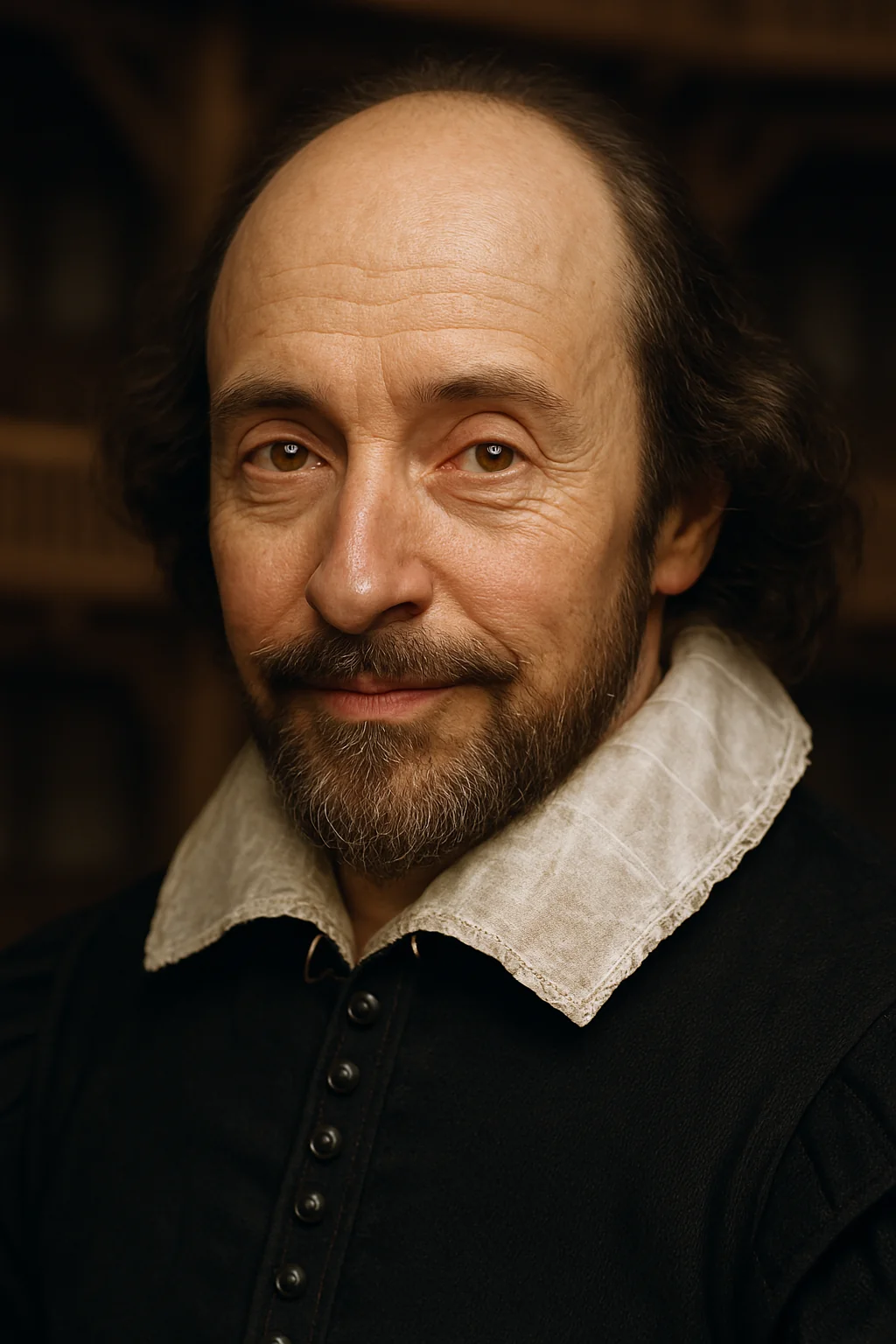
William Shakespeare: The Architect of Human Nature
In the bustling theaters of Elizabethan England, one playwright dared to capture the full spectrum of human experience with unparalleled insight and linguistic mastery. William Shakespeare, a glover's son from Stratford-upon-Avon, transcended his modest origins to become the most influential writer in the English language. Through 37 plays, 154 sonnets, and other poetic works, he crafted characters who continue to haunt our imaginations, coined phrases that still pepper our speech, and explored the timeless tensions of love, power, betrayal, and mortality. While his contemporaries wrote for their moment, Shakespeare somehow wrote for eternity, creating a body of work that remains startlingly relevant across cultures and centuries. As we journey through the world that shaped him and the legacy he created, we discover not just a literary genius, but a mirror in which humanity—with all its glory and folly—continues to recognize itself.
Context & Background
William Shakespeare entered a world poised at the threshold of modernity. Born in 1564 during the reign of Elizabeth I, he witnessed England's transformation from a relatively isolated island nation into an ambitious maritime power with expanding global aspirations. The Protestant Reformation had upended centuries of religious certainty, leaving in its wake theological debates that often turned violent. The Tudor dynasty, having emerged from the bloody Wars of the Roses, maintained a precarious stability under Elizabeth's shrewd leadership, though tensions with Catholic Spain would culminate in the failed Spanish Armada invasion of 1588 during Shakespeare's young adulthood.
The Elizabethan era pulsed with intellectual vitality. The Renaissance spirit, having crossed the Channel from Italy, kindled a new humanism that placed mankind—rather than God alone—at the center of artistic and philosophical inquiry. This period witnessed a revival of classical learning, with educated Englishmen devouring newly translated works of Ovid, Plutarch, and Seneca—texts that would later provide Shakespeare with narrative frameworks for his plays.
In Shakespeare's immediate environment, London was experiencing unprecedented growth, surpassing 200,000 inhabitants by the end of the 16th century. This teeming metropolis, with its sharp contrasts between courtly refinement and street-level squalor, offered the observant playwright a living laboratory of human behavior. The city's expanding merchant class created new audiences hungry for entertainment, fueling the explosion of commercial theater that made Shakespeare's career possible.
Theatrical traditions were rapidly evolving when Shakespeare arrived in London. The medieval mystery plays and morality tales were giving way to more sophisticated dramatic forms. University Wits like Christopher Marlowe had begun elevating theatrical language with mighty lines of blank verse. Public theaters—a revolutionary concept—were being constructed on London's outskirts, creating permanent spaces where cross-sections of society could gather to experience the same performances, albeit from different vantage points reflecting their social status.
Perhaps most crucially, Shakespeare worked during a unique window when theatrical censorship, while present, operated with relative flexibility. The Elizabethan and Jacobean stage became a space where political and social tensions could be explored through historical allegory and foreign settings. This delicate balance allowed Shakespeare to probe sensitive questions about power, legitimacy, and governance without directly challenging authority—a freedom that would diminish during later periods of stricter control.
The seeds of Shakespeare's genius found fertile soil in this environment of cultural transformation and relative artistic freedom. His humble origins and grammar school education (rather than university training) initially positioned him as an outsider to London's literary circles. Yet this liminal status—combined with his extraordinary observational powers and linguistic facility—may have enabled him to synthesize high and low cultural elements into works that resonated across the social spectrum, from groundlings to monarchs.
The geographical duality of Shakespeare's life reveals much about the man behind the masterpieces. While London provided the creative crucible for his theatrical innovations, Shakespeare maintained deep connections to Stratford-upon-Avon throughout his career—a tension between worlds that influenced both his professional choices and artistic themes.
Shakespeare's Stratford roots ran deep. Born to John Shakespeare, a glovemaker and local official whose fortunes rose and fell dramatically during William's youth, and Mary Arden, who came from a family of established landowners, young William absorbed the rhythms and social dynamics of provincial life. His grammar school education at King's New School immersed him in Latin literature and rhetoric—training that would later inform his sophisticated wordplay and classical allusions. At eighteen, he married Anne Hathaway, eight years his senior and already pregnant with their first child, Susanna. The couple later had twins, Hamnet and Judith.
The mysterious "lost years" between this early Stratford life and Shakespeare's emergence in London's theatrical scene around 1592 have spawned countless theories. Did he work as a schoolmaster? Join a traveling acting troupe? Flee poaching charges on a nobleman's estate? While evidence remains scarce, this period likely provided experiences that broadened his worldview beyond provincial boundaries.
In London, Shakespeare developed a remarkably successful dual career as actor and playwright. Initially associated with theatrical companies like Lord Strange's Men and the Lord Chamberlain's Men (later renamed the King's Men under James I's patronage), he gradually transitioned from performer to shareholder-playwright. This business acumen—often overlooked in romantic portrayals of artistic genius—enabled a financial stability unusual for writers of his era.
Yet throughout his London success, Shakespeare maintained his Stratford connections with revealing persistence. He invested substantial theatrical earnings in Stratford property, including the second-largest house in town, New Place. Tax records and legal documents suggest frequent journeys between the metropolis and his hometown. While London contemporaries like Ben Jonson embraced the identity of the professional writer—publishing carefully compiled works and cultivating literary personas—Shakespeare showed surprising indifference to the preservation of his plays in print, suggesting priorities beyond literary immortality.
This Stratford-London polarity found expression in Shakespeare's works through recurring tensions: court versus country, artifice versus authenticity, ambition versus contentment. From the forest of Arden in "As You Like It" to Prospero's renunciation of magical powers in "The Tempest," Shakespeare repeatedly explored the costs of worldly advancement and the lure of return. His final retirement to Stratford around 1613—when his commercial success would have allowed continued London prominence—suggests a man who ultimately chose the rooted identity over the cosmopolitan one.
Behind the immortal poetry and psychological insight that continue to captivate audiences lies a less celebrated aspect of Shakespeare's genius: his remarkable commercial instincts and professional adaptability. Far from the romantic image of the solitary artist, Shakespeare thrived as a theatrical entrepreneur in London's competitive entertainment market.
Shakespeare's career unfolded during a pivotal moment in theatrical history when drama was transforming from ad hoc performances into a structured industry. His decision to become a shareholder in the Lord Chamberlain's Men (later the King's Men) around 1594 proved pivotal—giving him financial stake in the company's success beyond mere playwright's fees. This arrangement created unprecedented artistic freedom, as he could write with specific actors and audiences in mind while benefiting directly from popular successes.
The construction of the Globe Theatre in 1599, in which Shakespeare held a 12.5% interest, represented both artistic and financial innovation. Situated in Southwark, just outside London's jurisdiction, the Globe's architecture reflected the social hierarchy of its audience—from affordable standing room for apprentices and laborers to cushioned galleries for merchants and occasionally visiting nobility. This broad appeal was mirrored in Shakespeare's dramaturgy, with scenes of high poetry and philosophy interspersed with bawdy jokes and action sequences.
Perhaps most telling was Shakespeare's responsiveness to changing theatrical fashions. Early in his career, he produced crowd-pleasing history plays during a surge of post-Armada patriotism. When indoor theaters like Blackfriars became fashionable among affluent audiences, Shakespeare crafted the more intimate, complex later romances suited to these spaces. While contemporaries like Thomas Kyd clung to formulas that had brought initial success, Shakespeare's willingness to reinvent his approach sustained a remarkably durable career spanning over two decades.
This pragmatic side manifested in his collaborative practices as well. Textual evidence suggests Shakespeare worked jointly with other playwrights including John Fletcher on late plays like "Henry VIII" and "The Two Noble Kinsmen"—indicating a writer concerned with productivity and theatrical effectiveness rather than solitary artistic expression. His plays bear marks of revision and adaptation for different performance contexts, showing a craftsman willing to modify his work for practical considerations.
The success of this business model was tangible. Unlike many fellow writers who died in poverty, Shakespeare accumulated significant wealth, purchased properties in both London and Stratford, secured a coat of arms for his family, and eventually retired in comfortable circumstances. This prosperity enabled his artistic achievement—providing the stability to experiment and innovate while developing the unparalleled body of work that transcended its commercial origins.
Beneath the monumental literary legacy and the sparse biographical record, glimpses of Shakespeare the man occasionally emerge—revealing complexities that defy simple characterization and remind us of the human behind the cultural icon.
Contrary to popular romanticized images, Shakespeare was notably litigious, appearing in court records for various business disputes and unpaid taxes. One particularly revealing case shows him pursuing a debt of just a few pounds—suggesting a man carefully attentive to financial matters, perhaps shaped by his father's experience with economic instability. This practical streak extended to his grain hoarding during food shortages in Stratford, an ethically ambiguous action that nonetheless protected his household interests.
His family relationships present intriguing contradictions. Despite living apart from his wife Anne for much of his professional life, Shakespeare left her his "second-best bed" in his will—a bequest often misinterpreted as an insult but potentially indicating a bed with intimate significance rather than the best guest bed. The premature death of his only son Hamnet at age eleven in 1596 coincided with Shakespeare's transition toward writing his greatest tragedies, though he never directly addressed this personal loss in his works. The absence of letters between family members—unusual for the period—has left their emotional dynamics largely speculative.
Shakespeare's professional relationships reveal a man of considerable tact and interpersonal skill. Unlike contemporaries notorious for tavern brawls and public controversies, he maintained productive relationships with theatrical colleagues for decades. Francis Meres, an early critic, described him as "most excellent among the English in both comedy and tragedy," suggesting his talent was recognized during his lifetime. Yet tellingly, no record exists of Shakespeare participating in the period's virulent literary feuds, despite operating in London's competitive literary scene.
Perhaps most revealing is Shakespeare's apparent indifference to literary immortality. Unlike Ben Jonson, who carefully oversaw the publication of his collected works, Shakespeare made no known effort to preserve his plays for posterity. Many were published in questionable "quarto" editions without his involvement, and roughly half his plays remained unpublished until the posthumous First Folio of 1623, compiled by colleagues John Heminge and Henry Condell. This seeming unconcern with his literary legacy contrasts sharply with his meticulous attention to his financial and social legacy in Stratford, suggesting a man whose self-conception might differ significantly from later cultural mythmaking.
This methodical attention to worldly concerns perhaps explains the extraordinary psychological realism in his characters. Shakespeare's powers of observation, combined with his position as both theatrical insider and social outsider, created the perfect vantage point from which to study the full spectrum of human behavior—from tavern revelry to court intrigue—that would populate his richly textured dramatic worlds.
William Shakespeare Quotes
One half of me is yours, the other half is yours,
I have no spur
The weight of this sad time we must obey,
The man that hath no music in himself, Nor is not moved with concord of sweet sounds, Is fit for treasons, stratagems, and spoils; The motions of his spirit are dull as night, And his affections dark as Erebus. Let no such man be trusted. Mark the music.
Love moderately. Long love doth so.
Villain, what hast thou done?
Thou shouldst not have been old till thou hadst been wise.
And sleep, that sometime shuts up sorrow's eye, Steal me awhile from mine own company.
Brevity is the soul of wit.
The fool doth think he is wise, but the wise man knows himself to be a fool.
Love looks not with the eyes, but with the mind; And therefore is wing'd Cupid painted blind. Nor hath love's mind of any judgment taste; Wings and no eyes figure unheedy haste: And therefore is love said to be a child, Because in choice he is so oft beguil'd.
There is nothing either good or bad, but thinking makes it so.
These violent delights have violent ends
I would not wish Any companion in the world but you, Nor can imagination form a shape, Besides yourself, to like of.
A miracle. Here's our own hands against our hearts. Come, I will have thee, but by this light I take thee for pity.
One fire burns out another's burning,
Take pains. Be perfect.
No sooner met but they looked; no sooner looked but they loved; no sooner loved but they sighed; no sooner sighed but they asked one another the reason; no sooner knew the reason but they sought the remedy; and in these degrees have they made a pair of stairs to marriage...
Angels are bright still, though the brightest fell.
turn him into stars and form a constellation in his image. His face will make the heavens so beautiful that the world will fall in love with the night and forget about the garish sun.
For sweetest things turn sourest by their deeds; Lillies that fester smell far worse than weeds.
Confusion now hath made his masterpiece.
Love's stories written in love's richest books.
Thus I die. Thus, thus, thus.
Love sought is good, but giv'n unsought is better.
To be honest, as this world goes, is to be one man picked out of ten thousand.
The quality of mercy is not strained.
Reputation is an idle and most false imposition, oft got without merit and lost without deserving. You have lost no reputation at all unless you repute yourself such a loser.
O, when she's angry, she is keen and shrewd! She was a vixen when she went to school; And though she be but little, she is fierce.
For I have sworn thee fair, and thought thee bright,
I am very proud, revengeful, ambitious, with more offences at my beck than I have thoughts to put them in, imagination to give them shape, or time to act them in. What should such fellows as I do crawling between earth and heaven? We are arrant knaves, all. Believe none of us.
This goodly frame, the earth, seems to me a sterile promontory, this most excellent canopy, the air, look you, this brave o'erhanging firmament, this majestical roof fretted with golden fire, why, it appears no other thing to me than a foul and pestilent congregation of vapours. What a piece of work is a man! how noble in reason! how infinite in faculty! in form and moving how express and admirable! in action how like an angel! in apprehension how like a god! the beauty of the world! the paragon of animals! And yet, to me, what is this quintessence of dust?
What win I, if I gain the thing I seek?
Then hate me when thou wilt; if ever, now;
And this our life, exempt from public haunt, finds tongues in trees, books in the running brooks, sermons in stones, and good in everything. I would not change it.
Eyes, look your last!
Give every man thy ear, but few thy voice; Take each man's censure, but reserve thy judgment. But not express'd in fancy; rich, not gaudy; For the apparel oft proclaims the man, And they in France of the best rank and station Are of a most select and generous chief in that.
Not that I loved Caesar less, but that I loved Rome more.
Why, what's the matter,
Suspicion always haunts the guilty mind; The thief doth fear each bush an officer.
I wish my horse had the speed of your tongue.
Why then, O brawling love! O loving hate!
All things are ready, if our mind be so.
Love is merely a madness; and, I tell you, deserves as well a dark house and a whip as madmen do; and the reason why they are not so punish'd and cured is that the lunacy is so
O sleep, O gentle sleep, Nature's soft nurse, how have I frightened thee. That thou no more will weigh my eyelids down, And steep my senses in forgetfulness?
Some are born great, some achieve greatness, and some have greatness thrust upon them. Your fate awaits you. Accept it in body and spirit. To get used to the life you'll most likely be leading soon, get rid of your low-class trappings.
If you prick us, do we not bleed? if you tickle us, do we not laugh? if you poison us, do we not die? and if you wrong us, shall we not revenge?
Better a witty fool, than a foolish wit.
Some Cupid kills with arrows, some with traps.
A coward dies a thousand times before his death, but the valiant taste of death but once. It seems to me most strange that men should fear, seeing that death, a necessary end, will come when it will come.
Men in rage strike those that wish them best.
What piece of work is a man, how noble in reason, how infinite in faculties, in form and moving, how express and admirable in action, how like an angel in apprehension, how like a god! The beauty of the world. The paragon of animals. And yet, to me, what is this quintessence of dust?
There is a tide in the affairs of men
Oh, I am fortune's fool!
There was a star danced, and under that was I born.
Love is not love which alters it when alteration finds, or bends with the remover to remove: O no! It is an ever fixed mark that looks on tempests and is never shaken; it is the star to every wandering bark whose worth's unknown, although his height be taken. Love's not Time's fool, though rosy lips and cheeks within his bending sickle's compass come: Love alters not with his brief hours and weeks, but bears it out, even to the edge of doom.
What's in a name? that which we call a rose
O teach me how I should forget to think (1.1.224)
Let me not to the marriage of true minds
Though this be madness, yet there is method in't.
Conscience doth make cowards of us all.
Out, damned spot! out, I say!—One, two; why, then ‘tis time to do’t.—Hell is murky!—Fie, my lord, fie! a soldier, and afeard? What need we fear who knows it, when none can call our power to account?—Yet who would have thought the old man to have so much blood in him? The thane of Fife had a wife; where is she now?—What, will these hands ne’er be clean?—No more o’that, my lord, no more o’that: you mar all with this starting. Here’s the smell of the blood still: all the perfumes of Arabia will not sweeten this little hand. Oh, oh, oh!
Love all, trust a few,
Be not afraid of greatness. Some are born great, some achieve greatness, and others have greatness thrust upon them.
The fault, dear Brutus, is not in our stars, but in ourselves.
Hell is empty and all the devils are here.
It is not in the stars to hold our destiny but in ourselves.
When he shall die,
We know what we are, but not what we may be.
All the world's a stage,
You speak an infinite deal of nothing.
Words are easy, like the wind; faithful friends are hard to find.
Though she be but little, she is fierce!
To be, or not to be: that is the question:
Cowards die many times before their deaths;
My tongue will tell the anger of my heart, or else my heart concealing it will break.
My bounty is as boundless as the sea,
By the pricking of my thumbs,
To-morrow, and to-morrow, and to-morrow,
The course of true love never did run smooth; But, either it was different in blood,
Lord, what fools these mortals be!
My only love sprung from my only hate!
Self-love, my liege, is not so vile a sin, as self-neglecting.
I have had a most rare vision. I have had a dream, past the wit of man to say what dream it was: man is but an ass, if he go about to expound this dream. Methought I was--there is no man can tell what. Methought I was,--and methought I had,--but man is but a patched fool, if he will offer to say what methought I had. The eye of man hath not heard, the ear of man hath not seen, man's hand is not able to taste, his tongue to conceive, nor his heart to report, what my dream was. I will get Peter Quince to write a ballad of this dream: it shall be called Bottom's Dream, because it hath no bottom...
For you, in my respect, are all the world.
Tis in ourselves that we are thus
When I bestride him, I soar, I am a hawk: he trots the air; the earth sings when he touches it; the basest horn of his hoof is more musical than the pipe of Hermes.
I say, there is no darkness
Let us not burthen our remembrance with
The Play's the Thing, wherein I'll catch the conscience of the King.
Men should be what they seem.
Now is the winter of our discontent
It’s easy for someone to joke about scars if they’ve never been cut.
The tempter or the tempted, who sins most?
O! she doth teach the torches to burn bright
True, I talk of dreams,
Men of few words are the best men."
To bait fish withal: if it will feed nothing else, it will feed my revenge. He hath disgraced me, and hindered me half a million; laughed at my losses,
Go to your bosom; Knock there, and ask your heart what it doth know.
Is love a tender thing? It is too rough, too rude, too boisterous, and it pricks like thorn.