
Winston Churchill
Quotes & Wisdom
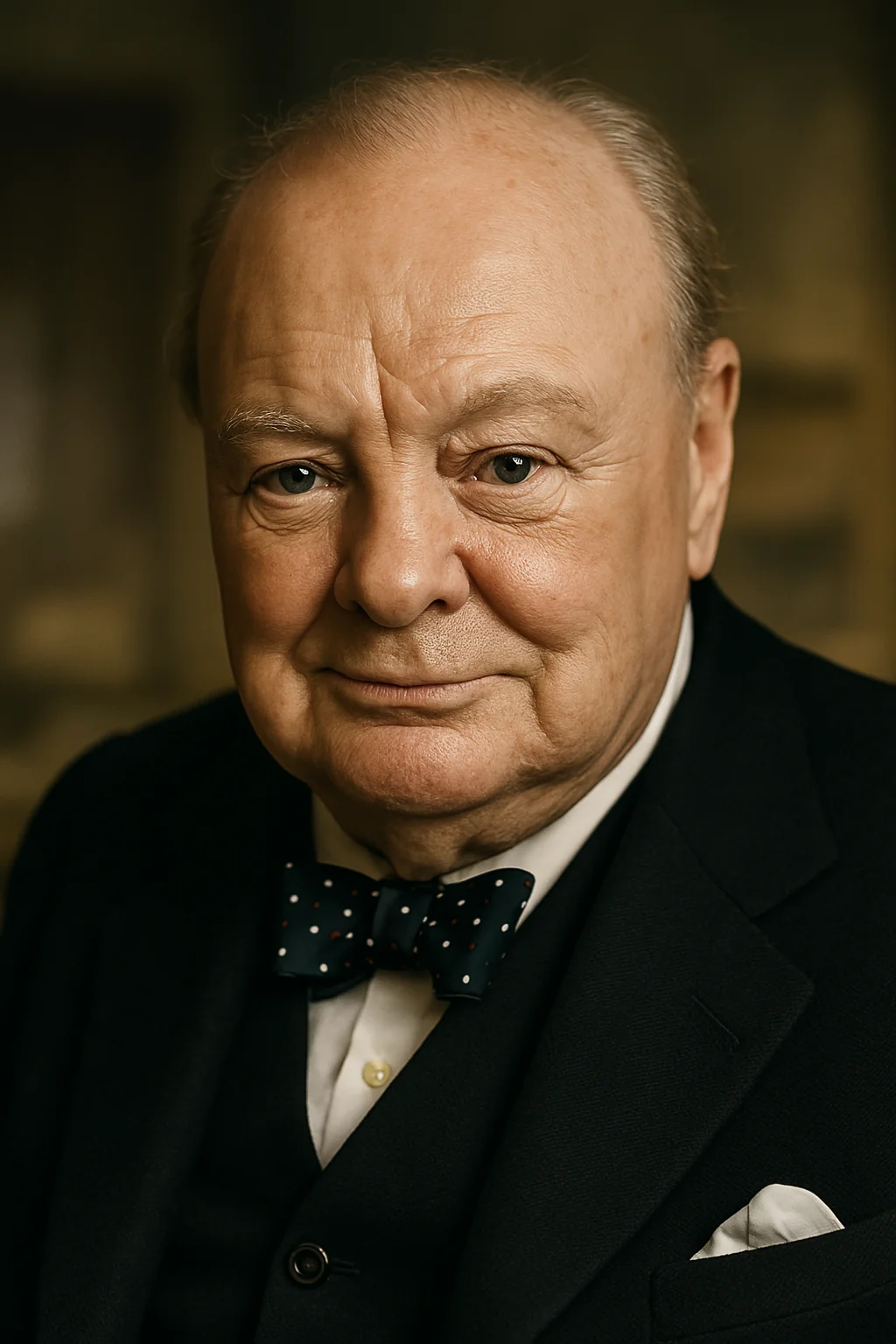
Winston Churchill: The Bulldog Statesman Who Shaped the Modern World
In the darkest hours of the 20th century, one man's defiant voice rallied a nation against the tide of tyranny. Winston Churchill—statesman, soldier, author, and orator—transformed political rhetoric into an art form that moved hearts and altered history. Rising to Prime Minister amid Britain's gravest crisis since the Spanish Armada, his leadership during World War II epitomized the intersection of personal courage and historical circumstance. Beyond his wartime heroics, Churchill's life reveals a complex tapestry of triumphs and failures, visionary insights and stubborn blindspots that span the twilight of the Victorian era through the dawn of the Cold War. A fierce defender of empire who nonetheless helped lay the groundwork for its dissolution, he embodied the profound contradictions of his changing times. Today, as we grapple with challenges to democracy and the nature of leadership, Churchill's journey offers rich insights into resilience in the face of adversity and the power of words to change the world.
Context & Background
Winston Churchill emerged in a Britain experiencing both the pinnacle of imperial power and the first tremors of its decline. Born in 1874 to aristocratic lineage (grandson of the 7th Duke of Marlborough), his formative years coincided with the late Victorian era—a period of unparalleled British global dominance, technological innovation, and rigid social hierarchies. Queen Victoria's long reign had established a particular brand of morality and imperial confidence that would shape Churchill's worldview throughout his life.
The geopolitical landscape of Churchill's youth was defined by the complex dance of European powers within the Concert of Europe system established after the Napoleonic Wars. Britain maintained its splendid isolation policy while expanding its colonial holdings across Africa and Asia through a combination of military might, economic leverage, and diplomatic maneuvering. The scramble for Africa was reaching its zenith, cementing European dominance over much of the globe. This imperial context would profoundly influence Churchill's conception of Britain's role in world affairs and his own sense of historical destiny.
Intellectually, Churchill's development occurred against the backdrop of competing currents: the rational optimism of late Enlightenment thinking, the social Darwinism that justified imperial expansion, and the growing challenges to traditional aristocratic power from both democratic and socialist movements. The works of Thomas Carlyle, with his emphasis on the decisive role of great men in history, particularly influenced Churchill's understanding of leadership and historical agency.
Militarily, Churchill came of age during a period of relative European peace but frequent colonial conflicts. His early career as a soldier-journalist in India, Sudan, and South Africa exposed him to the sharp end of imperial policy and the realities of warfare—experiences that would later inform his strategic thinking during both World Wars. The Boer War, in particular, revealed the limitations of British military power and the changing nature of modern conflict.
By the time Churchill entered Parliament in 1900, the social foundations of Victorian Britain were beginning to crack. The rise of labor movements, demands for universal suffrage, Irish Home Rule agitation, and the economic challenges posed by German and American industrial growth all signaled the approaching end of an era. Churchill's early political career straddled this transition—beginning as a Conservative before famously crossing the floor to join the Liberals in 1904 over the issue of free trade, then later serving in key positions implementing early welfare state reforms.
The catastrophe of World War I—with its unprecedented mechanized slaughter, collapse of empires, and revelation of warfare's modern horrors—marked the definitive end of the world into which Churchill had been born. His controversial role in the failed Dardanelles Campaign (1915) temporarily derailed his career but provided crucial lessons about the limits of military power and the cost of strategic miscalculation. The interwar years brought economic depression, the rise of totalitarian ideologies, and the growing obsolescence of the imperial system Churchill cherished. These developing storms would eventually thrust him into his most consequential role as wartime leader, drawing on the complex mixture of Victorian values, democratic ideals, and hard-earned wisdom that his journey through this transformative period had forged.
In May 1940, as Nazi forces swept across Western Europe and Britain faced its gravest threat since the Spanish Armada, Winston Churchill assumed the role for which history would most remember him. The circumstances could hardly have been more dire—France on the verge of surrender, British forces retreating from Dunkirk, the United States still neutral, and powerful voices within the British establishment contemplating peace negotiations with Hitler. It was against this backdrop that Churchill delivered his immortal call to resistance: "We shall fight on the beaches... we shall never surrender."
What made Churchill's leadership during this period remarkable was not merely his oratorical brilliance but the moral clarity and strategic vision it expressed. When intelligence reports and military assessments offered little cause for optimism, he transformed stubborn defiance into a coherent strategy. "Victory at all costs, victory in spite of all terror, victory however long and hard the road may be," he proclaimed, articulating a position that rejected the seemingly rational calculations of the appeasers. This stance emerged not from blind patriotism but from Churchill's deep reading of history and conviction that Nazi Germany represented a unique evil that could not be accommodated.
The months between the fall of France and the Battle of Britain revealed Churchill at his most psychologically complex. Privately acknowledging the dire situation in his correspondence, he nevertheless projected unwavering confidence in public, understanding that morale represented a crucial battlefield in modern warfare. His intimate knowledge of British capabilities—including the secret development of radar technology—informed his famous tribute to the RAF pilots: "Never in the field of human conflict was so much owed by so many to so few."
Churchill's leadership during this critical period transcended traditional political categories. His Conservative Party credentials reassured the establishment, while his defiant stance and recognition of ordinary citizens' sacrifices earned broad popular support across class lines. The formation of a truly national government under his leadership represented a remarkable achievement in a society still deeply divided by class and political affiliation.
Perhaps most significantly, Churchill's framing of Britain's isolated stand against Nazism—not as a defense of empire but as a struggle for civilization itself—helped transform the conflict's meaning both domestically and internationally. This moral clarity, combined with his tireless diplomatic efforts, proved crucial in securing American material support through Lend-Lease before the United States formally entered the war. Against the darkest of backdrops, Churchill's leadership during this period stands as a testament to how individual agency, moral courage, and strategic communication can alter the trajectory of history at its most pivotal moments.
Few aspects of Winston Churchill's legacy reveal more about the contradictions of his era than his steadfast commitment to the British Empire. Born into the Victorian aristocracy and coming of age during the empire's zenith, Churchill inherited a worldview that saw Britain's imperial project as a fundamentally civilizing mission. "I have not become the King's First Minister in order to preside over the liquidation of the British Empire," he famously declared in 1942, a statement that encapsulated both his defiance and his inability to fully grasp the transformative forces reshaping the post-war world.
Churchill's imperial vision was forged during his early experiences on the colonial frontier. As a young cavalry officer and war correspondent, he participated in the violent suppression of tribal rebellion in Sudan, culminating in the Battle of Omdurman (1898)—a decisive clash between British machine guns and Mahdist forces armed primarily with spears. His 1899 book "The River War" revealed a young man who, despite occasional notes of criticism toward excessive violence, fundamentally accepted the colonial hierarchies of his day. This formative period cemented Churchill's belief in British superiority and imperial responsibility that would remain remarkably consistent throughout his life, even as the world around him changed dramatically.
The most controversial manifestation of Churchill's imperial thinking emerged in his attitudes toward India. His vehement opposition to Indian self-government and particular animus toward Mahatma Gandhi revealed the limits of his democratic vision. "I hate Indians," he once remarked in a moment of frustration. "They are a beastly people with a beastly religion." Such statements reflected not merely personal prejudice but the broader racial hierarchies embedded in imperial thinking. During the devastating Bengal famine of 1943, Churchill's response—prioritizing wartime resource allocation over humanitarian relief—remains one of the most criticized aspects of his career.
Yet Churchill's relationship with empire contained complexities that defy simple characterization. The same man who resisted Indian independence also championed progressive policies in other colonial contexts, particularly in Africa. As Colonial Secretary in the early 1920s, he helped establish more humane policies in Kenya and supported limited forms of local governance in other territories. His conception of empire increasingly envisioned a Commonwealth of self-governing dominions rather than directly ruled territories, though this vision remained limited by the racial assumptions of his era.
Perhaps the greatest irony of Churchill's imperial stance lies in how his greatest triumph—leadership during World War II—accelerated the very imperial dissolution he opposed. The financial strains of the war, the rising tide of independence movements, and the emergence of new superpowers fundamentally undermined Britain's capacity to maintain its global position. Churchill's rhetoric about freedom and self-determination to rally resistance against Nazi tyranny inadvertently strengthened arguments for colonial liberation. The principles he so eloquently defended in Europe proved impossible to contain within geographic or racial boundaries.
In Churchill's imperial contradictions, we see reflected the broader tensions of a world in transition—between democratic ideals and imperial power, between moral principles and racialized worldviews, between the past he cherished and the future taking shape around him. These tensions make him not merely a great wartime leader but a complex historical figure whose life illuminates the profound transformations of the modern era.
Perhaps no quality better defines Winston Churchill's extraordinary career than his capacity for political resurrection. Long before he became the iconic wartime leader, Churchill had established a pattern of spectacular rises, dramatic falls, and improbable comebacks that would have ended most political careers many times over. This resilience reveals much about both his character and the turbulent era through which he navigated.
The first major setback came with the disastrous Gallipoli campaign of 1915. As First Lord of the Admiralty, Churchill bore significant responsibility for this failed attempt to knock the Ottoman Empire out of World War I—a strategic miscalculation that cost thousands of lives and earned him the bitter nickname "the Butcher of Gallipoli." Forced to resign from the government, Churchill briefly commanded a battalion on the Western Front before beginning his political rehabilitation. This pattern—major failure followed by personal reinvention—would become familiar throughout his career.
The 1920s brought further political wilderness. His controversial decision to return Britain to the gold standard as Chancellor of the Exchequer in 1925 damaged the economy and contributed to the General Strike of 1926. By 1929, Churchill found himself excluded from government, beginning what he later termed his "wilderness years." During this period of relative isolation, he focused on writing (producing his monumental biography of Marlborough and starting his history of the English-speaking peoples) while issuing increasingly urgent warnings about the rise of Nazi Germany that went largely unheeded.
What distinguished Churchill's resilience was not merely persistence but his capacity for substantive reinvention without abandoning core principles. His political journey from Conservative to Liberal and back to Conservative reflected genuine intellectual evolution rather than mere opportunism. Each setback prompted serious reflection and writing that deepened his historical understanding and strategic thinking. "Success is not final, failure is not fatal: it is the courage to continue that counts," he observed, a philosophy he embodied throughout his long career.
Perhaps most remarkably, after leading Britain through World War II, Churchill faced yet another rejection when voters ousted him in the 1945 election. Rather than retiring at age 70, he revitalized the Conservative opposition, continued writing his war memoirs (which would earn him the Nobel Prize in Literature), and delivered his influential "Iron Curtain" speech that helped define the emerging Cold War paradigm. By 1951, at an age when most politicians had long since departed the scene, he returned as Prime Minister for a final term.
Churchill's resilience drew from multiple sources: aristocratic self-confidence, a profound sense of historical destiny, psychological stubbornness, and the genuine pleasure he took in political combat. "When you're going through hell, keep going," he advised, a maxim that guided his own remarkable journey. In an age increasingly defined by specialized career paths and risk management, Churchill's capacity to embrace failure, learn from it, and emerge stronger offers a powerful counterpoint—one that explains both his historical significance and his enduring fascination for later generations.
Behind the iconic cigar, V-sign, and bulldog scowl that adorned wartime posters lay a Winston Churchill of surprising complexity and contradiction. Far from the purely stoic figure of popular imagination, Churchill struggled throughout his life with what he called his "black dog"—severe episodes of depression that could immobilize him for weeks. These dark periods, particularly acute during professional setbacks, reveal a profound vulnerability beneath his public persona of unflagging confidence. Rather than undermining his leadership, however, this personal battle with depression may have deepened his empathy for suffering and steeled his resolve during Britain's darkest hours.
Churchill's creative pursuits offer another window into his character. He produced over 500 paintings after taking up the hobby at age 40, approaching the canvas with the same intensity he brought to politics. "When I get to heaven, I mean to spend a considerable portion of my first million years in painting," he wrote. His paintings reveal sensitivity and attention to light that contradict the common perception of Churchill as merely pugnacious and domineering. This artistic side provided crucial psychological balance during political crises, offering both escape and perspective.
Perhaps most surprising was Churchill's relationship with technology and innovation. Far from a Victorian dinosaur, he demonstrated remarkable openness to new developments. During World War I, he championed the development of the tank when many military leaders remained skeptical. Later, he established Britain's first radar defense system, recognizing its strategic potential before many contemporaries. His scientific curiosity extended to personal correspondence with leading researchers of his day, revealing an intellectual agility that belied his traditional image.
In private settings, Churchill's conversational style could be exhausting—monologues delivered at machine-gun pace, jumping between topics with dizzying speed, and little tolerance for interruption. His secretary once observed that working for him was like "living with a Bengal tiger." Yet these same conversations revealed remarkable memory for detail and a capacity to shift from grand strategy to literary allusion within a single breath. "I am never satisfied until I have said what I want to say," he acknowledged, a trait that frustrated colleagues but contributed to his oratorical power.
Despite cultivating an image of bullish certainty, Churchill's private papers reveal constant revision and self-criticism. He would dictate speeches while pacing in his dressing gown, then meticulously edit transcripts, sometimes reworking a single paragraph dozens of times. This meticulous attention to language reflected his belief that "the difference between mere management and leadership is communication"—a conviction that words, properly deployed, could transform reality itself.
Winston Churchill Quotes
“How dreadful are the curses which Mohammedanism lays on its votaries! Besides the fanatical frenzy, which is as dangerous in a man as hydrophobia in a dog, there is this fearful fatalistic apathy. The effects are apparent in many countries. Improvident habits, slovenly systems of agriculture, sluggish methods of commerce, and insecurity of property exist wherever the followers of the Prophet rule or live. A degraded sensualism deprives this life of its grace and refinement; the next of its dignity and sanctity. The fact that in Mohammedan law every woman must belong to some man as his absolute property – either as a child, a wife, or a concubine – must delay the final extinction of slavery until the faith of Islam has ceased to be a great power among men. Thousands become the brave and loyal soldiers of the faith: all know how to die but the influence of the religion paralyses the social development of those who follow it. No stronger retrograde force exists in the world. Far from being moribund, Mohammedanism is a militant and proselytizing faith. It has already spread throughout Central Africa, raising fearless warriors at every step; and were it not that Christianity is sheltered in the strong arms of science, the science against which it had vainly struggled, the civilisation of modern Europe might fall, as fell the civilisation of ancient Rome.”
“...But the Mahommedan religion increases, instead of lessening, the fury of intolerance. It was originally propagated by the sword, and ever since, its votaries have been subject, above the people of all other creeds, to this form of madness. In a moment the fruits of patient toil, the prospects of material prosperity, the fear of death itself, are flung aside. The more emotional Pathans are powerless to resist. All rational considerations are forgotten. Seizing their weapons, they become Ghazis—as dangerous and as sensible as mad dogs: fit only to be treated as such. While the more generous spirits among the tribesmen become convulsed in an ecstasy of religious bloodthirstiness, poorer and more material souls derive additional impulses from the influence of others, the hopes of plunder and the joy of fighting. Thus whole nations are roused to arms. Thus the Turks repel their enemies, the Arabs of the Soudan break the British squares, and the rising on the Indian frontier spreads far and wide. In each case civilisation is confronted with militant Mahommedanism. The forces of progress clash with those of reaction. The religion of blood and war is face to face with that of peace.”
“Occasionally he stumbled over the truth, but hastily picked himself up and hurried on as if nothing had happened.”
“Men occasionally stumble over the truth, but most of them pick themselves up and hurry off as if nothing had happened.”