
Abraham Lincoln
Quotes & Wisdom
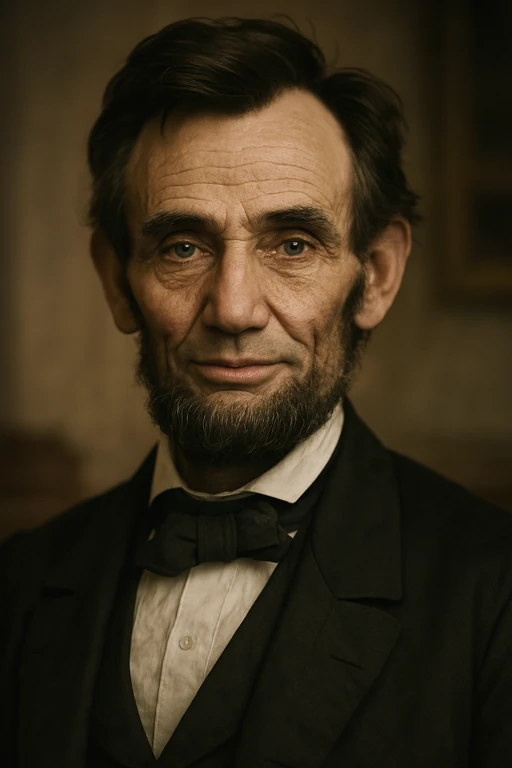
Abraham Lincoln: The Reluctant Revolutionary Who Redefined a Nation
Tall, gaunt, and perpetually solemn, Abraham Lincoln remains an enduring figure of paradoxes — a backwoods lawyer who became a constitutional visionary, a cautious pragmatist who waged a radical war for freedom. As the 16th President of the United States, he steered the country through its bloodiest conflict, preserved the Union, and redefined the very meaning of American democracy.
Emerging from the rough frontier of Kentucky and Indiana into the maelstrom of national politics, Lincoln embodied the tensions of his age: liberty and slavery, unity and division, pragmatism and idealism. His eloquence in prose, his steeliness in crisis, and his profound grasp of political nuance have secured his place not just as a historical leader, but as a timeless symbol of resilience and moral clarity.
In this profile, we journey through the world that shaped Lincoln, the crucible of war that defined him, and the seismic legacy he left behind — far beyond what even he might have imagined.
Context & Background
When Abraham Lincoln was born in 1809, the United States was still an audacious experiment. Barely three decades after the ratification of its Constitution, the young republic was already straining under regional tensions, economic growing pains, and the moral quagmire of slavery. Globally, the Enlightenment’s ideals of liberty and reason still flickered in the aftermath of the French Revolution, even as Napoleon’s shadow loomed over Europe.
In Lincoln’s formative years, the United States expanded westward under the ideal of Manifest Destiny — but expansion came at a heavy price. Native American displacement, sectional rivalries, and the brutal entrenchment of slavery in the South were ever-present realities. Industrialization was beginning to reshape Northern cities, fostering a rising middle class and new political alignments, while the rural South clung tightly to an economy — and a social order — built on enslaved labor.
Politically, the era was fractious. Andrew Jackson’s brand of populist democracy brought working-class white men into political life, but at the cost of deepening racial and class divides. Intellectual currents like transcendentalism, with figures such as Ralph Waldo Emerson, championed self-reliance and moral reform, while abolitionists like Frederick Douglass began demanding an immediate end to slavery, challenging the cautious compromises of earlier generations.
Lincoln absorbed this world with a sharp, questioning mind. Though largely self-educated, he devoured books on law, philosophy, and politics, developing a reverence for the Founding Fathers and a keen sense of moral complexity. Yet he was no radical firebrand — at least not at first. His early political career was rooted in Whig pragmatism: belief in the rule of law, gradual change, and a deep aversion to extremism. But history would soon demand more of him.
Before he became the Great Emancipator, Lincoln was simply a man trying to make a life on the margins of the American frontier. Working as a store clerk, surveyor, and eventually a self-taught lawyer, he honed a methodical intellect and a disarming sense of humor that masked deep ambition. His move to Springfield, Illinois, marked the beginning of a political ascent rooted in steady persistence rather than meteoric flashes.
Lincoln’s early years in politics were shaped by the crumbling of the Whig Party and the explosive debates over the expansion of slavery. The passage of the Kansas-Nebraska Act in 1854, which effectively repealed the Missouri Compromise, galvanized him. He emerged from semi-retirement to deliver some of his most powerful early speeches, warning that slavery’s spread would ultimately poison the moral core of the nation.
Yet even as he condemned slavery, Lincoln’s approach was measured. He sought not immediate abolition everywhere but containment, believing that if slavery was prevented from spreading, it would eventually die out. This nuanced position allowed him to bridge a fragile coalition of conservatives and progressives — a political balancing act that would become crucial when the stakes grew infinitely higher.
The Civil War was not the war Lincoln wanted, but once it began, it became the making of him. Initially focused narrowly on preserving the Union, Lincoln soon recognized that the nation's original sin — slavery — lay at the heart of the conflict. His transformation from cautious reformer to bold emancipator was gradual but inexorable.
Facing criticism from every quarter — radicals who thought him too slow, conservatives who thought him too extreme — Lincoln navigated with a mixture of political dexterity and growing moral clarity. His issuance of the Emancipation Proclamation in 1863 fundamentally reframed the war’s purpose, tying the Union cause to the fate of human freedom itself.
Privately burdened and publicly resolute, Lincoln oversaw an unprecedented mobilization of national resources, pioneered new uses of executive power, and sustained a faltering public will through his words. The Gettysburg Address, delivered in under three minutes, distilled the agony and hope of the entire American experiment into unforgettable prose.
Lincoln’s stewardship during these harrowing years revealed a capacity for strategic patience and moral boldness rarely matched in history. By the time of his second inaugural address, he had come to see the war as divine punishment for the collective sin of slavery, calling for "malice toward none" and "charity for all" in the hope of binding the nation's wounds.
On April 14, 1865, mere days after Confederate surrender at Appomattox, Abraham Lincoln was assassinated by John Wilkes Booth. His death turned him instantly into a national martyr — the embodiment of the sacrifices necessary to preserve the American ideal.
Yet Lincoln’s legacy was not automatically secured. Reconstruction would prove an uneven, tragic sequel to his vision, and debates over federal power, racial justice, and the meaning of equality continue to echo through American history. What makes Lincoln unique among great leaders is the elasticity of his example: invoked by civil rights activists like Martin Luther King Jr., studied by scholars across the political spectrum, admired for both his pragmatism and his moral vision.
In his lifetime, Lincoln was seen as cautious, sometimes maddeningly deliberate. In death, he became a symbol not of perfection, but of striving — an enduring reminder that democracy is both fragile and unfinished, requiring continual renewal.
Beneath the solemn portraits and marble memorials, Lincoln was a man of surprising complexity. His famously awkward appearance — tall, lanky, often clad in ill-fitting clothes — concealed a fierce competitive streak and a keen strategic mind. Friends noted his gift for telling humorous, sometimes ribald stories to defuse tension, a tactic he used masterfully in the White House to lighten the unbearable burdens of wartime leadership.
Lincoln also struggled privately with melancholy, what modern observers might diagnose as clinical depression. His profound empathy, evident in his political ideals, was mirrored by a deeply personal sorrowfulness that he carried like a permanent shadow. Far from hindering him, this internal battle seemed to deepen his capacity for compassion and resilience.
A lesser-known but telling detail: Lincoln was an enthusiastic amateur wrestler in his youth, once boasting that he could "throw down any man in Sangamon County." This physical and mental toughness — coupled with intellectual humility — became crucial assets during the Civil War.
Ultimately, Lincoln’s greatness lay not in being flawless, but in his relentless pursuit of a more perfect Union, even when the odds — and his own doubts — loomed large.
Abraham Lincoln Quotes
In this sad world of ours, sorrow comes to all; and, to the young, it comes with bitterest agony, because it takes them unawares. The older have learned to ever expect it. I am anxious to afford some alleviation of your present distress. Perfect relief is not possible, except with time. You can not now realize that you will ever feel better. Is not this so? And yet it is a mistake. You are sure to be happy again. To know this, which is certainly true, will make you some less miserable now. I have had experience enough to know what I say; and you need only to believe it, to feel better at once.
All that I am or ever hope to be, I owe to my angel mother.
I have been driven many times upon my knees by the overwhelming conviction that I had no where else to go. My own wisdom and that of all about me seemed insufficient for that day.
We are not enemies, but friends. We must not be enemies. Though passion may have strained, it must not break our bonds of affection. The mystic chords of memory will swell when again touched, as surely they will be, by the better angels of our nature.
The dogmas of the quiet past are inadequate to the stormy present. The occasion is piled high with difficulty and we must rise with the occasion. As our case is new, we must think anew and act anew. We must disenthrall ourselves, and then we shall save our country.
Our safety, our liberty, depends upon preserving the Constitution of the United States as our fathers made it inviolate. The people of the United States are the rightful masters of both Congress and the courts, not to overthrow the Constitution, but to overthrow the men who pervert the Constitution.
My father taught me to work; he did not teach me to love it.
Give me six hours to chop down a tree and I will spend the first four sharpening the axe.
Elections belong to the people. It's their decision. If they decide to turn their back on the fire and burn their behinds, then they will just have to sit on their blisters.
You cannot escape the responsibility of tomorrow by evading it today.
The better part of one's life consists of his friendships.
From whence shall we expect the approach of danger? Shall some trans-Atlantic military giant step the earth and crush us at a blow? Never. All the armies of Europe and Asia...could not by force take a drink from the Ohio River or make a track on the Blue Ridge in the trial of a thousand years. No, if destruction be our lot we must ourselves be its author and finisher. As a nation of free men we will live forever or die by suicide.
Be with a leader when he is right, stay with him when he is still right, but, leave him when he is wrong.
Fourscore and seven years ago our fathers brought forth on this continent, a new nation, conceived in Liberty, and dedicated to the proposition that all men are created equal.
I am a firm believer in the people. If given the truth, they can be depended upon to meet any national crisis. The great point is to bring them the real facts, and beer.
As a nation, we began by declaring that 'all men are created equal.' We now practically read it 'all men are created equal, except negroes.' When the Know-Nothings get control, it will read 'all men are created equal, except negroes, and foreigners, and Catholics.' When it comes to this I should prefer emigrating to some country where they make no pretense of loving liberty – to Russia, for instance, where despotism can be taken pure, and without the base alloy of hypocrisy.
It is difficult to make a man miserable while he feels worthy of himself and claims kindred to the great God who made him.
A house divided against itself cannot stand." I believe this government cannot endure, permanently half slave and half free. I do not expect the Union to be dissolved — I do not expect the house to fall — but I do expect it will cease to be divided. It will become all one thing or all the other.
You can have anything you want if you want it badly enough. You can be anything you want to be, do anything you set out to accomplish if you hold to that desire with singleness of purpose.
Four score and seven years ago our fathers brought forth on this continent a new nation, conceived in liberty and dedicated to the proposition that all men are created equal.
Hypocrite: The man who murdered his parents, and then pleaded for mercy on the grounds that he was an orphan.
Honor to the soldier and sailor everywhere, who bravely bears his country's cause. Honor, also, to the citizen who cares for his brother in the field and serves, as he best can, the same cause.
With malice toward none, with charity for all, with firmness in the right as God gives us to see the right, let us strive on to finish the work we are in, to bind up the nation's wounds, to care for him who shall have borne the battle and for his widow and his orphan, to do all which may achieve and cherish a just and lasting peace among ourselves and with all nations.
Get books, sit yourself down anywhere, and go to reading them yourself.
It is said an Eastern monarch once charged his wise men to invent him a sentence to be ever in view, and which should be true and appropriate in all times and situations. They presented him the words, "And this too, shall pass away." How much it expresses! How chastening in the hour of pride! How consoling in the depths of affliction!
Character is like a tree and reputation its shadow. The shadow is what we think it is and the tree is the real thing.
The best way to predict your future is to create it.
I laugh because I must not cry, that is all, that is all.
At this second appearing to take the oath of the Presidential office there is less occasion for an extended address than there was at the first. Then a statement somewhat in detail of a course to be pursued seemed fitting and proper. Now, at the expiration of four years, during which public declarations have been constantly called forth on every point and phase of the great contest which still absorbs the attention and engrosses the energies of the nation, little that is new could be presented. The progress of our arms, upon which all else chiefly depends, is as well known to the public as to myself, and it is, I trust, reasonably satisfactory and encouraging to all. With high hope for the future, no prediction in regard to it is ventured.
Those who write clearly have readers, those who write obscurely have commentators.
Let no feeling of discouragement prey
Determine that the thing can and shall be done and then... find the way.
Tact: the ability to describe others as they see themselves.
I have always found that mercy bears richer fruits than strict justice.
The best thing about the future is that it comes one day at a time.
My father taught me to work, but not to love it. I never did like to work, and I don't deny it. I'd rather read, tell stories, crack jokes, talk, laugh -- anything but work.
If you once forfeit the confidence of your fellow citizens, you can never regain their respect and esteem. It is true that you may fool all of the people some of the time; you can even fool some of the people all of the time; but you can't fool all of the people all of the time. -Speech at Clinton, Illinois, September 8, 1854.
Things may come to those who wait, but only the things left by those who hustle.
I care not for a man's religion whose dog and cat are not the better for it.
Every man's happiness is his own responsibility.
I am in favor of animal rights as well as human rights. That is the way of a whole human being.
I do not think much of a man who is not wiser today than he was yesterday.
It's not me who can't keep a secret. It's the people I tell that can't.
I don't know who my grandfather was; I am much more concerned to know what his grandson will be.
Achievement has no color
You have to do your own growing no matter how tall your grandfather was.
It has been my experience that folks who have no vices have very few virtues.
You cannot help people permanently by doing for them, what they could and should do for themselves.
You can tell the greatness of a man by what makes him angry
If this is coffee, please bring me some tea; but if this is tea, please bring me some coffee.
When I get ready to talk to people, I spend two thirds of the time thinking what they want to hear and one third thinking about what I want to say.
I do the very best I know how, the very best I can, and I mean to keep on doing so until the end.
No matter how much the cats fight, there always seem to be plenty of kittens.
We should be too big to take offense and too noble to give it.
I am not concerned that you have fallen -- I am concerned that you arise.
The Bible is not my book nor Christianity my profession. I could never give assent to the long, complicated statements of Christian dogma.
If there is anything that links the human to the divine, it is the courage to stand by a principle when everybody else rejects it.
The ballot is stronger than the bullet.
The greatest fine art of the future will be the making of a comfortable living from a small piece of land.
As I would not be a slave, so I would not be a master. This expresses my idea of democracy.
My great concern is not whether you have failed, but whether you are content with your failure.
Don’t criticize them; they are just what we would be under similar circumstances.
Die when I may, I want it said of me by those who knew me best, that I always plucked a thistle and planted a flower where I thought a flower would grow.
If this country is ever demoralized, it will come from trying to live without work.
Stand with anyone that is right; stand with him while he is right and part with him when he goes wrong.
You cannot build character and courage by taking away people's initiative and independence
Folks are usually about as happy as they make their minds up to be.
My Best Friend is a person who will give me a book I have not read.
My concern is not whether God is on our side; my greatest concern is to be on God's side, for God is always right.
Whatever you are, be a good one.
Do I not destroy my enemies when I make them my friends?
America will never be destroyed from the outside. If we falter and lose our freedoms, it will be because we destroyed ourselves.
Those who deny freedom to others, deserve it not for themselves
I am a slow walker, but I never walk back.
Those who look for the bad in people will surely find it.
When you reach the end of your rope, tie a knot and hang on.
Books serve to show a man that those original thoughts of his aren't very new after all.
Whenever I hear anyone arguing for slavery, I feel a strong impulse to see it tried on him personally.
I don't like that man. I must get to know him better.
You can fool some of the people all of the time, and all of the people some of the time, but you can not fool all of the people all of the time.
I'm a success today because I had a friend who believed in me and I didn't have the heart to let him down.
There are no bad pictures; that's just how your face looks sometimes.
I am not bound to win, but I am bound to be true. I am not bound to
When I do good, I feel good. When I do bad, I feel bad. That's my religion.
I can see how it might be possible for a man to look down upon the earth and be an atheist, but I cannot conceive how a man could look up into the heavens and say there is no God.
I would rather be a little nobody, then to be a evil somebody.
Be sure you put your feet in the right place, then stand firm.
No man is poor who has a Godly mother.
If I were two-faced, would I be wearing this one?
I will prepare and some day my chance will come.
All I have learned, I learned from books.
“I'm a success today because I had a friend who believed in me and I didn't have the heart to let him down.”
“That some achieve great success, is proof to all that others can achieve it as well.”
“Writing, the art of communicating thoughts to the mind through the eye, is the great invention of the world...enabling us to converse with the dead, the absent, and the unborn, at all distances of time and space.”
“Always bear in mind that your own resolution to succeed is more important than any one thing.”
“I have come to the conclusion never again to think of marrying, and for this reason, I can never be satisfied with anyone who would be blockhead enough to have me.”
“I can see how it might be possible for a man to look down upon the earth and be an atheist, but I cannot conceive how a man could look up into the heavens and say there is no God.”
“this too shall pass”
“Folks are usually about as happy as they make their minds up to be.”
“Take all that you can of this book upon reason, and the balance on faith, and you will live and die a happier man. (When a skeptic expressed surprise to see him reading a Bible)”