
Plato
Quotes & Wisdom
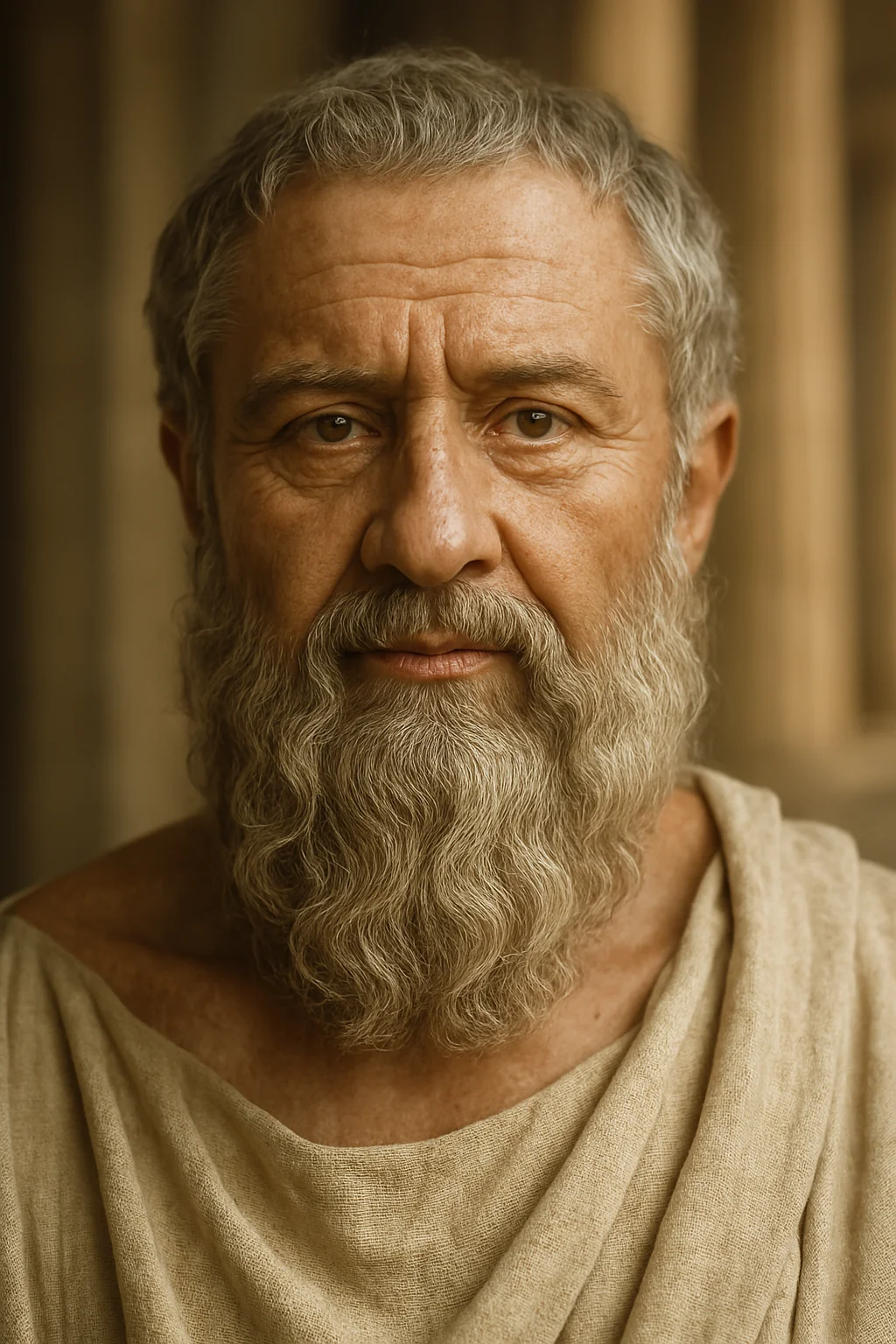
Plato stands as Western philosophy's fountainhead, the thinker whose questions still frame how we argue about reality, knowledge, ethics, and politics twenty-four centuries later. Student of Socrates and teacher of Aristotle, he transformed Athenian street-corner debates into systematic inquiry, founding the Academy - history's first university - and producing dialogues that remain models of philosophical argument. His Theory of Forms proposed that the visible world shadows a higher reality of perfect, eternal truths. His "Republic" imagined a just society ruled by philosopher-kings. Whether one agrees or violently dissents, engaging with Plato is where serious thinking about almost anything begins.
Context & Background
Plato was born around 428 BCE into one of Athens' most distinguished families, during the long shadow of the Peloponnesian War. His aristocratic lineage connected him to both the city's democratic reformers and its oligarchic reactionaries - a tension that would shape his political thought. His given name was Aristocles; "Plato" (meaning "broad") was apparently a nickname, possibly referring to his physical build or the breadth of his style.
Athens in Plato's youth had achieved unprecedented cultural heights - the architecture of the Acropolis, the tragedies of Sophocles, the democratic experiments that let citizens govern themselves. But the catastrophic war with Sparta was draining Athenian resources and confidence. The famous plague killed Pericles and thousands more. Democracy's critics blamed popular rule for military disasters and moral decline.
The event that transformed young Plato was the trial and execution of Socrates in 399 BCE. His mentor, convicted of impiety and corrupting the youth, chose death over exile, drinking hemlock while disciples wept. Plato was apparently absent due to illness, but the execution of the man he considered "the wisest and most just" crystallized his conviction that Athenian politics was fundamentally corrupt.
After Socrates' death, Plato traveled - to Megara, possibly Egypt, certainly to Syracuse in Sicily, where his attempts to create a philosopher-king ended disastrously. Around 387 BCE, he returned to Athens and founded the Academy in a grove sacred to the hero Academus. This school would operate for over nine hundred years, making it the longest-lasting educational institution in Western history.
Plato's Theory of Forms addresses a puzzle that still haunts philosophy: how can particular things share common properties? Every horse differs from every other horse, yet we recognize them all as horses. Every act of justice differs in circumstances, yet we call them all just. What accounts for this unity underlying diversity?
Plato's answer: the Forms, or Ideas - perfect, eternal, unchanging patterns that particular things imperfectly copy. The Form of Horse makes all horses horses; the Form of Justice makes all just acts just. The physical world we perceive through our senses is mere shadow; true reality consists of these Forms, accessible only through reason.
The "allegory of the cave" in the Republic dramatizes this vision. Prisoners chained since birth in an underground chamber see only shadows cast on the wall by a fire behind them. If one escapes and sees the sun, he recognizes the shadows for what they are. Returning to liberate his fellows, he finds they refuse to believe him - they prefer comfortable illusion to dazzling truth.
This metaphysics has profound implications. If reality is eternal and unchanging, if what we perceive is mere appearance, then true knowledge cannot come from observation but only from rational contemplation. Mathematics becomes philosophy's model: the geometer reasons about perfect circles that no compass can draw.
The "Republic" remains philosophy's most influential work of political theory, though perhaps not in ways Plato intended. His imagined city, Kallipolis, features rigid class division: philosopher-kings rule; guardians defend; producers work. The guardians hold property in common and share spouses; children are raised collectively, never knowing their parents. Poets are banned for inflaming dangerous passions.
Modern readers recoil from this apparent totalitarianism, and democratic critics from Plato's time to ours have accused him of legitimizing authoritarianism. Karl Popper's "The Open Society and Its Enemies" famously indicted Plato as intellectual ancestor of modern tyrannies.
Yet the "Republic" is explicitly a thought experiment - what conditions would create perfect justice? Plato never expected implementation. His central claim is that justice in the city parallels justice in the soul: a just person has reason ruling over spirit and appetite just as philosopher-kings rule over warriors and workers. Political philosophy becomes psychology.
Later dialogues like the "Laws" present more realistic proposals, including elements of mixed government that influenced Aristotle, Cicero, and the American founders. Plato's political thought cannot be reduced to simple advocacy of tyranny, though his skepticism about popular democracy was genuine and rooted in Socrates' execution.
Plato's dialogues explore love with sophistication that still surprises readers expecting dry metaphysics. The "Symposium" presents a drinking party where guests deliver speeches praising Eros. The climax comes when Socrates recounts teachings from the wise woman Diotima: erotic love begins with attraction to beautiful bodies but can ascend through stages - from bodies to souls to laws to knowledge - until the lover beholds Beauty itself.
This "ladder of love" became enormously influential. Christian thinkers adapted it to describe the soul's ascent toward God. Renaissance Neoplatonists used it to dignify human passion. The term "Platonic love" - meaning non-physical affection - derives from (and somewhat distorts) these ideas.
Yet Plato's treatment of love is complicated. The dialogues clearly assume that philosophical eros exists between men and boys - the conventional relationship of ancient Greek paideia. Whether Plato endorsed or merely described these relationships remains debated. What's clear is that he saw love as philosophy's engine: the desire for wisdom (philo-sophia) as erotic attraction to truth.
Unlike Socrates, who wrote nothing, Plato composed voluminously and seems to have preserved his complete works - an extraordinary survival. The dialogues feature Socrates as protagonist, raising questions about how much represents the historical teacher versus Plato's own development. Scholars generally see early dialogues (Apology, Crito, Euthyphro) as closer to Socrates, middle dialogues (Republic, Symposium, Phaedo) as Plato's mature system, and late dialogues (Parmenides, Sophist, Laws) as self-critical revisions.
Plato's prose style was celebrated in antiquity - Cicero claimed that if Jupiter spoke Greek, he would speak like Plato. The dialogues function as philosophical dramas, with memorable characters, vivid settings, and moments of genuine humor. Socrates' famous irony - claiming ignorance while exposing others' pretensions - creates effects both comic and profound.
The Academy's gate supposedly bore the inscription "Let no one ignorant of geometry enter." Whether historical or legendary, this captures Plato's conviction that mathematical training was essential to philosophical understanding. The Forms were discovered through dialectic reasoning, not mystical intuition, and mathematical objects provided the clearest examples of unchanging truth.
Plato died around 348 BCE, apparently while attending a wedding feast, still leading the Academy at approximately eighty years old. His body of work launched almost every subsequent philosophical conversation in the West. As Alfred North Whitehead famously observed, all Western philosophy is "a series of footnotes to Plato." One need not agree with him to acknowledge that ignoring him is impossible.
Plato Quotes
I would teach children music, physics, and philosophy; but most importantly music, for the patterns in music and all the arts are the keys to learning
A hero is born among a hundred, a wise man is found among a thousand, but an accomplished one might not be found even among a hundred thousand men.
Have you ever sensed that our soul is immortal and never dies?
Love is the pursuit of the whole.
According to Greek mythology, humans were originally created with four arms, four legs and a head with two faces. Fearing their power, Zeus split them into two separate parts, condemning them to spend their lives in search of their other halves.
The society we have described can never grow into a reality or see the light of day, and there will be no end to the troubles of states, or indeed, my dear Glaucon, of humanity itself, till philosophers become rulers in this world, or till those we now call kings and rulers really and truly become philosophers, and political power and philosophy thus come into the same hands.
The measure of a man is what he does with power.
I'm trying to think, don't confuse me with facts.
Courage is knowing what not to fear.
You know that the beginning is the most important part of any work, especially in the case of a young and tender thing; for that is the time at which the character is being formed and the desired impression is more readily taken....Shall we just carelessly allow children to hear any casual tales which may be devised by casual persons, and to receive into their minds ideas for the most part the very opposite of those which we should wish them to have when they are grown up?
Any man may easily do harm, but not every man can do good to another.
Books are immortal sons defying their sires.
He whom loves touches not walks in darkness.
In practice people who study philosophy too long become very odd birds, not to say thoroughly vicious; while even those who are the best of them are reduced by...[philosophy] to complete uselessness as members of society.
what if the man could see Beauty Itself, pure, unalloyed, stripped of mortality, and all its pollution, stains, and vanities, unchanging, divine,...the man becoming in that communion, the friend of God, himself immortal;...would that be a life to disregard?
The object of education is to teach us to love what is beautiful.
How can you prove whether at this moment we are sleeping, and all our thoughts are a dream; or whether we are awake, and talking to one another in the waking state?
Death is not the worst that can happen to men.
You're my star, a stargazer too,
We can easily forgive a child who is afraid of the dark; the real tragedy of life is when men are afraid of the light.
Only the dead have seen the end of war.
The price good men pay for indifference to public affairs is to be ruled by evil men.
The heaviest penalty for declining to rule is to be ruled by someone inferior to yourself.
I am the wisest man alive, for I know one thing, and that is that I know nothing.
Never discourage anyone...who continually makes progress, no matter how slow.
Love is a serious mental disease.
One of the penalties of refusing to participate in politics is that you end up being governed by your inferiors.
good people do not need laws to tell them to act responsibly, while bad people will find a way around the laws
If women are expected to do the same work as men, we must teach them the same things.
Ignorance, the root and stem of every evil.
Those who tell the stories rule society.
There is truth in wine and children
Human behavior flows from three main sources: desire, emotion, and knowledge.
Education is teaching our children to desire the right things.
The madness of love is the greatest of heaven's blessings.
There are three classes of men; lovers of wisdom, lovers of honor, and lovers of gain.
Love is the name for our pursuit of wholeness, for our desire to be complete.
How could they see anything but the shadows if they were never allowed to move their heads?
Man is a being in search of meaning.
At the touch of love everyone becomes a poet.
Either we shall find what it is we are seeking or at least we shall free ourselves from the persuasion that we know what we do not know.
The soul takes flight to the world that is invisible but there arriving she is sure of bliss and forever dwells in paradise.
No wealth can ever make a bad man at peace with himself
No human thing is of serious importance.
The difficulty, my friends, is not in avoiding death, but in avoiding unrighteousness; for that runs faster than death.
The greatest wealth is to live content with little.
Bodily exercise, when compulsory, does no harm to the body; but knowledge which is acquired under compulsion obtains no hold on the mind.
Love is simply the name for the desire and pursuit of the whole.
An empty vessel makes the loudest sound, so they that have the least wit are the greatest babblers.
Beauty lies in the eyes of the beholder
Character is simply habit long continued.
No man should bring children into the world who is unwilling to persevere to the end in their nature and education.
Musical innovation is full of danger to the State, for when modes of music change, the fundamental laws of the State always change with them.
There are two things a person should never be angry at, what they can help, and what they cannot.
The beginning is the most important part of the work.
When men speak ill of thee, live so as nobody may believe them.
The first and best victory is to conquer self
True friendship can exist only between equals.
The price of apathy towards public affairs is to be ruled by evil men.
A dog has the soul of a philosopher.
Excess of liberty, whether it lies in state or individuals, seems only to pass into excess of slavery.
Those who are able to see beyond the shadows and lies of their culture will never be understood, let alone believed, by the masses.
A house that has a library in it has a soul.
Necessity is the mother of invention.
“There is also a third kind of madness, which is possession by the Muses, enters into a delicate and virgin soul, and there inspiring frenzy, awakens lyric....But he, who, not being inspired and having no touch of madness in his soul, comes to the door and thinks he will get into the temple by the help of art--he, I say, and his poetry are not admitted; the sane man is nowhere at all when he enters into rivalry with the madman.”
“...when he looks at Beauty in the only way that Beauty can be seen - only then will it become possible for him to give birth not to images of virtue (because he's in touch with no images), but to true virtue [arete] (because he is in touch with true Beauty). The love of the gods belongs to anyone who has given to true virtue and nourished it, and if any human being could become immortal, it would be he.”
“Love is born into every human being; it calls back the halves of our original nature together; it tries to make one out of two and heal the wound of human nature.”
“Similarly with regard to truth, won't we say that a soul is maimed if it hates a voluntary falsehood, cannot endure to have one in itself, and is greatly angered when it exists in others, but is nonetheless content to accept an involuntary falsehood, isn't angry when it is caught being ignorant, and bears its lack of learning easily, wallowing in it like a pig?”
“Every heart sings a song, incomplete, until another heart whispers back. Those who wish to sing always find a song. At the touch of a lover, everyone becomes a poet.”
“...and when one of them meets the other half, the actual half of himself, whether he be a lover of youth or a lover of another sort, the pair are lost in an amazement of love and friendship and intimacy and one will not be out of the other's sight, as I may say, even for a moment...”
“For to fear death, my friends, is only to think ourselves wise without really being wise, for it is to think that we know what we do not know. For no one knows whether death may not be the greatest good that can happen to man.”
“Poetry is nearer to vital truth than history.”
“…if a man can be properly said to love something, it must be clear that he feels affection for it as a whole, and does not love part of it to the exclusion of the rest.”
“You should not honor men more than truth.”
“No one is more hated than he who speaks the truth.”
“The man who makes everything that leads to happiness depends upon himself, and not upon other men, has adopted the very best plan for living happily. This is the man of moderation, the man of manly character and of wisdom.”