
Aristotle
Quotes & Wisdom
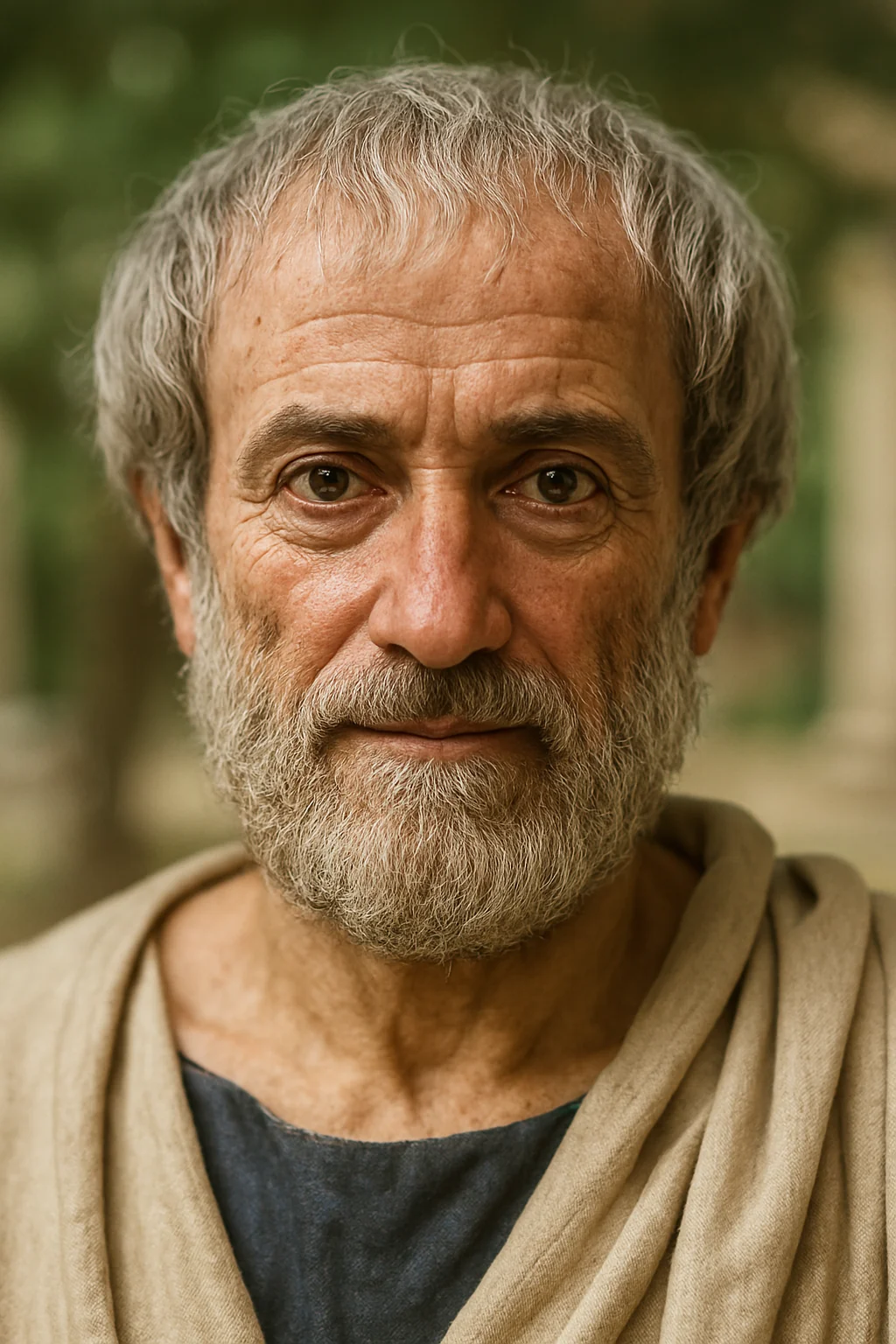
Aristotle may be history's most influential thinker, the philosopher whose ideas shaped Western science, politics, ethics, and logic for over two thousand years. Tutored by Plato, he became tutor to Alexander the Great, bridging Athens' golden age and the Hellenistic world. Where Plato sought truth in eternal Forms beyond the physical world, Aristotle looked at the world itself - dissecting animals, cataloging constitutions, analyzing arguments with unprecedented rigor. His works on biology, physics, metaphysics, ethics, politics, rhetoric, and poetics established frameworks that survived until the scientific revolution. To read Aristotle is to encounter the architectonics of Western thought itself.
Context & Background
Aristotle was born in 384 BCE in Stagira, a small Greek colonial town on the Chalcidic peninsula, far from Athens' intellectual ferment. His father Nicomachus served as personal physician to the king of Macedon - a connection that would prove fateful. Young Aristotle grew up surrounded by medical knowledge, the empirical observation of bodies and symptoms, which perhaps explains his lifelong preference for examining the particular over Platonic abstractions.
At seventeen, he traveled to Athens and joined Plato's Academy, remaining for twenty years until the master's death. Ancient sources suggest Plato called him "the mind" or "the reader" of the school. The relationship was complex: profound intellectual debt combined with growing disagreement. Where Plato's dialogues soar into myth and mysticism, Aristotle's treatises proceed methodically, categorizing, distinguishing, qualifying.
Plato's death in 348 BCE coincided with rising anti-Macedonian sentiment in Athens. Aristotle departed, first to Assos in Asia Minor (where he married the ruler's niece, Pythias), then to Lesbos, where he conducted groundbreaking biological research. In 343 BCE, Philip of Macedon summoned him to tutor his son Alexander. We know little of what Aristotle taught the future conqueror, but the association would later complicate his Athenian career.
After Alexander's conquests began, Aristotle returned to Athens in 335 BCE and founded his own school, the Lyceum, named for the nearby temple of Apollo Lyceios. Its covered walkway (peripatos) gave his followers their name: Peripatetics. Here Aristotle lectured, researched, and produced the treatises that survived - apparently lecture notes rather than polished publications, which accounts for their dense, sometimes cryptic style.
Aristotle's break with Plato centered on the Theory of Forms. He found it philosophically incoherent - how exactly do eternal Forms relate to changing particulars? - and scientifically useless. To understand why horses exist, we must study horses, not contemplate some abstract Horse-ness in a separate realm.
His alternative focused on substance: the concrete, individual thing that exists - this horse, this oak tree, this person. Each substance combines matter (the stuff it's made of) and form (the structure that makes it what it is). A bronze statue is matter (bronze) shaped by form (the statue's design). Neither can exist without the other in the physical world.
This seemingly technical distinction had revolutionary implications. Scientific inquiry should examine actual things in the world, classifying them, tracing their causes. Aristotle identified four types of causes: material (what something is made of), formal (its essential structure), efficient (what brought it about), and final (its purpose or goal). Understanding anything means grasping all four.
Final causes - purpose and function - were central to Aristotle's worldview in ways modern science rejects. For him, nature acts for ends: acorns grow toward becoming oaks; eyes exist for seeing. This teleological thinking made sense of biological development and ethical aspiration alike, even if it later impeded understanding of physics.
Aristotle's "Nicomachean Ethics" begins with a simple question: what is the good for human beings? His answer: eudaimonia - often translated as "happiness" but better understood as flourishing, living well, fulfilling human potential. We achieve eudaimonia through virtue, and virtue comes through habit. We become just by doing just acts, courageous by facing fears.
This ethics is resolutely practical. Aristotle offers no abstract moral rules but guidance for developing excellent character. His famous doctrine of the mean locates virtue between extremes: courage is the mean between cowardice and recklessness; generosity between stinginess and profligacy. The virtuous person judges correctly what each situation requires.
Yet individual flourishing requires political community. "Man is by nature a political animal," Aristotle observed - not a contractual arrangement for mutual convenience but an essential expression of human nature. The polis (city-state) exists to enable citizens to live well, not merely to live.
The "Politics" analyzes constitutions with empirical rigor, drawing on research into over 150 Greek city-states. Aristotle distinguished six types: monarchy, aristocracy, and polity (rule by one, few, or many for the common good) versus their corrupt forms: tyranny, oligarchy, and democracy (rule for the rulers' benefit). His preference for mixed constitutions influenced Polybius, Cicero, Montesquieu, and the American founders.
Aristotle's biological works reveal a researcher of astonishing range and acuity. He dissected over fifty animal species, made careful observations of embryonic development, and created classification systems that remained standard until Linnaeus. His descriptions of cephalopod reproduction, doubted for centuries, were confirmed by modern science.
His physical theories fared worse. He taught that heavier objects fall faster, that celestial bodies move in perfect circles, that the Earth stands motionless at the universe's center. These errors, enshrined as authoritative for nearly two millennia, became obstacles that Galileo and Newton had to demolish.
Yet even his mistakes were productive. Aristotle insisted on systematic observation, logical reasoning, and organizing knowledge into coherent frameworks. His treatises on logic - the "Organon" - established syllogistic reasoning as the standard form of valid argument. For two thousand years, logic meant Aristotelian logic.
His influence on medieval thought, transmitted through Arabic and Latin translations, shaped both Islamic and Christian philosophy. Thomas Aquinas called him simply "the Philosopher." Universities structured curricula around his texts. To challenge Aristotle was to challenge intellectual authority itself.
Aristotle wrote dialogues in his youth that ancient readers praised for their style; none survive. What we have are lecture notes - unpolished, sometimes repetitive, occasionally contradictory. Reading Aristotle means working through dense technical prose quite different from Plato's literary artistry.
His personal life remains largely obscure. After Pythias died, he lived with a woman named Herpyllis, who bore him a son, Nicomachus (namesake of the "Nicomachean Ethics"). Ancient tradition reports that he was thin-legged, small-eyed, and a sharp dresser with a fondness for rings - details impossible to verify but suggestive of a personality quite different from the austere treatises.
When Alexander died in 323 BCE, Athenians again turned against Macedonians and their associates. Charged with impiety - the same accusation that killed Socrates - Aristotle fled, reportedly saying he would not let Athens "sin twice against philosophy." He died the following year in Chalcis, at sixty-two.
His will reveals a humane personality: provisions for freeing his slaves, care for his companion Herpyllis, requests that his wife's bones be buried with his as she had wished. The man who classified and analyzed seemingly everything from political constitutions to the locomotion of animals ended his life attending to particular obligations and affections. The universal thinker was also, inescapably, a particular person.
Aristotle Quotes
To perceive is to suffer.
The Law is Reason free from Passion.
Courage is the first of human qualities because it is the quality which guarantees the others.
Comedy aims at representing men as worse, Tragedy as better than in actual life.
Educating the mind without educating the heart is no education at all.
Excellence is never an accident. It is always the result of high intention, sincere effort, and intelligent execution; it represents the wise choice of many alternatives - choice, not chance, determines your destiny.
Anybody can become angry — that is easy, but to be angry with the right person and to the right degree and at the right time and for the right purpose, and in the right way — that is not within everybody's power and is not easy.
Those who educate children well are more to be honored than they who produce them; for these only gave them life, those the art of living well.
The aim of art is to represent not the outward appearance of things, but their inward significance.
Learning is not child's play; we cannot learn without pain.
The more you know, the more you know you don't know.
Nature does nothing uselessly.
Through discipline comes freedom.
To lead an orchestra, you must turn your back on the crowd
youth is easily deceived because it is quick to hope.
He is his own best friend and takes delight in privacy whereas the man of no virtue or ability is his own worst enemy and is afraid of solitude.
Men acquire a particular quality by constantly acting a particular way... you become just by performing just actions, temperate by performing temperate actions, brave by performing brave actions.
Whatever lies within our power to do lies also within our power not to do.
Knowing yourself is the beginning of all wisdom.
It is the mark of an educated mind to be able to entertain a thought without accepting it.
What is a friend? A single soul dwelling in two bodies.
Hope is a waking dream.
No great mind has ever existed without a touch of madness.
A friend to all is a friend to none.
Wishing to be friends is quick work, but friendship is a slow ripening fruit.
Patience is bitter, but its fruit is sweet.
He who has overcome his fears will truly be free.
Those who know, do. Those that understand, teach.
The educated differ from the uneducated as much as the living differ from the dead.
Whosoever is delighted in solitude, is either a wild beast or a god.
I count him braver who overcomes his desires than him who conquers his enemies, for the hardest victory is over self.
Poverty is the parent of revolution and crime.
It is not enough to win a war; it is more important to organize the peace.
The antidote for fifty enemies is one friend.
Pleasure in the job puts perfection in the work.
Man is by nature a social animal; an individual who is unsocial naturally and not accidentally is either beneath our notice or more than human. Society is something that precedes the individual. Anyone who either cannot lead the common life or is so self-sufficient as not to need to, and therefore does not partake of society, is either a beast or a god.
For the things we have to learn before we can do them, we learn by doing them.
The whole is greater than the sum of its parts.
I have gained this by philosophy; I do without being ordered what some are constrained to do by their fear of the law.
It is not always the same thing to be a good man and a good citizen.
The energy of the mind is the essence of life.
All human actions have one or more of these seven causes: chance, nature, compulsion, habit, reason, passion, and desire.
It is during our darkest moments that we must focus to see the light.
Without friends, no one would want to live, even if he had all other goods.
Wit is educated insolence.
All men by nature desire to know.
Dignity does not consist in possessing honors, but in the consciousness that we deserve them.
Wise men speak when they have something to say, fools speak because they have to say something
All paid jobs absorb and degrade the mind.
Where your talents and the needs of the world cross, there lies your vocation.
Misfortune shows those who are not really friends.
Learning is an ornament in prosperity, a refuge in adversity, and a provision in old age.
All persons ought to endeavor to follow what is right, and not what is established.
The secret to humor is surprise.
Great men are always of a nature originally melancholy.
Character may almost be called the most effective means of persuasion.
Fear is pain arising from the anticipation of evil.
We make war that we may live in peace.
The only stable state is the one in which all men are equal before the law.
Philosophy can make people sick.
In all things of nature there is something of the marvelous.
The roots of education are bitter, but the fruit is sweet.
Freedom is obedience to self-formulated rules.
Mothers are fonder than fathers of their children because they are more certain they are therir own
Anyone who has no need of anybody but himself is either a beast or a God
All Earthquakes and Disasters are warnings; there’s too much corruption in the world
Memory is the scribe of the soul
Give me a child until he is 7 and I will show you the man.
“One swallow does not make a summer, neither does one fine day; similarly one day or brief time of happiness does not make a person entirely happy.”
“Happiness is a state of activity.”
“The void is 'not-being,' and no part of 'what is' is a 'not-being,'; for what 'is' in the strict sense of the term is an absolute plenum. This plenum, however, is not 'one': on the contrary, it is a 'many' infinite in number and invisible owing to the minuteness of their bulk.”
“Time crumbles things; everything grows old under the power of Time and is forgotten through the lapse of Time.”
“Happiness is the meaning and the purpose of life, the whole aim and end of human existence.”
“The high-minded man must care more for the truth than for what people think.”
“Happiness depends upon ourselves.”
“Happiness is a quality of the soul...not a function of one's material circumstances.”
“Poetry is finer and more philosophical than history; for poetry expresses the universal, and history only the particular.”
“With the truth, all given facts harmonize; but with what is false, the truth soon hits a wrong note.”