
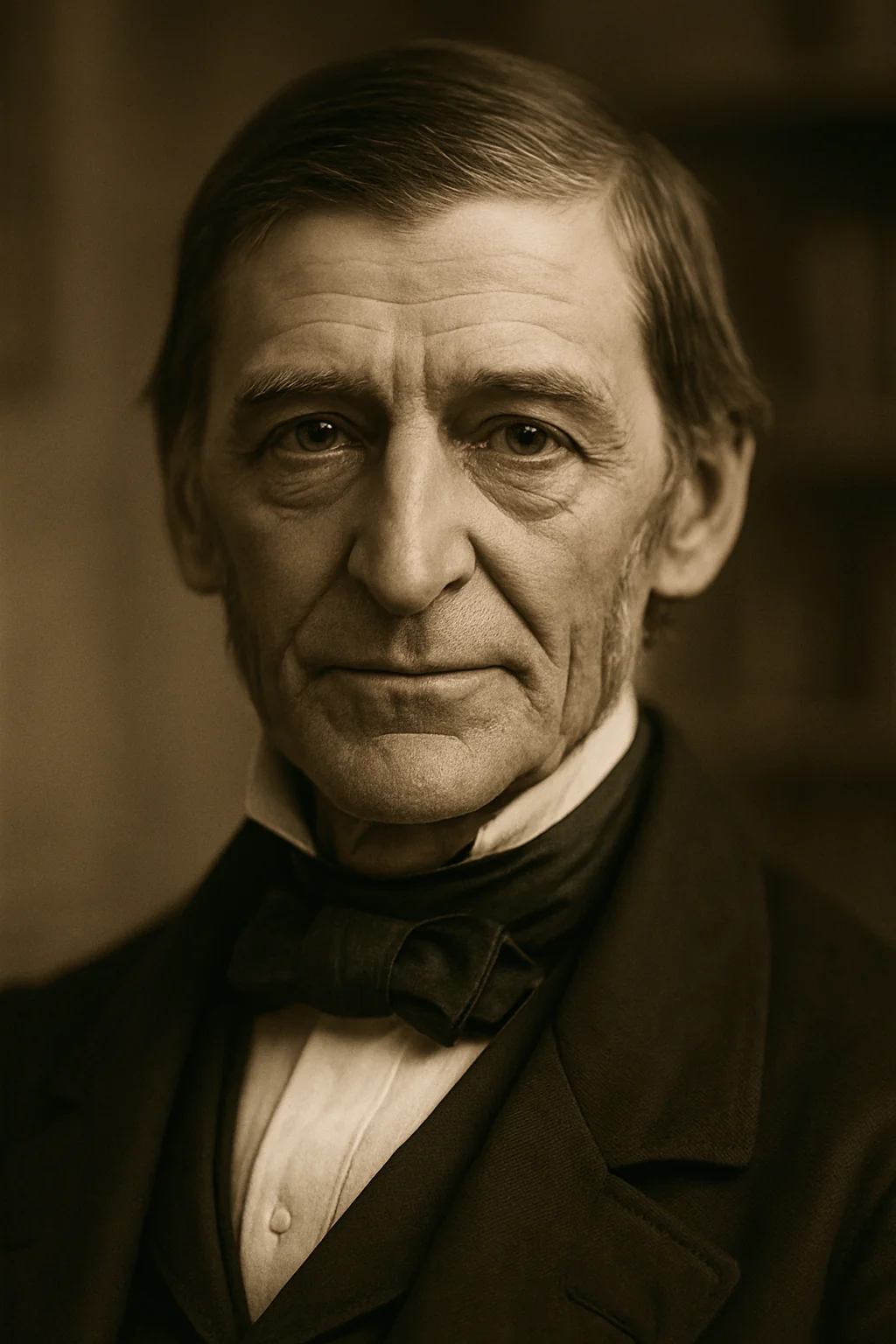
"“When we are young, we spend much time and pains in filling our note-books with all definitions of Religion, Love, Poetry, Politics, Art, in the hope that, in the course of a few years, we shall have condensed into our encyclopaedia the net value of all the theories at which the world has yet arrived. But year after year our tables get no completeness, and at last we discover that our curve is a parabola, whose arcs will never meet.”"
When We Are Young We Spend Much Time And Pains In
“When we are young, we spend much time and pains in filling our note-books with all definitions of Religion, Love, Poetry, Politics, Art, in the hope that, in the course of a few years, we shall have condensed into our encyclopaedia the net value of all the theories at which the world has yet arrived. But year after year our tables get no completeness, and at last we discover that our curve is a parabola, whose arcs will never meet.”
Similar Quotes
"“Observe the difference between your attitude to illusions and mine. You have to defend the religious illusion with all your might. If it becomes discredited - and indeed the threat to it is great enough - then your world collapses. There is nothing left for you but to despair of everything, of civilization and the future of mankind. From that bondage I am, we are, free. Since we are prepared to renounce a good part of our infantile wishes, we can bear it if a few of our expectations turn out to be illusions.”"
"“Those whose acquaintance with scientific research is derived chiefly from its practical results easily develop a completely false notion of the mentality of the men who, surrounded by a skeptical world, have shown the way to kindred spirits scattered wide through the world and through the centuries. Only one who has devoted his life to similar ends can have a vivid realization of what has inspired these men and given them the strength to remain true to their purpose in spite of countless failures. It is cosmic religious feeling that gives a man such strength. A contemporary has said, not unjustly, that in this materialistic age of ours the serious scientific workers are the only profoundly religious people.”"
"“...But I own that I cannot see as plainly as others do, and as I should wish to do, evidence of design and beneficence on all sides of us. There seems to me too much misery in the world. I cannot persuade myself that a beneficent and omnipotent God would have designedly created the Ichneumonidæ with the express intention of their feeding within the living bodies of Caterpillars, or that a cat should play with mice... I feel most deeply that the whole subject is too profound for the human intellect. A dog might as well speculate on the mind of Newton. Let each man hope and believe what he can.”"
"“It is this mythical, or rather symbolic, content of the religious traditions which is likely to come into conflict with science. This occurs whenever this religious stock of ideas contains dogmatically fixed statements on subjects which belong in the domain of science.”"
"“The secret of poetry is never explained - is always new. We have not got farther than mere wonder at the delicacy of the touch, & the eternity it inherits. In every house a child that in mere play utters oracles, & knows not that they are such. 'Tis as easy as breath. 'Tis like this gravity, which holds the Universe together, & none knows what it is.”"
"“Your question is the most difficult in the world. It is not a question I can answer simply with yes or no. I am not an Atheist. I do not know if I can define myself as a Pantheist. The problem involved is too vast for our limited minds. May I not reply with a parable? The human mind, no matter how highly trained, cannot grasp the universe. We are in the position of a little child, entering a huge library whose walls are covered to the ceiling with books in many different tongues. The child knows that someone must have written those books. It does not know who or how. It does not understand the languages in which they are written. The child notes a definite plan in the arrangement of the books, a mysterious order, which it does not comprehend, but only dimly suspects. That, it seems to me, is the attitude of the human mind, even the greatest and most cultured, toward God. We see a universe marvelously arranged, obeying certain laws, but we understand the laws only dimly. Our limited minds cannot grasp the mysterious force that sways the constellations. I am fascinated by Spinoza's Pantheism. I admire even more his contributions to modern thought. Spinoza is the greatest of modern philosophers, because he is the first philosopher who deals with the soul and the body as one, not as two separate things.”"