
Vincent Van Gogh
Quotes & Wisdom
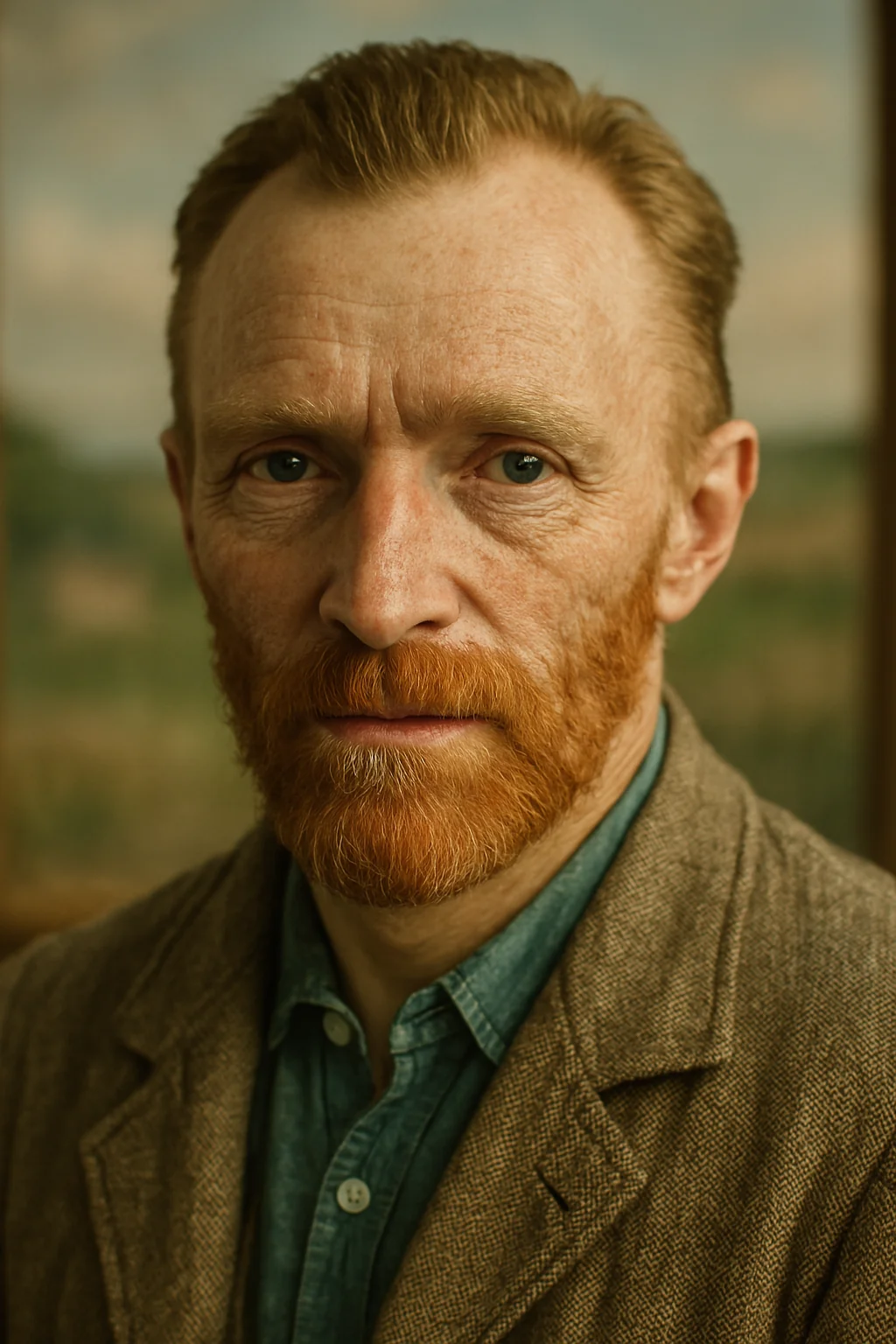
Vincent van Gogh compressed more artistic revolution into a single decade than most painters achieve in a lifetime, transforming himself from awkward amateur to posthumous legend through sheer relentless work. The swirling skies, blazing sunflowers, and pulsating colors that define his mature style emerged only in his final years - an explosion of creativity shadowed by mental illness and poverty. He sold perhaps one painting while alive; today his works fetch tens of millions. Yet Van Gogh's letters reveal something more valuable than artistic genius: a soul committed to finding beauty and meaning despite depression, loneliness, and repeated failure. His example teaches that art matters not as career but as calling.
Context & Background
Vincent Willem van Gogh was born on March 30, 1853, in Groot-Zundert, a village in the southern Netherlands, exactly one year after a stillborn brother also named Vincent - a coincidence that biographers have read as significant. His father was a Protestant minister; the family belonged to the respectable but not wealthy Dutch middle class.
The Netherlands of Van Gogh's youth was becoming industrialized, its rural traditions giving way to modern commerce. The Van Gogh family had art dealing in its blood - three of Vincent's uncles ran galleries, and the family firm, Goupil & Cie, would employ him for seven years. He seemed destined for a conventional career in the art trade.
But Vincent proved temperamentally unsuited to commerce. After working for Goupil in The Hague, London, and Paris, he was dismissed in 1876 for increasingly erratic behavior. He tried teaching, then threw himself into religious fervor, studying theology and working as a lay preacher in Belgian coal mining districts. His superiors found his identification with the poor excessive, embarrassing, unhinged. He was dismissed again.
In 1880, at twenty-seven, having failed at every conventional path, Van Gogh decided to become an artist. He had no training, no connections, no income beyond what his brother Theo would provide. He had only conviction that he must draw and paint, that this was his calling, and that with sufficient work he might achieve something.
Van Gogh's early works bear little resemblance to his famous later paintings. Dark, earthy, populated by peasants and laborers, they reflect both his Dutch heritage and his identification with the poor. "The Potato Eaters" (1885), which he considered his first major statement, depicts a peasant family eating dinner - faces rough, hands gnarled, the scene lit by a single lamp.
He studied obsessively: anatomy, perspective, color theory. He copied prints, drew from plaster casts, painted still lifes. His letters to Theo - over eight hundred survive - record both technical struggles and philosophical ambitions. He wanted art that would speak to ordinary people about things that mattered: work, faith, suffering, beauty.
In 1886, Van Gogh moved to Paris, where Theo worked as an art dealer, and discovered Impressionism, Japanese prints, and the bold colors that academic training had suppressed. His palette lightened; his brushwork loosened. He met Claude Monet, Camille Pissarro, Paul Gauguin, and other artists who were reinventing painting. The provincial Dutchman transformed himself into an avant-garde experimenter.
Seeking stronger light and cheaper living, Van Gogh moved to Arles in Provence in February 1888. Here his mature style burst forth. The sunflowers, the cafe terraces, the bedrooms, the starry nights - all emerged in an astonishing flood of productivity. He painted as if possessed, sometimes completing a canvas a day.
The famous yellow house became his studio and his dream of an artists' colony. He invited Gauguin to join him, hoping to establish a "Studio of the South" where painters could work together. Gauguin arrived in October 1888; by December, the relationship had collapsed in catastrophe.
The infamous ear incident - Van Gogh cutting off part of his own ear after a violent confrontation with Gauguin - marked his first major breakdown. He was hospitalized, released, hospitalized again as townspeople petitioned to have him removed. The artist who had sought community found himself a pariah, his behavior too disturbing for neighbors to tolerate.
Yet even from the asylum at Saint-Remy, where he voluntarily committed himself in May 1889, Van Gogh continued painting. "The Starry Night" emerged from this period - the swirling heavens, the cypress tree reaching like flame, the sleeping village below. Illness and art intertwined in ways that can never be fully separated.
In May 1890, Van Gogh moved to Auvers-sur-Oise, north of Paris, under the care of Dr. Paul Gachet, a physician interested in art and artists. He seemed to stabilize. He painted furiously - over seventy canvases in seventy days. The wheatfields around Auvers, Dr. Gachet's portrait, the village church - each canvas vibrated with color and emotional intensity.
On July 27, 1890, Van Gogh walked into a wheat field and shot himself in the chest. He died two days later, with Theo at his side, at thirty-seven years old. Whether this was deliberate suicide, an impulsive act during a breakdown, or (as some recent scholars suggest) an accident or even assault by local boys, remains debated. What's certain is that the gun ended one of art's shortest and most transformative careers.
Theo, devastated, died six months later. He had supported Vincent financially and emotionally throughout his artistic career, believing in his genius when no one else did. The brothers are buried side by side in Auvers, the ground covered by the ivy that Vincent painted in one of his final works.
Van Gogh produced roughly 2,100 artworks in his decade as an artist - over 860 oil paintings and more than 1,300 drawings and sketches. This output, averaging one finished work every day and a half, required discipline and determination that belied the image of the mad artist creating in frenzy.
His letters constitute one of art history's greatest literary documents. Articulate, self-aware, often beautiful in their own right, they record his artistic development, his reading, his psychological struggles, and his love for Theo. They reveal not madness but intelligence - a man who thought carefully about what he was doing and why.
He read voraciously: Dickens, Zola, Shakespeare, Carlyle. His paintings often responded to literature, and he understood his work as part of a broader cultural conversation. The idea of Van Gogh as naive genius misses how deliberately he studied both art and life.
His mental illness - probably some form of psychosis, perhaps exacerbated by alcohol, malnutrition, and overwork - produced periods of terrifying breakdown. But it did not produce his art. He painted between episodes, not during them. When well enough to work, he worked with purpose and control. The romantic equation of madness and creativity does him injustice.
Van Gogh never achieved recognition in his lifetime. The single painting he is documented to have sold, "The Red Vineyard," fetched 400 francs - not nothing, but hardly the millions his works command today. His posthumous fame began with exhibitions organized by Theo's widow, Johanna, who also preserved and published the letters. The artist who died in obscurity became, within decades, one of the most beloved painters in history.
Vincent Van Gogh Quotes
Close friends are truly life's treasures. Sometimes they know us better than we know ourselves. With gentle honesty, they are there to guide and support us, to share our laughter and our tears. Their presence reminds us that we are never really alone.
Love is eternal -- the aspect may change, but not the essence. There is the same difference in a person before and after he is in love as there is in an unlighted lamp and one that is burning. The lamp was there and was a good lamp, but now it is shedding light too, and that is its real function. And love makes one calmer about many things, and that way, one is more fit for one's work.
Many people seem to think it foolish, even superstitious, to believe that the world could still change for the better. And it is true that in winter it is sometimes so bitingly cold that one is tempted to say, ‘What do I care if there is a summer; its warmth is no help to me now.’ Yes, evil often seems to surpass good. But then, in spite of us, and without our permission, there comes at last an end to the bitter frosts. One morning the wind turns, and there is a thaw. And so I must still have hope.
I feel such a creative force in me: I am convinced that there will be a time when, let us say, I will make something good every day , on a regular basis....I am doing my very best to make every effort because I am longing so much to make beautiful things. But beautiful things mean painstaking work, disappointment, and perseverance.
If you work with love and intelligence, you develop a kind of armour against people's opinions, just because of the sincerity of your love for nature and art. Nature is also severe and, to put it that way, hard, but never deceives and always helps you to move forward.
If one feels the need of something grand, something infinite, something that makes one feel aware of God, one need not go far to find it. I think that I see something deeper, more infinite, more eternal than the ocean in the expression of the eyes of a little baby when it wakes in the morning and coos or laughs because it sees the sun shining on its cradle.
If you hear a voice within you say
What am I in the eyes of most people — a nonentity, an eccentric, or an unpleasant person — somebody who has no position in society and will never have; in short, the lowest of the low. All right, then — even if that were absolutely true, then I should one day like to show by my work what such an eccentric, such a nobody, has in his heart. That is my ambition, based less on resentment than on love in spite of everything, based more on a feeling of serenity than on passion. Though I am often in the depths of misery, there is still calmness, pure harmony and music inside me. I see paintings or drawings in the poorest cottages, in the dirtiest corners. And my mind is driven towards these things with an irresistible momentum.
If you truly love nature, you will find beauty everywhere.
I want to touch people with my art. I want them to say
At present I absolutely want to paint a starry sky. It often seems to me that night is still more richly coloured than the day; having hues of the most intense violets, blues and greens. If only you pay attention to it you will see that certain stars are lemon-yellow, others pink or a green, blue and forget-me-not brilliance. And without my expatiating on this theme it is obvious that putting little white dots on the blue-black is not enough to paint a starry sky.
How right it is to love flowers and the greenery of pines and ivy and hawthorn hedges; they have been with us from the very beginning.
To suffer without complaint is the only lesson we have to learn in this life
Your profession is not what brings home your weekly paycheck, your profession is what you're put here on earth to do, with such passion and such intensity that it becomes spiritual in calling.
I am still far from being what I want to be, but with God's help I shall succeed.
It is a pity that, as one gradually gains experience, one loses one's youth.
Just slap anything on when you see a blank canvas staring you in the face like some imbecile. You don't know how paralyzing that is, that stare of a blank canvas is, which says to the painter, ‘You can't do a thing’. The canvas has an idiotic stare and mesmerizes some painters so much that they turn into idiots themselves. Many painters are afraid in front of the blank canvas, but the blank canvas is afraid of the real, passionate painter who dares and who has broken the spell of `you can't' once and for all.
One may have a blazing hearth in one's soul and yet no one ever came to sit by it. Passers-by see only a wisp of smoke from the chimney and continue on their way.
Though I am often in the depths of misery, there is still calmness, pure harmony and music inside me. I see paintings or drawings in the poorest cottages, in the dirtiest corners. And my mind is driven towards these things with an irresistible momentum.
And when I read, and really I do not read so much, only a few authors, - a few men that I discovered by accident - I do this because they look at things in a broader, milder and more affectionate way than I do, and because they know life better, so that I can learn from them.
Those who love much, do much and accomplish much, and whatever is done with love is done well.... Love is the best and noblest thing in the human heart, especially when it is tested by life as gold is tested by fire. Happy is he who has loved much, and although he may have wavered and doubted, he has kept that divine spark alive and returned to what was in the beginning and ever shall be.
Success is sometimes the outcome of a whole string of failures.
Keep your love of nature, for that is the true way to understand art more and more.
I shouldn't precisely have chosen madness if there had been any choice, but once such a thing has taken hold of you, you can't very well get out of it.
What preys on my mind is simply this one question: what am I good for, could I not be of service or use in some way?
There is a great difference between one idler and another idler. There is someone who is an idler out of laziness and lack of character, owing to the baseness of his nature. If you like, you may take me for one of those. Then there is the other kind of idler, the idler despite himself, who is inwardly consumed by a great longing for action who does nothing because his hands are tied, because he is, so to speak, imprisoned somewhere, because he lacks what he needs to be productive, because disastrous circumstances have brought him forcibly to this end. Such a one does not always know what he can do, but he nevertheless instinctively feels, I am good for something! My existence is not without reason! I know that I could be a quite a different person! How can I be of use, how can I be of service? There is something inside me, but what can it be? He is quite another idler. If you like you may take me for one of those.
There was a sentence in your letter that struck me, I wish I were far away from everything, I am the cause of all, and bring only sorrow to everybody, I alone have brought all this misery on myself and others. These words struck me because that same feeling, just the same, not more nor less, is also on my conscience.
I dream my painting and I paint my dream.
Be clearly aware of the stars and infinity on high. Then life seems almost enchanted after all.
A great fire burns within me, but no one stops to warm themselves at it, and passers-by only see a wisp of smoke
I don't know anything with certainty, but seeing the stars makes me dream.
I put my heart and soul into my work, and I have lost my mind in the process.
I often think that the night is more alive and more richly colored than the day.
The sadness will last forever.
What would life be if we had no courage to attempt anything?
If I am worth anything later, I am worth something now. For wheat is wheat, even if people think it is a grass in the beginning.
Art is to console those who are broken by life.
I am seeking, I am striving, I am in it with all my heart.
The fishermen know that the sea is dangerous and the storm terrible, but they have never found these dangers sufficient reason for remaining ashore.
Great things are not done by impulse, but by a series of small things brought together.
I try more and more to be myself, caring relatively little whether people approve or disapprove.
I am always doing what I cannot do yet, in order to learn how to do it.
I always think that the best way to know God is to love many things.
It is with the reading of books the same as with looking at pictures; one must, without doubt, without hesitations, with assurance, admire what is beautiful.
The beginning is perhaps more difficult than anything else, but keep heart, it will turn out all right.
As we advance in life it becomes more and more difficult, but in fighting the difficulties the inmost strength of the heart is developed.
We spent our whole lives in unconsous excercise of the art of expressing our thoughts with the help of words
La tristesse durera toujours.
So often, a visit to a bookshop has cheered me, and reminded me that there are good things in the world.
There may be a great fire in our soul, yet no one ever comes to warm himself at it, and the passers-by see only a wisp of smoke.
I’m trying now to exaggerate the essence of things, and to deliberately leave vague what’s obvious.
I wish they would take me as I am.
Someday death will take us to another star.
The sunflower is mine, in a way.
In spite of everything, I shall rise again; I will take up my pencil, which I have forsaken in my great discouragement, and I will go on with my drawing.
If you don’t have a dog--at least one--there is not necessarily anything wrong with you, but there may be something wrong with your life.
I will not live without love.
In the end we shall have had enough of cynicism, skepticism and humbug, and we shall want to live more musically.
When I have a terrible need of - shall I say the word - religion, then I go out and paint the stars.
I'm such a nobody.
Whoever loves much, performs much, and can accomplish much, and what is done in love is done well.
I confess I do not know why, but looking at the stars always makes me dream.
Let us keep courage and try to be patient and gentle. And let us not mind being eccentric, and make distinction between good and evil.
Only when I fall do I get up again.
Don't lose heart if it's very difficult at times, everything will come out all right and nobody can in the beginning do as he wishes.
What is done in love is done well.
But for one's health as you say, it is very necessary to work in the garden and see the flowers growing.
Looking at the stars always makes me dream, as simply as I dream over the black dots representing towns and villages on a map.
...and then, I have nature and art and poetry, and if that is not enough, what is enough?
I experience a period of frightening clarity in those moments when nature is so beautiful. I am no longer sure of myself, and the paintings appear as in a dream.
Admire as much as you can. Most people do not admire enough.
“There is peace even in the storm”
“For my part I know nothing with any certainty, but the sight of the stars makes me want to dream.”
“It is good to love many things, for therein lies the true strength, and whosoever loves much performs much, and can accomplish much, and what is done in love is well done.”
“The heart of man is very much like the sea, it has its storms, it has its tides and in its depths it has its pearls too”
“There is nothing more truly artistic than to love people.”
“Seek only light and freedom and do not immerse yourself too deeply in the worldly mire.”
“It is looking at things for a long time that ripens you and gives you a deeper meaning.”